Iran retaliates after US strikes, defying Trump’s warning it could be hit ‘much harder’

Iran Retaliates After US Strikes Hit Multiple Sites
Activelifezero.com – Iran retaliates after US strikes with a coordinated barrage of ballistic missiles and drone swarms aimed at three Gulf states. Tehran fired at Jordan, Bahrain, and Kuwait on Tuesday, hours after Washington completed a second wave of airstrikes across Iranian territory. President Donald Trump had framed the American bombing as a measured answer to ongoing Iranian harassment of commercial shipping and deployed US forces in the region.
The exchange marks a sharp escalation in a conflict that had drifted into weeks of uneasy quiet following its initial outbreak. Both sides had already traded fire overnight into Monday — the first direct exchange in more than a month — and Tuesday’s salvo pushed the confrontation back toward open, multi-theater warfare.
Trump’s Ultimatum and Tehran’s Answer
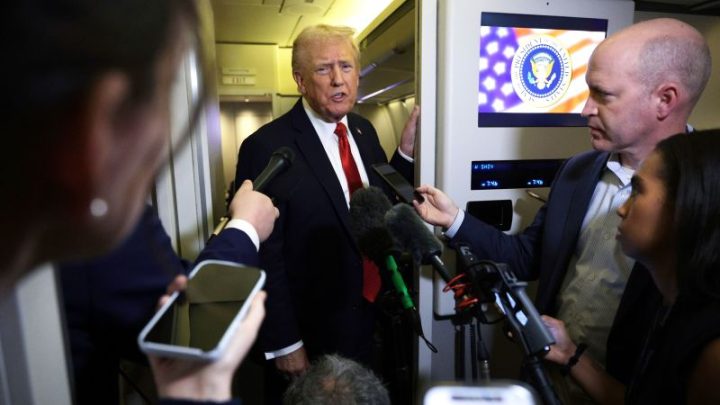
Before the Iranian missiles left the ground, Trump posted what amounted to a final warning on Truth Social Tuesday morning. He called the US strikes a “very justified attack” and told Iranians that a larger operation was already being prepared.
“They will be hit again at a much harder and higher level, but it will not be the biggest attack of them all, that is waiting in the wings and, when it is over, there will be very little left of the Islamic Republic of Iran!”
Iran’s leadership did not absorb the blow. Officials vowed a “crushing” response and directed ballistic missiles toward Jordan while sending unmanned aerial vehicles at Bahrain and Kuwait, explicitly designating US military installations as targets. The decision to fire rather than endure signaled that Tehran judged the political cost of silence to outweigh the military cost of escalation.
Scope, Duration, and Targets of the US Bombing
US Central Command confirmed the Tuesday operation began at 12 p.m. Eastern Time and was declared complete more than six hours later. Targets included air-defense batteries, radar installations, maritime facilities, mine-laying platforms, and communications nodes tied to the Islamic Revolutionary Guard Corps. CENTCOM stated the strikes were a direct answer to recent Iranian attempts to interdict commercial shipping through the Strait of Hormuz and to threaten American troops stationed in the region.
Since the initial US bombing on Sunday, maritime trackers Marisks and the United Kingdom Maritime Trade Operations have logged two tanker strikes by projectiles in the waterway — a corridor through which roughly one-fifth of the world’s traded oil passes daily.
Human Toll Across Iranian Territory
The strikes touched multiple provinces. Seven people were killed in Khuzestan, the oil-rich central region bordering Iraq, according to a regional official cited by state-affiliated IRNA. The port cities of Chabahar and Konarak on the Gulf of Oman came under bombardment, and explosions were recorded east of Bandar Abbas and around Qeshm Island, the narrow landmass straddling the mouth of the Strait of Hormuz.
Iran’s state broadcaster Press TV reported that the strikes also hit Jiroft Airport in the southeast and a fishmeal processing plant on Qeshm Island. A separate blast was heard in Asaluyeh, the Gulf-coast hub handling much of Iran’s natural-gas and petrochemical output, per the semi-official Fars News Agency.
The most visceral casualty report came from the coastal village of Kouhestak in Sirik county, southern Iran. Shrapnel from one of the US strikes fell on a building hosting a wedding celebration, killing at least four people — including a toddler and a four-year-old child — and wounding at least 68 others, Press TV said. Footage released by the semi-official Tasnim news agency showed thick smoke rising above rubble while bystanders shouted in the background.
Regional Ripple: Jordan, Bahrain, Kuwait, and Erbil
Jordan’s military announced it intercepted ten Iranian missiles; three additional projectiles landed in sparsely populated areas well away from towns. No Jordanian casualties were reported. Kuwait and Bahrain both activated their air-defense networks to shoot down incoming drones, their respective authorities confirmed.
Iran additionally claimed a combined missile-and-drone salvo aimed at Erbil, capital of Iraq’s autonomous Kurdistan region, extending the theater of operations one step further north.
Market Reaction and Strategic Calculus
Oil futures jumped above $94 a barrel in the hours following the exchange, as traders priced in the risk of sustained disruption to the Strait of Hormuz corridor. Analysts noted that the two tanker strikes logged since Sunday, combined with Tuesday’s multi-directional Iranian salvo, made a near-term de-escalation unlikely.
Frequently Asked Questions
What did the US strike on Tuesday? CENTCOM said the operation targeted air-defense batteries, radar sites, maritime facilities, mine-laying platforms, and IRGC-linked communications nodes across multiple Iranian provinces. The run lasted more than six hours.
Where did Iran’s retaliatory missiles and drones land? Ballistic missiles were fired at Jordan (ten intercepted, three landed in empty areas). Drone swarms were directed at Bahrain and Kuwait, where air defenses shot them down. Iran also claimed a salvo aimed at Erbil in northern Iraq.
How many people were killed in Iran? At least seven died in Khuzestan, and at least four more — including two young children — were killed when shrapnel struck a wedding venue in Kouhestak village. At least 68 others were wounded in that incident.
What is the impact on global oil supply? The Strait of Hormuz carries roughly one-fifth of the world’s traded oil. Two tanker strikes have been logged since Sunday, and oil futures moved above $94 a barrel after Tuesday’s exchange, signaling elevated risk premium.