A Qing Dynasty vase 200 years ahead of its time

Daftar Isi
A Glass Vase from the Qianlong Court That Looks Like It Belongs in a 1960s Living Room
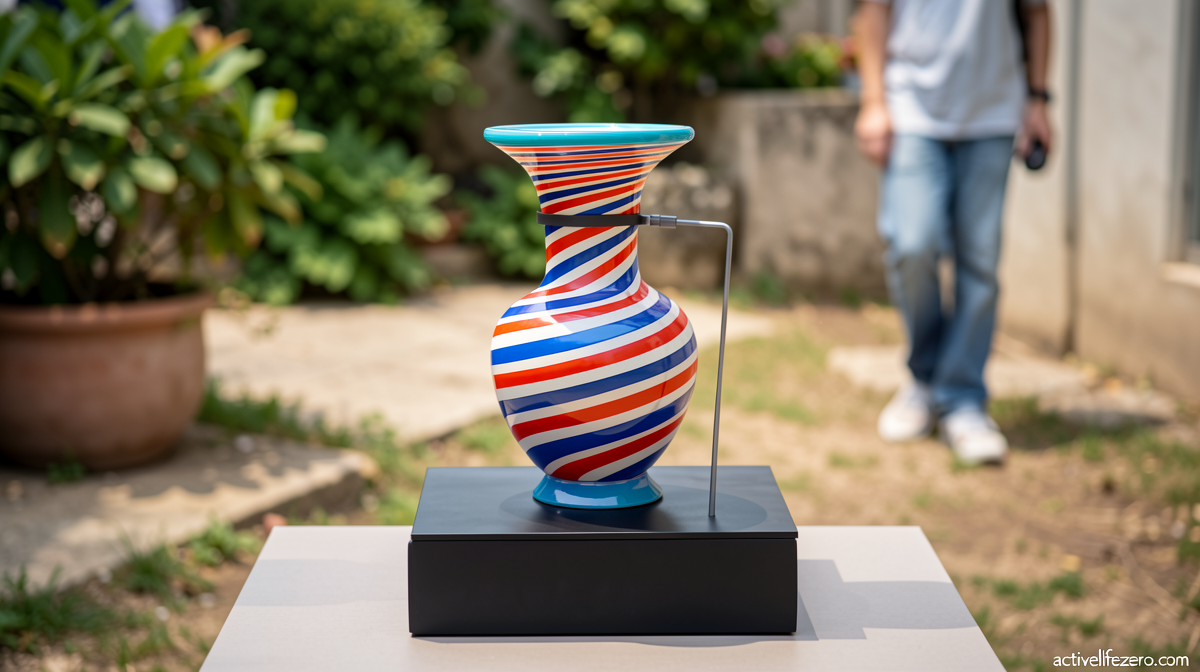
Activelifezero.com – Among the hundreds of thousands of imperial treasures housed in China’s Forbidden City, one object stands apart from everything else on display. It is not porcelain. It is not cloisonné enamel. It is not lacquerware or jade. It is a blown-glass vase, just over eight inches tall, wrapped in swirling ribbons of red, white, and blue glass with an emerald-green base and mouth. At first glance, the piece reads as something you might find on a mid-century coffee table — a spinning barbershop pole rendered in molten silica. Yet it carries the reign mark of the Qianlong Emperor, one of the most powerful and acquisitive rulers in Chinese history, who governed for six decades during the eighteenth century.
An Emperor Who Believed More Was Always More
The Qianlong reign produced an extraordinary volume of artistic output. Hundreds of thousands of objects were inscribed or stamped with his reign characters, a testament to a court that commissioned art on an industrial scale. The emperor’s personal taste leaned heavily toward excess — layered textures, saturated palettes, and dense ornamentation.
“He loved the profusion of colors, and textures, and all kinds of fine things,” said Daisy Wang, Deputy Director and Chief Curator at the Hong Kong Palace Museum. “He always thought, ‘more is more.'”
Wang, who oversaw the vase’s exhibition on loan from the Beijing Palace Museum until August of this year, described the ruler as a figure who would meticulously document every object in his collection and frequently issue precise instructions regarding design, proportion, and scale. In the language of modern corporate culture, she called him a micromanager — a boss who reviewed every deliverable and punished substandard work with penalties as severe as the forfeiture of an entire year’s salary.
European Technology Meets Chinese Aesthetic
The vase’s existence raises an immediate question: why glass? By the eighteenth century, Chinese artisans had pushed ceramics and lacquerwork to extraordinary heights of refinement. Glass, however, remained a domain where European workshops held a technological edge, even though Chinese craftsmen had been working the material since the Western Zhou period, more than two millennia earlier. Most glass vessels produced in China up to that point were small, undecorated, and single-toned.
“Suddenly, you have this vase with multiple colors, and a style of decoration that was alien,” said Marco Almeida, Senior Vice President at Christie’s Asia Pacific and the auction house’s Head of Chinese Ceramics and Works of Art. “I think the emperor must have been quite taken by it and quite pleased.”
Almeida noted that the manufacturing technique — drawing hot colored glass into thin tubes, adhering fragments to the vessel’s body, and repeatedly heating and rolling the piece until a swirled pattern emerged — closely resembled the latticino method long practiced in Venetian glassmaking. The shape, however, was unmistakably Chinese, as was the reign mark stamped into the base. He called the result “the perfect, and clear-cut marriage of what is Chinese and what is Western.”
The Missionary Connection and the Zaobanchu
Wang believes the vase was either crafted directly by a European missionary or produced using techniques and raw materials introduced by missionaries who ended up employed within the imperial workshops, known collectively as the zaobanchu. The institutional roots of this glassmaking activity trace back to the Kangxi emperor’s reign, when the German Jesuit Kilian Stumpf assumed oversight of glass production inside the palace complex.
The zaobanchu, distributed across the Forbidden City grounds and other locations throughout the empire, operated dozens of specialized departments covering painting, textile, wood carving, metallurgy, and numerous other crafts. During the Qianlong period, the workshops employed nearly one thousand artisans, all working under the constant pressure of an emperor whose appetite for novelty never dimmed.
The cosmopolitan character of the court is striking. Much like the Mughal court in India, the Qing imperial establishment welcomed skilled workers from across China and from abroad, integrating foreign techniques into domestic production without regard for national origin.
“Putting myself in Qianlong’s shoes, he would consider the vase to be really beautiful, different and novel. That was the value,” Wang said.
Rarity and Value
The vase’s scarcity is almost difficult to grasp. The Beijing Palace Museum holds more than 300,000 porcelain pieces spanning thousands of years of Chinese ceramic history. Against that vast corpus, the number of glass vases in the collection amounts to what Wang described as a “handful.” The object occupies a vanishingly small niche within one of the world’s largest art repositories.
Almeida acknowledged that assigning a monetary figure to the piece would be difficult. He nonetheless characterized it as “borderline priceless” — a phrase that captures both its market elusiveness and its irreplaceable position within the material record of the Qianlong court.
What the Vase Tells Us
Read as a document of cultural exchange, the vase illustrates how the eighteenth-century Qing court absorbed foreign technology while retaining its own formal vocabulary. The latticino-inspired technique supplied the visual effect; the Chinese silhouette and imperial inscription supplied the identity. The result is neither a European import nor a purely domestic product, but a hybrid born inside the walls of the zaobanchu under direct imperial supervision.
Wang is preparing a forthcoming exhibition at the Hong Kong Palace Museum in September that will examine the imperial workshops more broadly, situating objects like this glass vase within the larger ecosystem of state-sponsored craft production. The vase, with its improbable barbershop-pole aesthetic and its unmistakable imperial pedigree, will serve as a vivid reminder that the Qianlong court’s creative output was far stranger, more eclectic, and more globally connected than the porcelain-and-jade stereotype suggests.
Related Reading
Frequently Asked Questions
What is A Qing Dynasty vase 200 years?
A Qing Dynasty vase 200 years is the main topic of this guide. The article explains the context, practical details, and next steps readers should understand.
Why does A Qing Dynasty vase 200 years matter?
A Qing Dynasty vase 200 years matters because readers are looking for a useful answer, not just a short summary. Good content should match search intent and help them decide what to do next.