
Zelensky faces protests over ousting of Ukraine’s defense minister despite military gains
Ukraine’s Defense Minister Ouster Triggers Unprecedented Protests Amid Military Disagreement
A Political Storm Erupts in Kyiv
Zelensky faces protests over ousting of Ukraine – Ukraine’s capital has witnessed rare demonstrations following the unexpected dismissal of Mykhaylo Fedorov from his position as defense minister. The removal comes despite recent military victories against Russian forces, creating an unusual situation where public discontent has emerged alongside battlefield successes. Fedorov, who served only six months in the role, announced his departure late Wednesday, citing fundamental disagreements with General Oleksandr Syrskyi, the armed forces commander-in-chief.
President Volodymyr Zelensky addressed the growing unrest on Thursday, expressing confidence that Fedorov would continue serving within his administration. The president indicated that further discussions would determine the former minister’s future role. This political upheaval has sent ripples through Ukraine’s Western partnerships, with European officials expressing surprise at the decision. One senior diplomat stationed in Kyiv characterized the move as unexpected, warning that it might significantly impact Ukraine’s relationships with crucial international allies who valued Fedorov’s dedication to combating corruption throughout both military and civilian institutions.
Fedorov’s Innovative Contributions
Before assuming defense ministerial duties, Fedorov led Ukraine’s digital transformation efforts. At thirty-five years old, he earned widespread appreciation from soldiers for implementing improved compensation packages and optimizing frontline rotation schedules. His technological innovations proved particularly valuable during combat operations. Fedorov actively promoted Ukrainian technology startups in creating diverse drone systems that substantially reduced Russian territorial gains while simultaneously damaging critical infrastructure deep within Russian territory.
His contributions extended to developing medium-range aerial vehicles that effectively isolated Crimea, the peninsula Moscow annexed in 2014. If Fedorov’s replacement is confirmed, he would become the fifth defense minister since Russia launched its full-scale invasion in 2022. Despite his accomplishments, Fedorov encountered significant resistance from certain segments of Ukraine’s military establishment, ultimately leading to the most visible internal division within the defense leadership since hostilities began.
Public Outcry and Leadership Response
“Decisions are made based on loyalty, not data,” Fedorov declared during his Thursday news conference. “There is sabotage of changes. There are constant lies, including about me.”
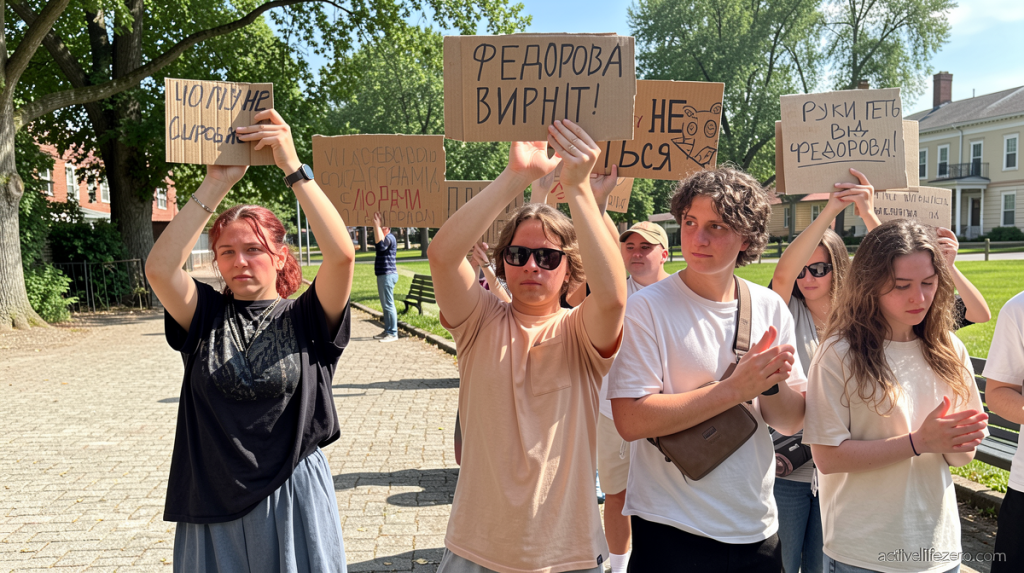
Centuries of tradition were challenged as hundreds of predominantly young citizens assembled in Kyiv to demonstrate against Fedorov’s dismissal. Several demonstrators expressed confusion over the timing, with one individual highlighting that Fedorov “introduced the technology that allowed drones to do most of the fighting instead of people.” This marked the first major wartime demonstration in the capital since thousands gathered a year earlier to demand greater independence for Ukraine’s anti-corruption agency.
Zelensky announced Thursday evening that he had selected Yevhenii Khmara, currently serving as acting head of Ukraine’s Security Service, to temporarily assume defense ministerial responsibilities. The president simultaneously urged parliamentary members to endorse Khmara’s formal nomination. The timing proved particularly dramatic, as Russian missiles struck Kyiv during the early hours of Thursday, producing audible explosions throughout the Ukrainian capital.
Deepening Military Divisions
“I would very much like to see unity” between the army and Defense Ministry, Zelensky acknowledged Thursday. “But they had only communicated through me. And the problem lies not only with the parties, but with me as well…I respect the parties; I know their strengths, I know their weaknesses.”
Fedorov’s subsequent criticism of Syrskyi proved particularly pointed. He challenged the prevailing narrative regarding mobilization effectiveness, questioning whether meaningful military reforms were actually occurring. The former minister suggested that Syrskyi’s approach prioritized internal divisions over strategies for defeating Russia. He characterized the notion that Syrskyi alone could maintain the frontline as misleading, arguing that the commander had focused more on creating divisions than developing victory conditions.
“Strong military leaders were sidelined. There is constant resistance we need to overcome,” Fedorov complained regarding opposition from certain commanders.
Mykhailo Drapatiy, one of the senior commanders Fedorov specifically mentioned, offered strong support for his colleague. Drapatiy stated that the military had gained an invaluable partner during Fedorov’s six-month tenure, noting that the defense minister not only addressed institutional needs but also demanded innovative approaches, accelerated decision-making processes, and backed commanders willing to accept responsibility for their choices.
The situation remains fluid as Ukraine navigates this internal crisis while continuing to face external threats. Analysts suggest that Zelensky’s ultimate vision for Fedorov’s role remains unclear, though the president’s public statements indicate he intends to retain the former minister’s expertise within his administration. The coming days will likely reveal whether this political storm strengthens or weakens Ukraine’s position as it continues its defense against Russian aggression.
