
Venezuela’s acting president defends country’s territory and rejects Trump’s 51st state remarks
Venezuela’s acting president defends country’s territory and rejects Trump’s 51st state remarks
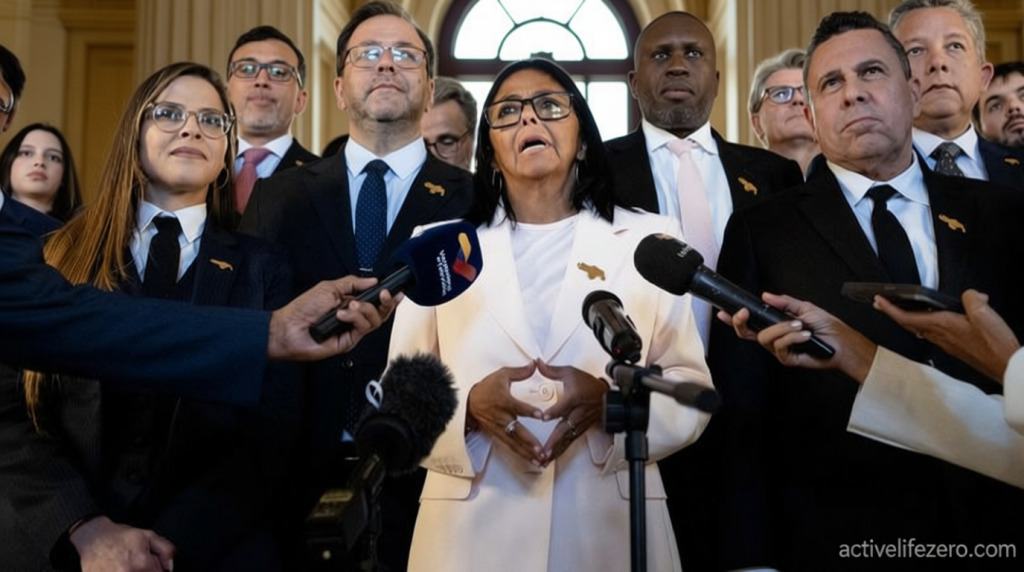
Venezuela s acting president defends country – During a recent press conference in The Hague, Venezuela’s interim leader, Delcy Rodríguez, reaffirmed her nation’s commitment to territorial sovereignty after President Donald Trump suggested the country might become the 51st U.S. state. The remarks came amid ongoing legal proceedings at the International Court of Justice, where Venezuela and Guyana are disputing ownership of the Essequibo region, a vast area rich in natural resources. Rodríguez, who assumed power in January following a U.S.-led military operation that ousted former President Nicolás Maduro, emphasized that Venezuela would not cede its claim to the territory, dismissing Trump’s comments as an isolated statement.
Essequibo: A Contested Land
The Essequibo region, spanning 62,000 square miles, has been a source of contention for over a century. It constitutes two-thirds of Guyana’s total landmass and is estimated to hold significant reserves of gold, diamonds, timber, and offshore oil. Currently, Guyana’s oil production averages 900,000 barrels per day, nearly matching Venezuela’s daily output of approximately 1 million barrels. This makes the Essequibo area a critical asset for Guyana’s economy, while also positioning it as a potential prize for Venezuela in its diplomatic standoff.
“We will continue to defend our integrity, our sovereignty, our independence, our history,” said Rodríguez, addressing the court’s panel of judges. She added, “Venezuela is not a colony, but a free country.”
Historically, Venezuela has considered the Essequibo region part of its territory since the Spanish colonial era. However, the 1899 arbitration by Britain, Russia, and the United States redrawn the border, largely favoring Guyana. This decision, which split the region, has been a point of contention for Venezuela, which argues that a 1966 Geneva agreement effectively overturned the 19th-century ruling. The 1966 accord, intended to resolve disputes between the two nations, is seen by Venezuela as a binding framework that should guide future negotiations.
Despite these claims, Guyana’s government took the dispute to the International Court of Justice in 2018, three years after ExxonMobil discovered substantial oil reserves off the Essequibo coast. The move came amid rising tensions, which escalated in 2023 when Maduro’s administration held a referendum to annex the territory, sparking accusations of unilateralism. Maduro was captured in January during a U.S. military operation in Caracas and is now facing drug trafficking charges in New York. His predecessor, Rodríguez, did not reference the referendum during her court appearance but highlighted the strategic importance of maintaining dialogue between the two nations.
Trump’s 51st State Gambit
President Donald Trump, during an interview with Fox News, hinted at the possibility of Venezuela becoming the 51st state of the United States. “Serious consideration” was the term he used to describe the idea, according to a social media post by Fox News co-anchor John Roberts. The exact context of the remark remains unclear, with the White House yet to provide a formal response. This potential shift in U.S. foreign policy has drawn mixed reactions, with some analysts questioning its feasibility and others seeing it as a political maneuver.
“I am seriously considering making Venezuela the 51st US state,” Trump stated, adding that such a move could reshape the geopolitical landscape in South America.
While Trump’s comments have reignited debate about Venezuela’s status, the administration’s spokesperson, Anna Kelly, later clarified that the remarks were not an official policy. “The president is known for challenging the status quo,” Kelly said in a separate interview with Roberts, while praising Rodríguez for her “incredible cooperation” with U.S. officials. Rodríguez herself noted that ongoing discussions between Venezuelan and U.S. representatives aim to foster mutual understanding, though she did not elaborate on the specifics of these talks.
Political Dynamics and the Court’s Role
As the International Court of Justice prepares to issue a final ruling, both nations remain entrenched in their positions. Venezuela’s legal team has argued that Guyana’s decision to escalate the dispute to the court was opportunistic, occurring after the 2015 discovery of the Essequibo oil field. “This shift from negotiation to judicial resolution was not accidental,” Rodríguez stated, “as it coincided with the emergence of a resource that could significantly boost Venezuela’s economic prospects.”
Guyana’s foreign minister, Hugh Hilton Todd, has criticized the court’s involvement, claiming the dispute has long hindered the country’s development as a sovereign entity. “The Essequibo region has been a blight on our existence as a sovereign state from the very beginning,” Todd told the judges. He emphasized that 70% of Guyana’s territory is at stake, underscoring the stakes for both nations.
Venezuela’s argument hinges on the 1966 Geneva agreement, which it believes established a framework for resolving the Essequibo issue. The country contends that Guyana’s reliance on the 1899 arbitration ignores the binding nature of this more recent pact. However, Guyana maintains that the 19th-century decision remains valid, pointing to its long-standing claim over the region.
The court’s ruling, expected to take months to finalize, could have far-reaching implications. Venezuela has warned that its participation in the hearings does not equate to recognizing the court’s authority. “Our presence here is not an acknowledgment of jurisdiction,” Rodríguez stated, reinforcing her government’s stance that the dispute must be resolved through political dialogue rather than legal intervention.
While the U.S. has yet to officially endorse Trump’s 51st state proposal, the remarks have injected new energy into the debate over Venezuela’s international standing. The nation’s leaders continue to stress its independence, framing the Essequibo dispute as a testament to its historical and legal claims. As the court deliberates, the outcome may influence not only the relationship between Venezuela and Guyana but also broader discussions about the role of foreign powers in regional politics.
With the U.S. administration’s comments adding a layer of complexity to the situation, the Essequibo case remains a focal point for Venezuela’s diplomatic strategy. Rodríguez’s emphasis on sovereignty and cooperation underscores a dual effort: maintaining national pride while seeking pragmatic solutions to a long-standing territorial conflict. The coming months will determine whether the court’s decision can bridge the gap between the two nations or further deepen their divisions.
