Trump is trying to tighten the screws on an Iran numb to economic pain

Daftar Isi
Empty shelves, soaring prices, and a new wave of American economic pressure: Iran’s economy teeters
Activelifezero.com – For months, the people of Tehran and Karaj have watched their markets go quiet. Fresh produce sits unsold on stalls while residents scramble to find basic medications at any price. Now, as President Donald Trump prepares to unveil what his Treasury chief calls the most punishing sanctions package ever assembled against the Islamic Republic, the question hanging over the country is whether a regime already battered by a six-month war and decades of isolation can absorb yet another blow to its revenue lifelines.
The measures, set to be detailed at a Monday news conference, arrive at a moment of acute deadlock in negotiations aimed at ending the conflict between the United States, Israel, and Iran. Simultaneously, Tehran continues to inflict global economic disruption by choking shipping through the Strait of Hormuz — the narrow waterway through which roughly a fifth of the world’s traded oil passes each day. Every tanker held or rerouted adds pressure to energy markets and deepens the fiscal strain on a government already hemorrhaging resources.
The president’s own admission
Iran’s leadership has not hidden the severity of the situation. President Masoud Pezeshkian, speaking through state media channels, acknowledged that the country is locked in a comprehensive struggle on multiple fronts.
“We are apologetic that these problems exist, as we find ourselves in a full-scale economic, military, and security war,” Pezeshkian said. “As the government, we are seeking with all our being to steer inflation, public problems, people’s livelihoods, people’s jobs, people’s future, and people’s lives towards dignity and pride.”
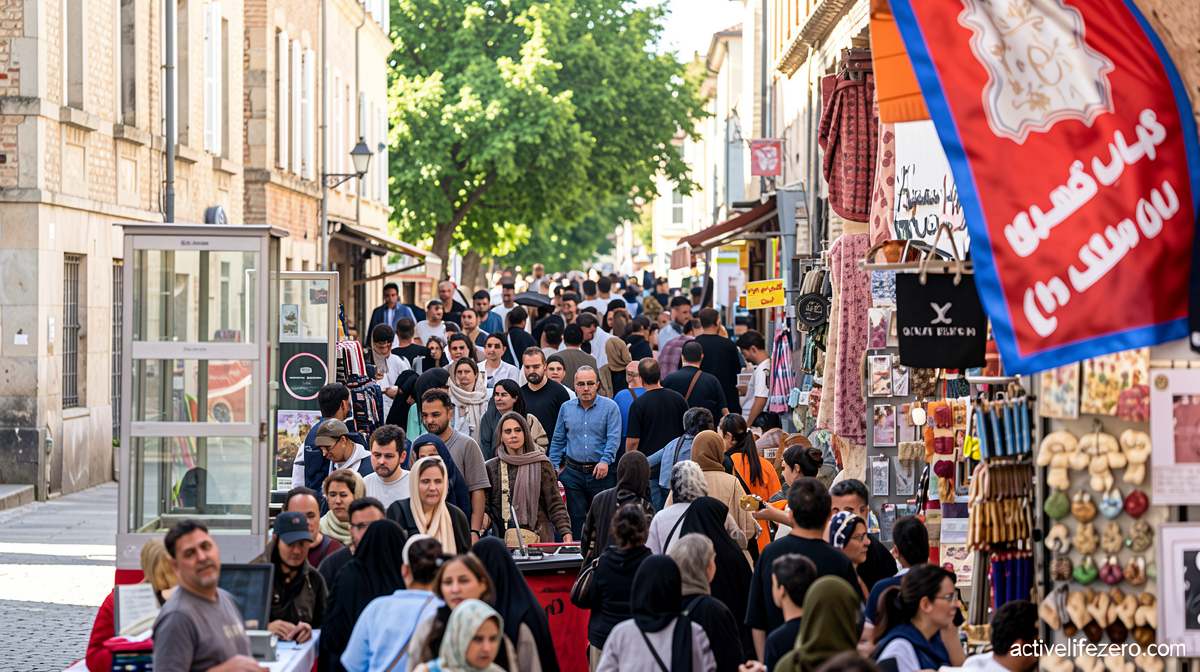
Those words land against a backdrop of social-media footage circulating last week that showed nearly deserted produce markets in Tehran and Karaj. Vendors complained that customers simply could no longer afford to buy. A 36-year-old Tehran resident named Nima described conditions as “untenable,” noting that beyond the universal price surge, certain essential medications had become outright unavailable.
A small-shop owner, who spoke anonymously to protect his livelihood, described a business barely surviving. Foreign-branded toiletries — shampoo, conditioner, toothpaste — were disappearing from shelves, and even domestically produced goods required price hikes to cover rising input costs.
The architecture of evasion
Decades of international pariah status forced the Islamic Republic to build what amounts to a parallel financial infrastructure. Front companies, currency-exchange houses, brokers, and a shadow tanker fleet that relies on ship-to-ship transfers, altered AIS tracking data, and fabricated documentation have become the connective tissue of Iran’s oil trade. The system is decentralized precisely so that no single point of failure can collapse the entire network.
The scale of the problem is not trivial. According to the US Financial Crimes Enforcement Network (FinCEN), roughly $9 billion in Iranian shadow-banking activity flowed through American correspondent accounts in 2024 alone, based on filings from US financial institutions. The Treasury Department has identified shell companies operating in oil, shipping, and investment sectors that channel billions of dollars through corridors spanning the United Arab Emirates, Hong Kong, and Singapore.
Umund Shokri, an energy strategist and senior visiting fellow at George Mason University, explained that payments are frequently settled in Chinese yuan, executed through barter arrangements, or routed entirely outside the dollar-based banking system — making them far harder for Washington to intercept than conventional wire transfers.
What the new package aims to do
Treasury Secretary Scott Bessent framed the upcoming measures in uncompromising terms. In a recent interview with CNBC, he said the package would “squash” the economy of what he called “this murderous regime,” curtail Tehran’s capacity to “project power through their proxies,” and constrain its ability to fund the Iranian military apparatus.
The stated objective is to cut off revenue streams that have kept the state afloat despite prior rounds of sanctions. If successful, the measures would target not merely the visible oil trade but the shadow channels — the correspondent-account flows, the yuan-settled transactions, the barter deals — that allow Iranian petrodollars to re-enter the global economy under different names and jurisdictions.
Who bears the cost
Experts caution, however, that the human toll will fall disproportionately on ordinary citizens rather than on the political and military elite. Shokri warned that further sanctions would weaken the rial, accelerate inflation, raise the cost of imported goods and industrial inputs, and erode household purchasing power.
“Ordinary Iranians will experience the most immediate pain, and further sanctions would weaken the rial, increase inflation, raise the cost of imported goods and industrial inputs, and reduce household purchasing power,” Shokri said.
Wage earners, pensioners, small-business operators, and lower-income families would be particularly exposed, he added. By contrast, politically connected institutions and intermediaries would remain partially “insulated,” continuing to profit from smuggling, currency manipulation, and control over scarce imported goods.
The China variable
For the sanctions to bite where Washington intends, the administration would need to reach major Chinese buyers of Iranian crude, independent refineries that process that oil, and the banks that process the resulting revenue. Yet doing so risks provoking retaliation from Beijing, which has become Iran’s most reliable commercial partner precisely because the dollar system has been closed to Tehran. Any escalation that touches Chinese financial interests could complicate broader US-China negotiations and introduce a new layer of geopolitical friction into an already volatile region.
Whether Trump stays the course on this economic front — or whether domestic political pressures, energy-market volatility, or diplomatic overtures pull him toward a different calculus — remains the central uncertainty. What is clear is that the people of Iran, already stretched to the breaking point by war and isolation, face another round of tightening screws with little prospect of relief in the near term.
Related Reading
Frequently Asked Questions
What is Trump is trying to tighten the screws?
Trump is trying to tighten the screws is the main topic of this guide. The article explains the context, practical details, and next steps readers should understand.
Why does Trump is trying to tighten the screws matter?
Trump is trying to tighten the screws matters because readers are looking for a useful answer, not just a short summary. Good content should match search intent and help them decide what to do next.