
The Milky Way’s black hole is eerily quiet. Scientists have now found evidence of its missing wind
The Milky Way’s Black Hole Wind Finally Detected
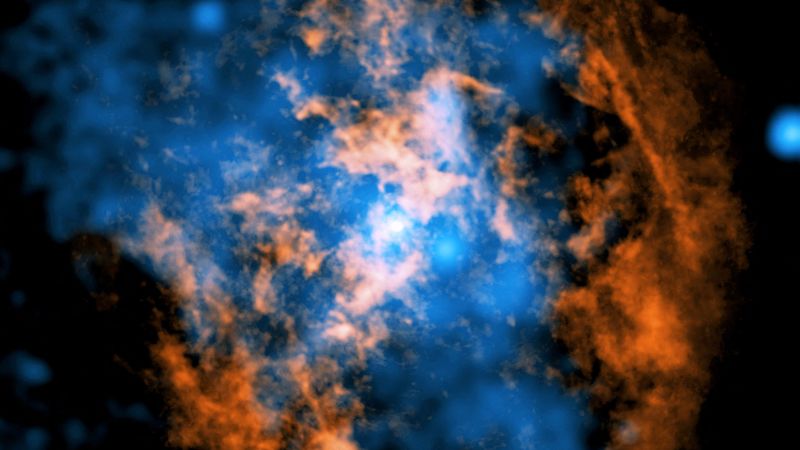
The Milky Way s black hole – The Milky Way’s black hole has long been a mystery. For decades, scientists observed its seemingly quiet behavior, with no clear evidence of powerful winds or outflows. However, a recent study has revealed subtle signs that this massive cosmic entity, Sagittarius A*, is indeed generating a wind. Researchers from Northwestern University analyzed five years of data and found a cone-shaped void in surrounding cold gas, suggesting the presence of a previously undetected outflow. This discovery, published in the Astrophysical Journal Letters, challenges assumptions about the black hole’s activity and highlights its role in shaping our galaxy’s evolution.
Why the Milky Way’s Black Hole Defied Detection
Sagittarius A*, located at the galaxy’s center, has captivated astronomers since its discovery over 50 years ago. Despite its immense mass—equivalent to nearly 4 million suns—it has appeared unusually dormant compared to other supermassive black holes. Theoretical models predicted it should expel material through winds, but observations revealed only faint, intermittent flares. “It’s the closest black hole we’ve studied, yet it seemed to lack the expected outflows,” noted Mark Gorski, a researcher involved in the study. This inconsistency led to questions about whether the Milky Way’s black hole operates differently or if its activity is simply obscured by cosmic dust.
Researchers speculate that the wind may not have been visible as a strong jet but instead exerted a subtle influence over millennia. The lack of direct observation meant that its impact was only revealed through indirect evidence, such as the displacement of surrounding gas. “The wind is warm and strong enough to interact with nearby material, but not so intense as to erase it entirely,” Gorski explained. This delicate balance explains why the wind remained hidden for so long, despite its significance in galactic dynamics.
Advanced Telescopes Unveil the Hidden Signature
The breakthrough relied on cutting-edge technology. Using the Atacama Large Millimeter/Submillimeter Array (ALMA) in Chile, the team captured the most detailed images of the cold gas around Sagittarius A*. By eliminating radio interference, they identified a cavity approximately 3 light-years in length, with a 45-degree opening angle. This structure, Gorski and Lena Murchikova argue, is the direct result of the black hole’s wind pushing through the galactic core. “It’s like a hair dryer,” Gorski said, “blowing hot plasma into denser material and shaping it over time.”
Further confirmation came from NASA’s Chandra X-ray Observatory, which detected how the cold gas was being moved by warm, energetic winds. “The X-ray data aligns with the idea that this wind is actively interacting with the galaxy’s structure,” Gorski added. The combination of these findings provides a clearer picture of how the Milky Way’s black hole influences its environment, even when it’s not visibly active.
Revisiting Theories on Galactic Evolution
Black hole winds play a critical role in regulating galaxy growth by redistributing energy and gas. In other galaxies, these outflows are visible as powerful jets, but Sagittarius A* had remained an exception. Christopher Reynolds, a professor at the University of Maryland, emphasized the importance of this study. “The Milky Way’s black hole is a key player in galactic evolution, and its wind has been shaping the core for thousands of years,” he wrote. “This research shows that even quiet black holes can have profound effects.”
The discovery also raises questions about the universality of black hole behavior. While many supermassive black holes are known to emit strong winds, Sagittarius A* has historically appeared inactive. This could mean either
