
Switzerland’s ‘Brexit moment’: Vote on a population cap sets up potential collision with EU
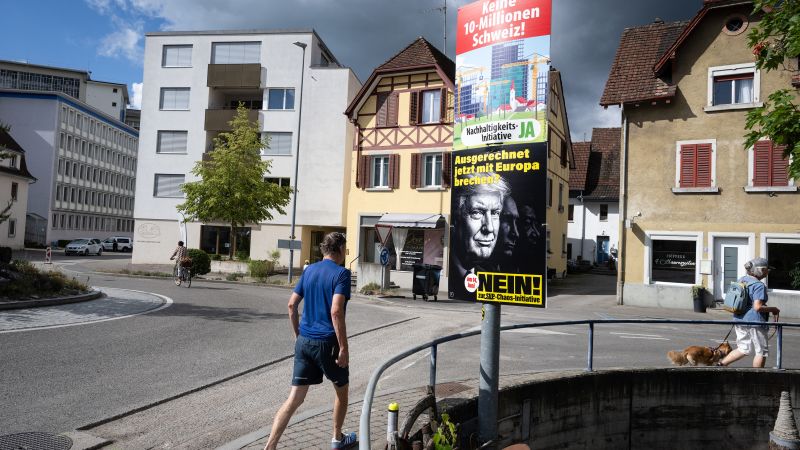
Switzerland’s ‘Brexit moment’: Vote on a population cap sets up potential collision with EU
Switzerland s Brexit moment – Switzerland is preparing to cast its vote in a crucial referendum on Sunday, weighing whether to impose a population cap of 10 million. The proposal, championed by the country’s right-wing Swiss People’s Party (SVP), seeks to address concerns about unchecked immigration, a debate that has deepened political tensions and raised questions about Switzerland’s future relationship with the European Union. If approved, the measure would mark the first instance of a European nation legally restricting its population size, potentially altering the dynamics of its ties with EU member states.
A Growing Divide Over Immigration
The referendum centers on a simple question: Should Switzerland’s population be capped at 10 million? The current population exceeds 9 million, a figure that has risen steadily over the past decade, from 8.3 million in 2014. According to Swiss government data, more than a quarter of its residents were born abroad, with foreign-born individuals forming a significant part of the workforce. This influx has sparked debates about national identity and resource allocation, with the SVP framing the issue as a matter of economic sustainability.
The party’s campaign materials argue that uncontrolled immigration is driving rapid population growth, which they claim is straining public services and eroding cultural values. “Uncontrolled immigration is causing Switzerland to grow far too quickly,” the SVP’s website states, highlighting “negative consequences noticeable in all areas of life.” These include overcrowded housing, increased traffic, and a perceived loss of national character. The party also notes that many citizens now feel like “strangers in their own country,” a sentiment it ties to the rising number of foreign residents, particularly from the EU.
Business Fears Over Economic Impact
Opponents of the cap, including business leaders and economists, warn that the proposal could disrupt Switzerland’s economic health. Jürg Müller, director of the Swiss think-tank Avenir Suisse, told CNN that the country’s population growth is partly a result of its economic appeal. “You see the tensions on housing markets, infrastructure, and even access to natural areas like lakes,” he said. “For many, it feels too crowded.” Müller explained that the SVP has capitalized on this sentiment, transforming concerns about overcrowding into a call for a population limit.
According to Müller, the SVP’s initiative reflects a broader anxiety about the pace of growth. “Switzerland is attractive because of its high quality of living and strong economy,” he noted. “It has historically balanced economic policies with low regulation and favorable tax rates, which have drawn migrants from neighboring countries.” However, he argues that the referendum is less about xenophobia and more about a desire to manage growth responsibly. “People are worried about the uncontrolled rate of increase,” Müller said, emphasizing that the cap is a response to perceived imbalances rather than outright hostility toward foreigners.
Referral to the EU and Schengen Area
Switzerland’s population growth is closely linked to its integration with the EU. Despite not being a member, the country has maintained a free-movement agreement since 2002, allowing citizens of EU nations to live and work freely. It is also part of the Schengen area, which facilitates borderless travel across 26 European countries. These arrangements have made Switzerland a popular destination for workers, particularly from Italy, Germany, Portugal, and France, which together account for nearly half of the foreign nationals residing in the country.
The SVP’s proposal, however, risks creating friction with the EU. If implemented, it could challenge the free-movement principles that underpin Switzerland’s current relationship with the bloc. Critics argue that the cap might force the country to renegotiate its agreements, potentially limiting labor mobility and affecting trade. Delphine Klopfenstein, a Green Party member, criticized the SVP’s rhetoric as “xenophobic” and “deceitful,” claiming it scapegoats foreigners for societal issues.
Close Race in the Polls
Recent opinion polls suggest the referendum outcome may be tightly contested. At the start of May, a survey showed the two sides were evenly matched, but later results from gfs.bern indicated a slight edge for those opposing the cap, with 52% favoring the status quo. This narrow margin underscores the polarized nature of the debate, with supporters and opponents drawing starkly different conclusions about the role of immigration in Switzerland’s development.
The historical context of population growth adds another layer to the discussion. Over the past century, Switzerland’s population has tripled, reaching 9 million in 2024 despite declining fertility rates. This trend has been fueled by its economic stability and geographic position at the heart of Europe. “Life in France and Germany has changed over the last decades, and in Switzerland, the quality of living remains high,” Müller explained. “Three hours to Paris, three hours to Milan—Switzerland is a convenient place to live, especially for those seeking a balance between urban opportunities and rural tranquility.”
Anti-Muslim Rhetoric in Campaigns
While the SVP frames the cap as a sustainability measure, its campaign materials incorporate anti-Muslim rhetoric to amplify public concern. One section of the pro-cap website highlights “problems with asylum seekers from Muslim countries,” citing studies that claim certain migrant groups are “many times more criminal than the rest of the population.” This language resonates with voters who feel the influx of immigrants is threatening Swiss traditions.
Another part of the campaign uses imagery to evoke cultural fears. A photograph of a woman wearing a headscarf holds up a Swiss passport under the headline “Loss of culture and identity.” The same page describes “creeping Islamization” and alleges that women at Swiss swimming pools face harassment from French nationals of North African origin. These arguments, while not universally accepted, have helped the SVP frame the debate in terms of national security and cultural preservation.
Refendum Process and Political Challenges
Switzerland’s referendum system requires proposals to gather at least 100,000 signatures within 18 months to qualify for a public vote. The population cap initiative met this threshold, prompting a nationwide debate. While the SVP enjoys strong support among conservative voters, opposition from political parties and business groups has created a divided landscape. The SVP’s focus on national identity has also drawn criticism from those who see it as an attempt to politicize migration concerns.
Despite the political opposition, the SVP remains confident in its chances. “The idea of limiting population growth has gained traction among many citizens,” Müller said, acknowledging that the measure is a reflection of public sentiment. However, he warned that the cap could have unintended consequences, such as slowing economic growth or deterring skilled workers. “Switzerland has thrived because of its openness to international talent,” he argued. “Restricting population may curb that momentum.”
Implications for EU Relations
The referendum’s outcome could influence Switzerland’s negotiations with the EU. If the cap passes, it may require adjustments to current agreements, such as reducing the number of EU citizens allowed to reside in the country. This could lead to disputes over labor rights and trade terms, potentially straining the already delicate relationship between Switzerland and its European neighbors. The SVP, however, has not ruled out using the cap as a leverage point in future talks.
Switzerland’s position as a neutral country with strong economic ties to the EU means any population restriction could have far-reaching effects. The nation’s prosperity has long relied on its ability to attract skilled migrants, a strategy that has supported industries ranging from finance to healthcare. If the cap is implemented, companies may face challenges in recruiting workers, particularly in sectors reliant on EU labor. “The economic stability of Switzerland is tied to its openness,” Müller said. “Closing this door could have serious implications.”
A Nation at a Crossroads
As Switzerland prepares to vote, the country stands at a crossroads. The referendum represents a broader ideological shift, with some citizens prioritizing national identity over international integration. Yet, the proposal also raises questions about the future of Swiss economic policies and its role in Europe. The SVP’s campaign has succeeded in framing the issue as a necessary step to protect Swiss values, but opponents argue that it risks isolating the country from its economic and cultural partners.
Delphine Klopfenstein, a Green Party member, accused the SVP of using “scapegoats” to deflect blame for societal challenges. “It is dangerous because it is deceitful,” she said, pointing out that the cap’s supporters often conflate immigration with broader economic or cultural changes. The referendum, she argued, should be seen as a test of Switzerland’s commitment to balancing growth with sustainability, rather than a move toward exclusion.
Ultimately, the vote on Sunday will determine whether Switzerland embraces a more restrictive model of population management or continues its open-door policy.
