
Scientists believe newly discovered demon cavefish may be among the rarest fish in the world
A Mysterious New Cavefish Species Found in Alabama’s Bobcat Cave
Activelifezero.com – When Dr. Matthew Niemiller ventured into Bobcat Cave near Huntsville last year, he anticipated encountering familiar inhabitants. The cave was already known to shelter the endangered Alabama cave shrimp, two distinct cave crayfish varieties, and the southern cavefish. However, his expedition yielded an unexpected surprise—a peculiar fish that had never been documented by science before. According to Niemiller, this remarkable creature could rank among the most uncommon fish on Earth.
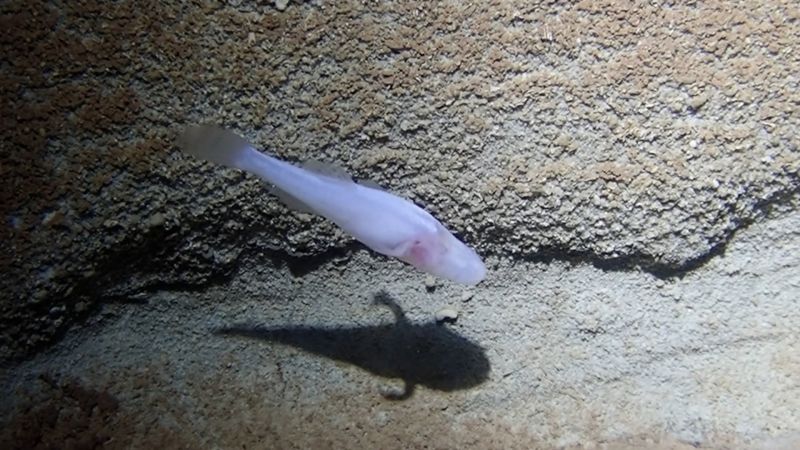
The newly identified species presents several distinctive characteristics. It lacks eyes entirely, possesses a hunched back, features spiny rays, and displays a snout configuration unlike any other cavefish. Additionally, the fish is completely devoid of pigment, allowing observers to see its brain through translucent skin. Dr. Jonathan Armbruster, curator of fishes at Auburn University’s Museum of Natural History in Alabama and a coauthor of the recent study, noted that such transparency occurs occasionally in smaller aquatic creatures.
“You usually see it in the smaller fishes, things that live in open water,” Armbruster explained. “They’ll often have a clear body so that they can be cryptic in the clear waters.”
A Name Inspired by Science Fiction
The creature’s appearance evokes imagery from science fiction narratives, which proved fitting when researchers named it Demogorgonichthys arcanus, commonly referred to as the demon cavefish. This designation draws from the Demogorgon monster featured in Netflix’s popular series “Stranger Things.” Initially, Niemiller, who serves as lead author of the new study, questioned whether the specimen might represent a known species—the southern cavefish. He acknowledged that cavefish exhibit considerable variability and that he had previously been misled by animals appearing different yet proving genetically similar.
“Over the years, I’ve seen how variable cavefish can be, and I’ve been fooled before by animals that looked different but were genetically very similar,” said Niemiller, an associate professor of biological sciences at the University of Alabama in Huntsville. “But this one was different in ways that kept holding up.”
Niemiller sent photographs of the fish to Armbruster and Dr. Pamela Hart, an assistant professor of biology at the University of Alabama and another coauthor. After examining specimens alongside the southern cavefish, Armbruster began identifying distinguishing features. The research team conducted CT scans, genetic testing, and additional analyses, revealing that these unusual creatures possessed skeletal differences from other cave-dwelling animals. Consequently, scientists classified the fish as a novel genus and species.
Rarity and Research Findings
The exact population of demon cavefish remains unknown, though Niemiller suggests they might be among the world’s rarest fish. He communicated via text message that the species originates from one location according to current understanding, likely maintaining a modest population size. The team’s discoveries appeared in the journal Scientific Reports on July 6.
The naming choice connected to cultural references. In “Stranger Things,” the Demogorgon creature pursues residents of Hawkins, Indiana. The term’s etymology remains uncertain, though academics propose Greek origins. Creators of Dungeons & Dragons, which launched in the 1970s, incorporated the name for a villain. Netflix subsequently utilized it for their television monster. At the time of discovery, a new season of “Stranger Things” approached release. Armbruster, an enthusiastic viewer of the show, proposed honoring the Demogorgon.
“What do you call a plain white, eyeless, rather nondescript thing? I mean, it’s hard to come up with descriptive names for something like that, and so what you’ll see is a lot of cave organisms have some kind of tie-in with underground creatures of some sort,” Armbruster remarked.
Unanswered Questions and Future Discoveries
Scientific knowledge about this cavefish remains limited. Researchers cannot distinguish between male and female specimens and possess “zero clue” regarding reproductive mechanisms, according to Armbruster. Regarding nutrition, the demon cavefish probably consumes anything small enough to fit within its mouth. The discovery hints at potential unidentified species even within thoroughly examined regions, the study indicates. Such organisms might inhabit restricted-access territories like military bases.
Bobcat Cave, where the demon cavefish was found, lies beneath the US Army’s Redstone Arsenal. Dr. Suzanne McGaugh, a University of Minnesota professor specializing in cavefish evolution, characterized findings of new North American vertebrate species like the demon cavefish as “exceedingly rare.” She expressed amazement that two cavefish species coexist in one cave despite following independent evolutionary paths from distinct ancestors.
Related Reading
Frequently Asked Questions
What is Scientists believe newly discovered demon cavefish?
Scientists believe newly discovered demon cavefish is the main topic of this guide. The article explains the context, practical details, and next steps readers should understand.
Why does Scientists believe newly discovered demon cavefish matter?
Scientists believe newly discovered demon cavefish matters because readers are looking for a useful answer, not just a short summary. Good content should match search intent and help them decide what to do next.
