
Scientists are cracking the code of interspecies communication. Is that a good thing?
Scientists are cracking the code of interspecies communication. Is that a good thing?
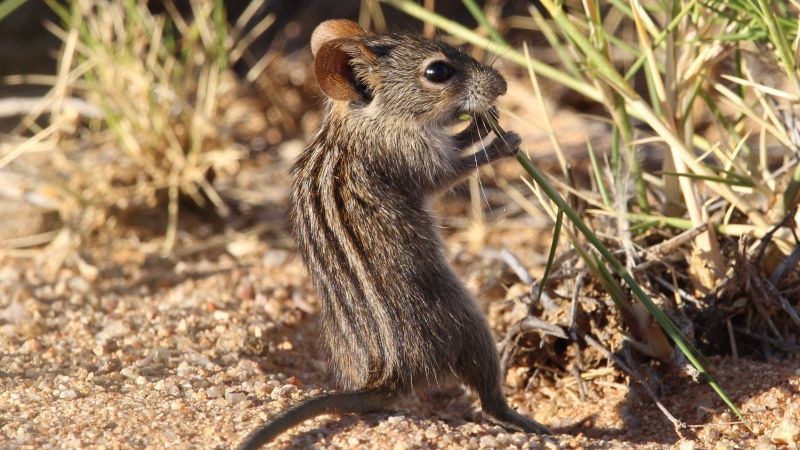
Scientists are cracking the code of interspecies – Deep within South Africa’s Karoo region, a semidesert landscape stretching across thousands of miles, an African striped mouse sits quietly beneath the dappled light of a shrub. Its routine is interrupted by a series of high-pitched sounds, inaudible to the human ear, emanating from nearby microphones. These ultrasonic calls, crafted by researchers, mimic the vocalizations of another mouse in a neighboring nest. The subject mouse reacts immediately, standing on its hind legs with alert eyes and a tense posture. But when the same mouse hears a call from a mouse in its own nest, it remains relaxed, continuing its sunbathing as if no event had occurred. This experiment, led by Nicolas Mathevon, a professor at the University of Saint-Etienne in France, has revealed a startling complexity in mouse communication, challenging long-held assumptions about animal vocal behavior.
Unlocking the Hidden Language of Rodents
Mathevon’s team, over a period of 12 days and nights, recorded over 122,000 squeaks from dozens of African striped mice using 23 microphones strategically placed across four nest bushes. The findings suggest that mice use at least seven distinct types of vocalizations, some for signaling within their immediate group and others for interacting with outsiders. The results, published in a recent study, highlight that these sounds carry more than just random noise—they are purposeful, structured, and even socially nuanced. “The mice respond differently to calls from strangers than to those from familiar individuals,” Mathevon explained. “It’s as if they’re recognizing the source of the sound, not just the sound itself.”
“When it’s a vocalization from a neighboring individual, they pay a lot more attention. They really look at the speaker. They are disturbed,” Mathevon said. “If it’s from a complete stranger, then we see an even stronger reaction, like the mouse fleeing into the bush because they are really surprised.”
This breakthrough is part of a growing body of research that is reshaping our understanding of animal communication. For years, scientists believed that vocal exchanges among animals were simple, instinctual, and devoid of the complexity seen in human language. However, studies on birds, dolphins, monkeys, hyenas, and crocodiles have shown otherwise. Mathevon, who has spent years analyzing the sounds of diverse species, including human infants, argues that animal communication is far more sophisticated than previously thought. “We’ve come to realize that animals are not just reacting to their environment—they are actively communicating with each other in ways that are often as intricate as our own.”
Technology and the Future of Animal Talk
The tools behind these discoveries are as advanced as the insights they produce. By combining cutting-edge recording equipment with machine learning algorithms, researchers can process vast amounts of data and identify patterns that would be impossible to detect manually. Mathevon’s team used an artificial neural network—similar to the systems powering large language models like ChatGPT—to analyze the mice’s vocalizations. The network uncovered that each nest developed a unique acoustic signature, much like a fingerprint, and that individual mice within a nest also had distinct vocal markers. “Machine learning is absolutely essential because you have too many calls, too many vocalizations, you cannot handle them,” Mathevon emphasized. “It’s like having a translator for the entire ecosystem.”
These findings have broader implications. If mice can convey identity through sound, it raises questions about how other animals might encode more dynamic information in their vocalizations. Mathevon and his colleagues are now exploring whether these calls can transmit details about stress levels, emotions, or even intentions. Such capabilities would transform our perception of animal intelligence, suggesting that communication systems may be more advanced than previously credited. “The next step is to understand whether these sounds carry meaning beyond static identity,” he said. “Are they discussing the weather? Or warning of danger? We’re just beginning to scratch the surface.”
Chasing the Dolittle Vision
Mathevon’s work is among four finalists for the Dolittle Prize, an annual award sponsored by British billionaire Jeremy Coller. The prize celebrates groundbreaking progress in decoding animal communication, offering $100,000 to the winning team. Its ultimate ambition, however, goes further: to recognize a species that can communicate independently with researchers without recognizing human presence. This year’s competition includes projects that explore not only mice but also other animals, such as hippos, which Mathevon is currently studying. The prize’s criteria push scientists to imagine a future where humans and animals engage in fluent, reciprocal dialogue—like the fictional Dr. Dolittle.
“The vision is supposed to be fluent two-way communication, where humans can interact with wild animals in the way that they interact with each other, creating a kind of genuine, meaningful contact,” said Jonathan Birch, a prize judge and professor at the London School of Economics. “We recognize we are a way from that goal.”
While the Dolittle Prize is a milestone, it also highlights a debate among experts. Some believe that understanding animal communication could lead to better conservation strategies, improved wildlife management, and even new ways to protect endangered species. Others, however, caution that such advancements might disrupt natural behaviors or create unintended dependencies. “There’s a risk that we could overinterpret the signals or impose human frameworks on their systems,” said one unnamed researcher. “We need to be careful not to assume they’re thinking like us.”
Despite these concerns, the trend toward decoding animal language is accelerating. As bioacousticians refine their methods, they are uncovering a world of hidden interactions. From the Karoo to the coastal waters of Sarasota, Florida, where the 2025 Dolittle Prize winner discovered a language-like system in dolphin whistles, the field is expanding rapidly. These studies are not just about understanding animal communication—they are about redefining what it means to be sentient. “Animals are not just responding to stimuli; they are building meaning, just as we do,” Mathevon said. “And if we can learn to listen, we might soon find ourselves speaking back.”
As the June 25 announcement of this year’s Dolittle Prize approaches, the scientific community remains both excited and cautious. The implications of interspecies communication are vast, touching on philosophy, biology, and even the future of human-animal relationships. Whether this is a positive development or a challenge to natural order depends on how we choose to interpret and use these new insights. For now, the African striped mouse continues its silent vigil, a reminder that the world of sound is far more intricate than it appears.
