
‘It’s not by mistake’: A family demands justice after 7-month-old killed by Israeli soldier
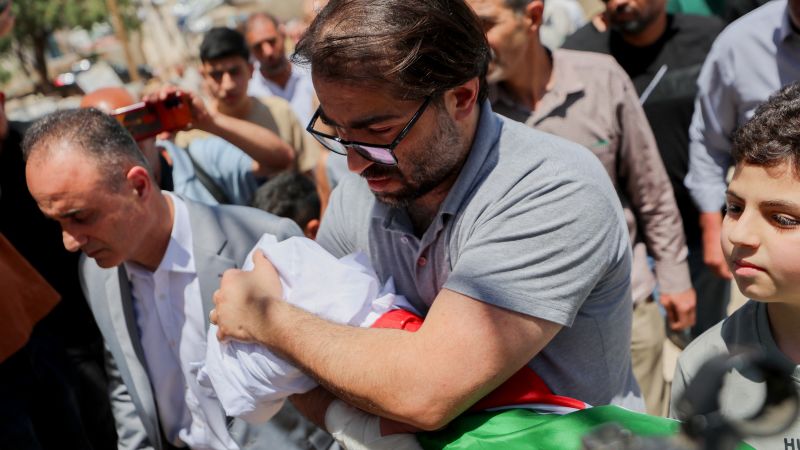
‘It’s not by mistake’: A family demands justice after 7-month-old killed by Israeli soldier
It s not by mistake – Last week, Fahd Abu Haikal was navigating a Palestinian city with his family when he spotted a group of Israeli soldiers approaching. As the vehicle came to a halt, one of the soldiers raised his rifle and fired. A bullet pierced the hood, but another struck through the windshield, grazing the steering wheel and one of Fahd’s fingers before fatally hitting his son, Sam, in the head. The infant was only seven months old, leaving the family devastated. This incident marks Sam Abu Haikal as the 13th child killed by Israeli forces in the occupied West Bank this year, according to the Israeli human rights group B’Tselem. The organization has recorded 236 child deaths in the region since the Hamas attacks on Israel began on October 7, 2023.
Tragedy captured in video
Footage from the scene, obtained by B’Tselem and shared with CNN, reveals the moment of the shooting. Fahd, cradling his bloodied baby, attempts to press his hand against Sam’s head to stop the bleeding. The video shows him scanning the surroundings, his expression a mix of anguish and helplessness, as the cries of his wife and mother echo in the air. He then lifts Sam into a nearby car, carrying him away in a desperate bid for survival. “I just wanted to go out and carry him to the hospital,” Fahd said in an interview with CNN days later. “And when you see this hit, there is no hope. No hope at all.”
Sam’s mother, Dania, recounted the harrowing experience in a separate interview. “They tried to save him, they gave him blood units, but they couldn’t do anything to save him,” she said. “Nothing could be done.” The footage, though silent, captures the gravity of the situation. The person who filmed it told B’Tselem that the soldier fired as the car was stopping, contradicting the Israeli military’s initial claim that the vehicle was accelerating. Fahd and his mother, who was seated in the front passenger seat, both confirmed the same moment of the shooting while reviewing the video with CNN. They also identified the same soldier—standing just 30 feet from the car—as the one who fired the fatal shot.
Israeli military statement and conflicting accounts
Hours after the incident, the Israeli military issued a statement acknowledging the June 5 shooting in Hebron. It stated that soldiers “perceived a vehicle accelerating toward them” and “responded with single shots toward the vehicle.” However, the video obtained by B’Tselem challenges this narrative. It clearly shows Fahd’s car decelerating, not speeding up, as it reaches the soldiers. The absence of audio in the clip does not diminish its impact, as the witness described the soldier’s actions in detail.
Feryal, Fahd’s mother, expressed her frustration with the military’s response. “We expected them to say, ‘go out, return, you must return’ or to shoot in the air to let us turn around,” she said. “But they didn’t do anything—only they shot him.” The video also reveals the soldier walking away from the car after firing, with no attempt to assist the wounded. Eyewitnesses confirmed that none of the soldiers present provided medical aid, leaving the family to cope with the aftermath alone.
Mothers’ grief and physical scars
At a family mourning house in Bethlehem, friends and relatives gathered to offer comfort to Dania, who lay on a bed in the corner, her body still bearing the marks of the bullet that killed her son. The same projectile that struck Sam also passed through her face, entering her right cheek and exiting behind her ear. Fragments of shrapnel remain lodged in her chest, so close to her heart that doctors opted against surgery to remove them. “I was breastfeeding him,” she said, her voice trembling. “Now, my chest hurts me.”
Dania’s daily routine has become a painful reminder of her loss. She now relies on a breast pump to feed her baby, a task that triggers waves of sorrow. “Every time I use this pump, I start crying,” she admitted. The phone’s camera roll, once filled with countless photos and videos of her joyful child, now holds only memories. Sam was Dania’s only child, and the grief of losing him has deepened the emotional toll of her own injuries. Her words underscore the compounded trauma of a mother who not only lost her son but also suffered life-altering wounds.
Ongoing investigation and hopes for justice
While the Israeli military has launched an investigation into the shooting, local residents and business owners reported that forces later returned to the area and confiscated all CCTV recordings. This action has raised questions about transparency and the possibility of uncovering additional evidence. CNN’s efforts to retrieve footage from the street where the incident occurred were met with limited success, as the military declined to comment on the confiscation of recordings.
Despite these challenges, Fahd remains committed to seeking justice for his son. “When you see something in front of you and aim at him and shoot him, it’s not by mistake,” he said, pointing to the soldier who fired the fatal shot. “He shot directly to kill.” The family’s insistence on accountability reflects a broader demand for justice in the West Bank, where 236 children have been killed by Israeli forces since the Hamas attacks. Fahd’s willingness to cooperate with the inquiry highlights his determination to ensure that the truth is revealed.
The incident has sparked conversations about the circumstances under which such tragedies occur. While Israeli military investigations are often seen as thorough, they rarely lead to disciplinary action, let alone criminal charges. For Sam’s family, however, the process is more than a formality—it is a chance to reclaim their dignity and demand recognition of their son’s death. As the community mourns, the question remains: will the soldier’s actions be deemed an error, or will justice be served for a child whose life was taken in an instant?
Throughout the days following the shooting, the family’s grief has been palpable. The mourning house in Bethlehem has become a sanctuary for those who wish to share their condolences, though the pain of loss is universal. Dania’s words, “Every time I use this pump, I start crying,” echo the silent suffering of many mothers in similar situations. Their stories are a testament to the resilience of families in the face of unimaginable tragedy, even as they navigate the complexities of a system that may not always deliver justice.
As the investigation continues, the Abu Haikal family awaits answers. Their insistence on clarity and accountability underscores the importance of every life lost, especially those of the most vulnerable. For now, the road ahead is lined with sorrow, but their determination to seek justice remains unshaken. “We will do all we can to get justice for our son,” Fahd said, a promise that carries the weight of both loss and hope.
