
In a city of high-rises, ‘cardboard grannies’ collect waste for cash
In a city of high-rises, ‘cardboard grannies’ collect waste for cash
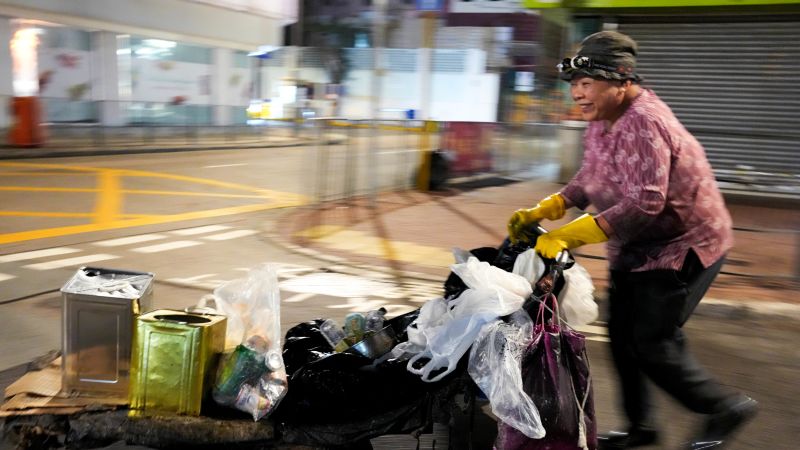
In a city of high rises – Amid Hong Kong’s towering skyline and labyrinthine streets, a quiet but persistent group of elderly women—referred to as ‘cardboard grannies’—engage in a daily struggle to make ends meet. These women, often in their 70s or beyond, spend hours gathering discarded cardboard from alleyways, sidewalks, and commercial districts, selling it for a modest income. Their work, though grueling, has become a vital lifeline in a city where living costs are among the highest in the world.
For many, this task is more than mere survival; it’s an unspoken pact with the city’s rhythm. Wu Sau-jing, 71, begins her day before dawn, navigating the bustling streets with a trolley filled with flattened cardboard. Her routine is repetitive, yet she finds a sense of purpose in it. “I maintain a livelihood and it’s also my hobby,” she explains to CNN. “If you don’t like it, it can be quite exhausting.” Despite the physical demands, the job has become a second nature for her, a routine she’s followed for over three decades.
“It’s like smoking and gambling,” Wu adds. “It’s a hobby you can’t get rid of… I’ll do it until the day I can’t do it anymore.”
While Wu’s determination is admirable, the financial rewards are minimal. Lai, another senior collector in her 70s, says she earns approximately HK$100 ($12) per day, which barely covers two meals. “It’s not enough to live comfortably,” she admits. This modest income reflects the broader economic reality for Hong Kong’s aging population. A 2024 report by Oxfam Hong Kong revealed that nearly 580,000 elderly residents are living in poverty, a stark contrast to the city’s status as one of Asia’s wealthiest hubs.
The government provides a small monthly allowance to support elderly citizens, but for many, this is insufficient. Recurring expenses, such as housing and groceries, force them to supplement their income through informal work like cardboard collection. However, the market for recycled materials has grown increasingly unforgiving. Lai notes that recycling companies once paid HK$0.6 ($0.078) per kilogram, aligning with the government’s minimum recommendation. Now, they offer only HK$0.3 ($0.038), a drop that has significantly impacted her earnings. “The money has halved in the past year,” she says. “Sometimes I walk away with nothing, as strangers or officials mistake my haul for litter.”
Chan Ngai-kan, 95, faced a particularly tough day when her usual recycling center closed unexpectedly. After pushing her trolley through multiple districts in a single afternoon, she discovered the facility no longer accepted cardboard. Forced to discard her collection at a nearby waste station, she left empty-handed. “My children are in Canada and I have no money,” Chan tells CNN, underscoring the vulnerability of these workers who rely on the city’s waste streams for survival.
While most of these collectors are women, there are exceptions. Cheung, 80, is one of the few men in this trade. Unlike his female counterparts, he follows no fixed schedule, instead picking up whatever cardboard he encounters. Once his load reaches a manageable size, he embarks on a 30-minute journey to the nearest recycling center, often navigating steep hills and narrow roads. His work, though less visible, is equally demanding, highlighting the role of both genders in this informal economy.
A wasteful city
Hong Kong’s waste management system is a double-edged sword. The city generates approximately 1.51 kilograms of waste per person daily, outpacing its Asian neighbors like Tokyo, Seoul, and Taipei. Despite this, only 30%-40% of the city’s waste is recycled, according to official statistics. In comparison, countries such as Taiwan and South Korea recycle over half their waste, indicating a gap in Hong Kong’s sustainability efforts.
The challenge of recycling is compounded by the sheer volume of cardboard waste. Businesses and restaurants, which are major contributors to the city’s trash, often discard large quantities of cardboard in the early hours. This creates opportunities for the grannies to collect and sell it, but also exposes them to the risk of having their hauls seized by municipal officials. Their lack of official employment status leaves them in a precarious position, where even a small loss can have a significant impact on their income.
For some, like Wu Sau-jing, the job has evolved into an addiction. She describes her nightly routines with a mix of resilience and nostalgia, finding solace in the familiar act of collecting. “It’s a habit I can’t break,” she says. “Even when I’m tired, I feel compelled to keep going.” Her words echo the experiences of others in the group, who view the work as both a necessity and a source of identity. In a city where modernity often overshadows tradition, these elderly women have carved out a unique niche, blending survival with a sense of community.
As Hong Kong continues to grapple with economic pressures and environmental challenges, the stories of the cardboard grannies offer a glimpse into the lives of those often overlooked. Their contributions, though small, are a testament to human adaptability and the enduring spirit of those who refuse to let circumstance dictate their future. Whether it’s the physical toll of their labor or the emotional weight of their circumstances, these women embody the resilience of a city where even the smallest scraps can hold great value.
Despite the hardships, the job remains a lifeline for many. It provides not just income, but a sense of purpose in a world that moves at a relentless pace. As the sun rises over the city’s skyline, the grannies return home, their trolleys laden with the day’s earnings—a modest sum that, for them, is enough to keep their lives afloat in a metropolis of endless possibilities and unrelenting costs.
