Germany blames Russia for drone attack on Leipzig airport

Daftar Isi
Berlin Points Finger at Moscow After Drone Found at Leipzig Cargo Hub
Activelifezero.com – Germany formally attributed last month’s near-miss drone incident at one of Europe’s busiest freight airports to Russian intelligence, marking a sharp escalation in the continent’s simmering hybrid-warfare standoff with Moscow. The accusation, delivered alongside a package of diplomatic and border-control penalties aimed at Russia, signals that Berlin intends to treat covert operations on its soil as acts of statecraft rather than isolated anomalies.
The revelation lands at a moment when European capitals are increasingly convinced that a pattern of sabotage, electronic interference, and targeted disruptions stretching from the Baltic to the North Sea is being orchestrated from the Kremlin. By naming Russia directly for the Leipzig episode, Germany moves beyond the cautious language of “unexplained incidents” that has characterized much of the past two years of Western commentary.
The August 5 Incident
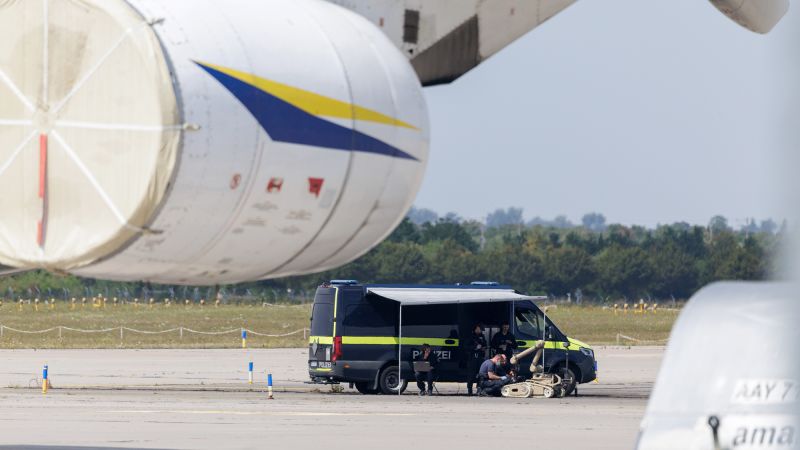
On August 5, airport security personnel discovered a small unmanned aerial vehicle inside the restricted perimeter of Leipzig/Halle Airport, positioned near the south runway — the strip primarily used by freight operations. The craft carried a military-grade explosive charge with an attached detonator. A bomb-disposal robot was brought to the site, and technicians carefully extracted the detonator. Photographs released afterward showed the robot operating in close proximity to a Ukrainian cargo aircraft parked nearby.
On the same day, a second airborne object struck a freight plane in the vicinity of the airport, inflicting minor structural damage. That aircraft completed its flight and touched down safely in Hannover. Interior Minister Alexander Dobrindt characterized the episode at the time as a serious step up in threat level:
“Drone sightings, drone threats including in a hybrid context, are something we know from the past. That a drone armed with explosives is at an airport is a new threat scenario.”
German media subsequently reported that roughly a week after the initial discovery, a third drone was located in a field adjacent to the airport, fueling speculation that the operation may have involved multiple craft deployed in sequence. The German Federal Prosecutor’s Office, which has jurisdiction over the matter, declined to offer further detail, citing an active investigation.
Berlin’s Countermeasures
In response to the attribution, Foreign Minister Johann Wadephul ordered the immediate closure of the Russian consulate in Bonn and the Russian House, a long-standing cultural institution in Berlin. Entry screening for Russian nationals arriving in Germany will also be tightened, a move that will affect the tens of thousands of Russian residents, students, and business visitors who maintain legal status in the country.
Dobrindt framed the broader posture in blunt terms:
“We are not at war, but we are a daily target of hybrid attacks.”
The minister’s phrasing underscores a growing consensus in European capitals: that the conflict between Russia and Ukraine has not remained confined to the Ukrainian front but has bled into Western airspace, infrastructure, and diplomatic space through a sustained campaign of low-intensity coercion.
US Intelligence Assessment
A US defense official stationed in Europe confirmed that Washington’s own analysis concluded the Leipzig drone was the product of a Russian intelligence service. The official described the payload as military-grade, consistent with the type of shaped-charge explosives used in small tactical munitions rather than improvised devices.
Separately, recent American intelligence assessments — shared with allied partners — indicate that President Vladimir Putin may seek to probe NATO’s collective-defense commitments by launching a limited strike against an allied nation within the coming years. Three sources familiar with the reporting told CNN that such a scenario is under active consideration in Moscow’s planning cycle. The Kremlin was contacted for comment on both the drone attribution and the broader escalation assessment; no response had been received at the time of publication.
Why Leipzig/Halle Matters
The airport’s strategic significance goes well beyond its role as a commercial freight node. Since Russia’s full-scale invasion of Ukraine began in February 2022, the Ukrainian state carrier Antonov Airlines has operated its European cargo fleet out of Leipzig/Halle after the destruction of its historic home base at Hostomel, northwest of Kyiv, in the opening days of the war. The airport thus functions as a critical lifeline for Ukrainian military logistics and humanitarian supply chains. A drone carrying a shaped charge parked beside one of those aircraft is not merely a local security event; it is a direct threat to the flow of materiel that keeps Ukraine’s war effort supplied.
The Wider Pattern
Western intelligence agencies have repeatedly linked a catalogue of apparently disparate incidents across Europe to Russian operators: arson at warehouses and transit hubs, high-profile cyber intrusions into government and corporate networks, GPS jamming episodes over North Sea shipping lanes, and physical sabotage of undersea telecommunications cables, railway junctions, and logistics depots. Each event, taken alone, invites explanations ranging from mechanical failure to domestic criminality. Taken together, they form what European defense planners now describe as a coherent hybrid-warfare architecture designed to erode confidence, raise insurance costs, and test allied reaction times without crossing the threshold of open armed conflict.
By publicly assigning blame for the Leipzig drone and pairing that attribution with concrete diplomatic penalties, Germany is attempting to convert that pattern from an intelligence assessment into a matter of public record and policy consequence. Whether Moscow responds with reciprocal measures, further covert operations, or a calibrated conventional probe of NATO’s Article 5 commitments will shape the security environment across the continent in the months ahead.
Related Reading
Frequently Asked Questions
What is Germany blames Russia for drone attack?
Germany blames Russia for drone attack is the main topic of this guide. The article explains the context, practical details, and next steps readers should understand.
Why does Germany blames Russia for drone attack matter?
Germany blames Russia for drone attack matters because readers are looking for a useful answer, not just a short summary. Good content should match search intent and help them decide what to do next.