
East Asia’s tallest tree is the ‘Heaven Sword,’ an environmental guardian
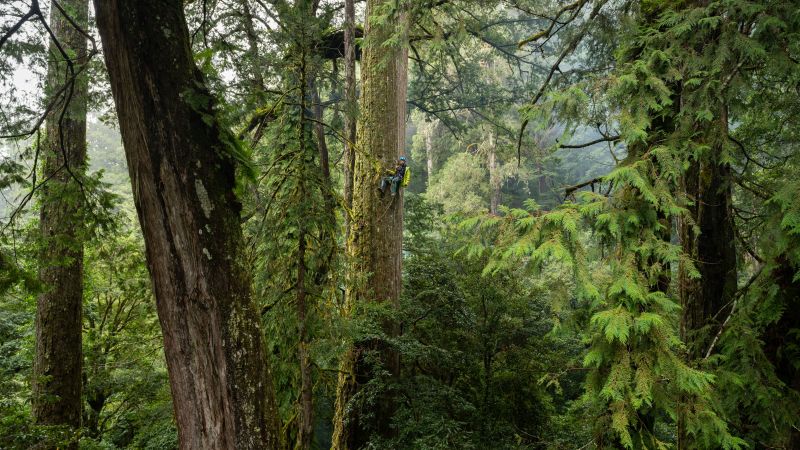
East Asia’s Tallest Tree Revealed as a Symbol of Natural Heritage
East Asia s tallest tree is – In a remote valley bordering one of Taiwan’s longest rivers, scientists have discovered the island’s tallest known tree, a towering fir dubbed the “Heaven Sword of the Da’an River.” The name draws from the legendary weapon in Jin Yong’s martial arts literature, reflecting the tree’s mythical status among locals. Researchers estimate the tree stands at 84.1 meters (276 feet) and has been growing for over a millennium. This achievement, the result of a decade-long effort, marks a significant milestone in understanding Taiwan’s unique biodiversity.
A Decade of Exploration and Indigenous Knowledge
The quest to locate the Taiwania fir, scientifically named Taiwania cryptomerioides, began with a blend of modern technology and traditional wisdom. Indigenous Rukai communities, who have long inhabited the southern mountains of Taiwan, refer to the species as “the tree that hits the moon.” This poetic description highlights the cultural reverence for the plant, which has grown in some of the island’s most rugged landscapes. The researchers’ journey to confirm the tree’s status as the tallest in East Asia involved meticulous fieldwork and collaboration with local experts.
For context, the world’s tallest living tree, Hyperion, a coast redwood in California’s Redwood National Park, reaches 116 meters (381.3 feet). Despite this, Taiwan’s forests host a wealth of towering trees, a legacy of its dramatic topography and favorable climate. Forests cover approximately 60% of the island, with an estimated 950 million trees, as reported by a 2016 study. However, identifying the tallest among them proved daunting, particularly for the rare and ancient Taiwania firs.
Combining Technology and Human Ingenuity
Over the years, a dedicated group of Taiwan-based tree enthusiasts has worked to map the island’s colossal flora. This team, composed of professional climbers, ecologists, geologists, and remote-sensing specialists, began their mission in 2014. Their efforts culminated in the creation of the Taiwan Giant Tree Map, which aggregates data from aerial surveys and field observations. Yet, even with advanced technology, the search for the Heaven Sword remained challenging.
While remote-sensing tools provided valuable insights, they occasionally misled. Taiwan’s uneven terrain, with steep cliffs and dense canopies, caused the algorithms to overestimate tree heights. To address this, the team turned to a unique strategy: inviting citizen scientists to analyze the lidar-generated images. This crowdsourced approach revealed that 93% of the trees had been inaccurately measured, prompting a more hands-on method for validation.
Ultimately, the researchers confirmed the Heaven Sword’s height by physically climbing the tree and dropping a tape measure from its peak. This traditional technique, paired with cutting-edge lidar data, offered a dual approach to accuracy. “The common characteristics are probably that we are all tree lovers and like adventures,” said Dr. Rebecca Chia-Chun Hsu, the study’s lead author and assistant researcher at the Taiwan Forestry Research Institute. Her team’s innovative methods could serve as a blueprint for large-scale tree surveys, crucial for global conservation efforts.
Preserving Ancient Forests Amid Environmental Pressures
Dr. Hsu noted that Taiwan’s climate, characterized by abundant rainfall and stable conditions, has allowed ancient trees to thrive for centuries. However, industrial logging between 1912 and 1991 disrupted this balance, reducing some of the island’s old-growth forests. The steep, inaccessible terrain of Taiwan, she explained, shielded many of these giants from human encroachment, enabling their survival in protected areas today.
The discovery of the Heaven Sword was not an isolated event. It built on earlier efforts, such as the team’s 2014 work to document “The Three Sisters,” three giant Taiwania firs in the expansive Cilan conservation area. This initiative, which began 12 years ago, laid the groundwork for the current project. The collaboration with remote-sensing experts from Taiwan’s National Cheng Kung University was pivotal, as lidar technology enabled the creation of a detailed 3D representation of the forest canopy.
The team’s methods, blending high-tech scanning with human observation, underscore the importance of interdisciplinary approaches in ecological research. While lidar provides precise data, it requires interpretation. For instance, the technique can misinterpret tree heights when surrounded by dramatic landforms. By involving citizen scientists, the researchers not only corrected these errors but also fostered public engagement in conservation efforts.
A Legacy of Resilience and Future Implications
The Heaven Sword’s existence is a testament to nature’s resilience and the value of preserving ecosystems. Its height, surpassing many of its counterparts in East Asia, highlights the potential for Taiwan’s forests to harbor extraordinary biodiversity. As the climate crisis intensifies, such findings become increasingly vital for understanding and protecting Earth’s natural heritage.
Dr. Hsu emphasized the significance of their work: “Industrial logging has diminished some ancient forests, but Taiwan’s steep terrain has preserved these giants.” With many of the island’s largest trees now found in protected zones, the team’s research provides a critical tool for monitoring and conserving these ecosystems. Their success in verifying the Heaven Sword’s height through a combination of technology and manual effort offers a model for other regions seeking to catalog their tallest flora.
As the study published in the journal Frontiers in Forests and Global Change details, the collaboration between professionals and the public has transformed tree measurement into a dynamic process. The team’s journey—from aerial surveys to ground-level verification—illustrates how innovation and tradition can converge to uncover nature’s hidden marvels. The Heaven Sword, both a scientific achievement and a cultural icon, stands as a symbol of the delicate balance between human activity and the natural world’s enduring strength.
Looking ahead, the Taiwan Giant Tree Map serves as a foundation for further exploration. It not only aids in identifying the tallest trees but also sheds light on the ecological roles these giants play. As deforestation and climate change threaten global forests, the lessons learned from Taiwan’s research could inspire similar initiatives worldwide, ensuring that these towering ecosystems are safeguarded for future generations.
