
Downed by lightning eight decades ago, a US airman is finally coming home
Downed by Lightning Eight Decades Ago, a US Airman is Finally Coming Home
Downed by lightning eight decades ago – Eight decades after his final flight, the remains of 1st Lt. Franklin McKinney, a U.S. Army Air Force pilot, have been officially identified. The journey to confirm his identity began with a senior thesis by a cadet at the U.S. Air Force Academy, a Thai air force officer’s enduring connection to the past, a villager’s vivid recollection of a mid-20th-century event, an American expatriate’s relentless curiosity, and even a catastrophic flood in Bangkok. These seemingly disparate elements converged in 2023 to bring McKinney, who vanished in a lightning strike during World War II, back to his homeland.
The Quest for Identification
The search for McKinney’s remains was initiated in 2008 when Dan Jackson, a first-year cadet at the U.S. Air Force Academy in Colorado Springs, reached out to Sakpinit Promthep, then head of the Royal Thai Air Force Museum. Jackson was researching his senior thesis, a history of a fighter squadron that operated in China and Thailand during the war. His inquiry sparked a collaboration that would span years, connecting American military history with Thai archival records. Despite their efforts, McKinney’s fate remained a mystery until 2012, when a breakthrough emerged from an unexpected source.
At the time, Sakpinit was working through the aftermath of a severe flood that had submerged the Thai archives in 2011. The floodwaters were so high that officials had to navigate the museum’s corridors in rowboats to salvage documents. “We were afraid the humidity would destroy the old files we kept,” Sakpinit recalled in a Facebook video. “So we tried sitting down and sorting through things… It turned out we found a report.” The document, a telephone log from a Thai Air Force wing commander to Bangkok headquarters, provided crucial insight into McKinney’s crash. It stated that a P-38 photo reconnaissance variant had been found with a single human skull, and the cause was listed as a lightning strike.
“They found one human skull. The cause was listed as a midair lightning strike,” the log said, according to Sakpinit.
The discovery of this report reignited the search for McKinney’s remains. Researchers, including Jackson and Richard Hakanson, an independent American scholar based in Chiang Mai, Thailand, delved deeper into the archives. Hakanson, who described himself as “a man who loves solving mysteries,” played a pivotal role in cross-referencing historical data and military records. Their work uncovered details about McKinney’s final mission, which had been shrouded in uncertainty for decades.
The Flood That Uncovered Clues
The 2011 flood, which had initially disrupted archival efforts, ultimately became a turning point in McKinney’s story. As water levels receded, documents that had been previously overlooked were brought to light. Sakpinit’s recollection of the flood’s impact highlights the serendipity involved in the identification process. “It was like the water had washed away everything except what we needed,” he said in a later interview. The report, however, was not the only clue. A 95-year-old villager from northern Thailand, whose memory of the event had remained unshaken, also contributed vital information about the location of McKinney’s crash site.
While the flood’s role was critical, the identification of McKinney’s remains required more than just archival luck. The U.S. Embassy in Bangkok confirmed the match between the recovered bones and McKinney’s physical records, a process that involved DNA analysis and historical comparisons. This final step validated a decades-long quest, fulfilling the U.S. military’s commitment to “leave no one behind,” even as time passed and the war’s echoes faded.
Mckinney’s Mission and Personality
McKinney’s final flight took place on November 5, 1944, from Beitan Airfield in Yunnan, China. His mission was to photograph Japanese military installations in the northern Thai provinces of Uttaradit and Chiang Mai, as well as in Burma. As a member of the 35th Photo Reconnaissance Squadron, McKinney was assigned to operate the F-5E variant of the P-38 Lightning, a twin-engine aircraft adapted for reconnaissance. Unlike fighter pilots, who engaged in direct combat, McKinney and his crew were tasked with flying at high altitudes to capture strategic intelligence.
McKinney’s approach to his duties, however, was anything but typical. Jackson’s book, *Fallen Tigers* (2021), reveals that McKinney was reluctant to take on reconnaissance missions. He preferred the thrill of combat, where he could engage enemy aircraft with guns rather than cameras. “He hated having to fly high and fast and run for home when he encountered hostile aircraft,” Jackson wrote. His colleagues noted his tendency to descend to as low as 19,000 feet during missions, placing himself in greater danger than the squadron’s standard operating altitude of 30,000 feet. This risk-taking, while admirable, left his comrades anxious about his safety.
McKinney’s best friend and bunkmate, 1st Lt. Sterling Barrow, documented the day of his disappearance in a journal entry. “Mac was overdue at 4:15,” Barrow wrote. “Haven’t had any word on him yet. God grant he be safe – please!” This message, recorded just hours after McKinney’s last takeoff, underscored the camaraderie and concern within the squadron. Days later, Barrow’s journal reflected growing uncertainty, with speculation that enemy fighters might have intercepted McKinney at a low altitude. “I wonder if the daredevil was caught too close to the ground,” Jackson noted in his research, highlighting the risks of McKinney’s unconventional tactics.
The Legacy of a Forgotten Hero
The identification of McKinney’s remains has not only brought closure to his family but also revived interest in the history of the Flying Tigers, the volunteer American unit that played a key role in China’s defense against Japan before the U.S. formally entered the war. McKinney’s story is a testament to the bravery and sacrifice of these pilots, many of whom were never found. His final mission, though brief, was part of a broader campaign that helped shape the course of World War II in the Pacific theater.
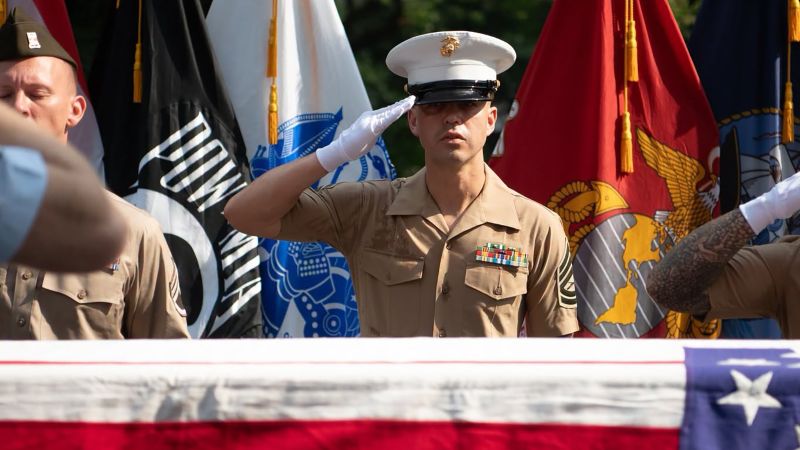
As the U.S. military honors its promise to recover missing personnel, McKinney’s homecoming symbolizes the enduring connection between American and Thai forces. The collaborative effort between Thai officials, American researchers, and local historians demonstrates how historical events, once buried by time, can resurface through dedicated inquiry. For McKinney’s family in Providence, Rhode Island, the confirmation of his identity after eight decades is a poignant reminder of the sacrifices made during the war and the power of perseverance in uncovering the past.
McKinney’s story also underscores the challenges of wartime identification. While his remains were found in a rice paddy, the lack of a clear crash site and the absence of records for years delayed recognition. The flood, which initially threatened to destroy archives, instead revealed the key evidence that led to his identification. This twist of fate highlights the unpredictable nature of historical discovery, where serendipity and persistence can bring resolution to long-standing mysteries.
Today, McKinney’s legacy is preserved through the efforts of those who never stopped searching. His final flight, once a shadow in history, now stands as a chapter in the broader narrative of World War II. The U.S. military’s dedication to honoring its fallen, even decades later, ensures that stories like McKinney’s are not forgotten. As his remains are prepared for repatriation, the journey home marks not just the end of a 1st lieutenant’s service but the culmination of a decades-long quest that bridges two nations and two generations.
