China postpones launch of unprecedented water-hunting moon mission amid space race

Daftar Isi
China Pushes Back Chang’e-7 Moon Probe as Lunar Water Race Intensifies
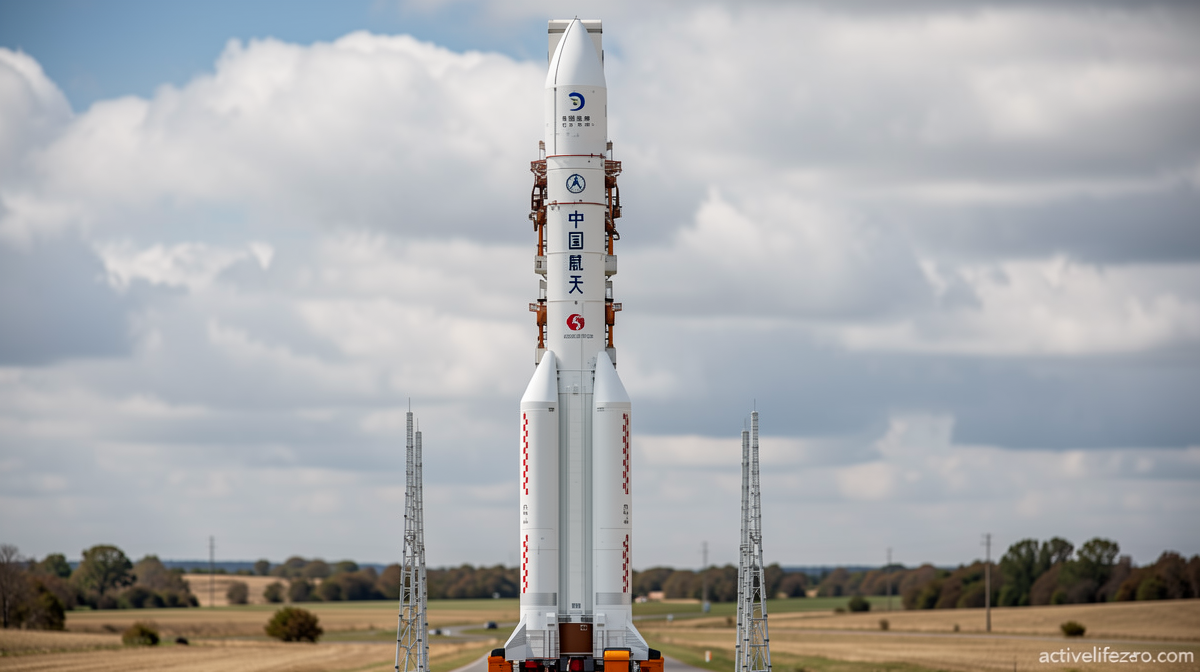
Activelifezero.com – Beijing has delayed the launch of its Chang’e-7 robotic spacecraft, a mission engineered to drill into the moon’s permanently shadowed south-pole craters and deliver the first direct, on-site analysis of lunar water ice. The China Manned Space Engineering Office confirmed through state media that the probe “cannot take place during the planned window this year,” effectively scrubbing a launch that had been anticipated as early as Sunday evening or Monday morning, Beijing time. No revised date has been announced, and the precise technical cause behind the postponement remains undisclosed.
State media offered only a terse explanation: the spacecraft failed to satisfy its launch-readiness criteria, and the decision was reached after an evaluation guided by what officials called the “prudence, reliability and absolute mission success” principle. In practical terms, that language signals an internal engineering review concluded the vehicle was not yet cleared for flight — though the specific subsystem or parameter that triggered the hold was not made public.
Why the South Pole Matters
The lunar south pole has become the most contested real estate in the current space race because of a single resource: water locked as ice inside craters that have not seen sunlight for billions of years. If present in sufficient quantity, that ice can be split into oxygen and hydrogen — yielding breathable air for crews, potable water, and, critically, rocket propellant for deeper-space missions. A lunar base that can manufacture its own fuel from local ice would be dramatically cheaper to sustain than one that must ship every kilogram of propellant from Earth.
Orbiting satellites have already mapped thermal signatures consistent with large ice deposits in these shadowed regions, and the United States has begun estimating the volume of those stores from space. Yet no spacecraft has ever drilled into the regolith and returned a physical sample for laboratory analysis. Chang’e-7 was designed to close that gap, carrying instruments capable of boring into the surface and characterizing the ice in situ.
A Competitive Window Narrows
The postponement lands at a moment when American and commercial partners are pressing forward on their own south-pole campaigns. Within roughly the next twelve months, multiple US-linked spacecraft are slated to reach the same lunar terrain that Chang’e-7 targets. Astrobotic Technologies, headquartered in Pittsburgh, has indicated its Griffin lander could fly to the south pole as early as late 2026. Separately, Jeff Bezos’s Blue Origin has outlined plans to deliver up to two robotic landers to the moon next year; at least one of those vehicles may carry the VIPER rover, a NASA-built prospecting robot purpose-built to traverse shadowed terrain and sample subsurface ice.
The competitive stakes were already visible in 2025, when Intuitive Machines, a Texas-based company, flew a water-hunting drill to the south pole. The spacecraft tripped during its descent onto the notoriously rugged, low-visibility terrain and was unable to complete its science objectives. That near-miss underscored both the difficulty of the environment and the urgency of getting a working probe down before rivals do.
By delaying Chang’e-7, China has not forfeited its claim to first direct contact with lunar ice, but it has handed the United States and its commercial partners a temporary window in which to attempt what no mission has yet accomplished. Whether that window proves decisive depends on the reliability of the American landers and rovers still in development and flight-test phases.
What the Delay Means for Lunar Science
Yuqi Qian, a lunar geologist at the University of Hong Kong, framed the mission’s significance in terms that go beyond a single data point. He noted that Chang’e-7 could help make
“important progress on this question, sharpening and focusing experiments for further exploration and testing.”
In other words, even a partial confirmation — or a partial absence — of usable ice would recalibrate every subsequent mission design, from base-site selection to propellant logistics. Qian added that the probe represents a structural shift in how Beijing thinks about its lunar program:
“shifting from an exploration program to a resource utilization program.”
That distinction matters. Earlier Chang’e missions mapped the surface, returned samples, and demonstrated soft-landing capability. Chang’e-7, by contrast, is explicitly oriented toward extraction feasibility: can the ice be reached, quantified, and ultimately harvested? A delay of months rather than years would keep China inside the same competitive season as its American counterparts. A delay stretching into the following year, however, would allow US missions to establish a foothold — literally and figuratively — before the Chinese probe arrives.
For now, the question hanging over the south pole remains unanswered: is there enough frozen water in those ancient craters to power a permanent human presence? The answer will shape the next decade of lunar architecture, and every week of delay reshuffles who gets to ask the question first.
Related Reading
Frequently Asked Questions
What is China postpones launch of unprecedented water?
China postpones launch of unprecedented water is the main topic of this guide. The article explains the context, practical details, and next steps readers should understand.
Why does China postpones launch of unprecedented water matter?
China postpones launch of unprecedented water matters because readers are looking for a useful answer, not just a short summary. Good content should match search intent and help them decide what to do next.