
Carney seeks new US-Canada partnership as world undergoes ‘rupture’
Carney seeks new US-Canada partnership as world undergoes ‘rupture’
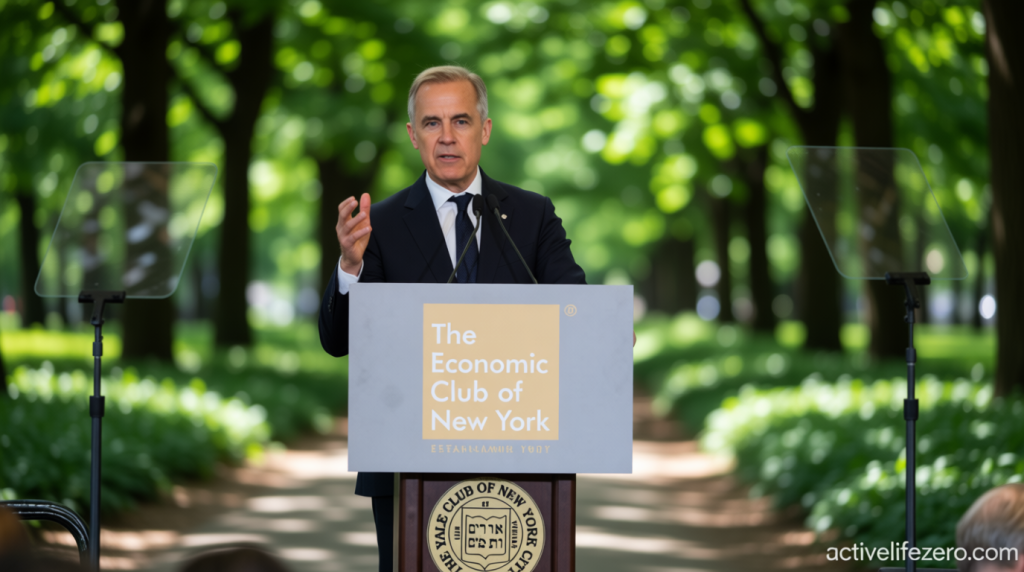
Carney seeks new US Canada partnership – Canadian Prime Minister Mark Carney emphasized the need for a renewed bilateral relationship with the United States during a speech in New York on Thursday, framing the initiative as a means to “help make America great again.” The remarks came amid shifting global economic dynamics and a reevaluation of North American trade ties. Carney highlighted how the U.S. is recalibrating its commercial alliances, describing the current period as one of “rupture” that demands closer collaboration between Canada and its northern neighbor.
Trade Dynamics and Strategic Shifts
According to Carney, the transformation of U.S. trade policies has created opportunities for Canada to deepen its involvement in key sectors such as aluminum production, automotive manufacturing, and the extraction of critical minerals. These industries, he argued, are vital for both nations’ economic resilience, especially as global markets become increasingly volatile. While the U.S. has been engaged in a trade war with several partners, Carney expressed confidence that strengthening ties with Canada would provide a stable foundation for mutual growth.
The prime minister also outlined a commitment to expanding Canada’s export capabilities beyond the U.S., pledging to double its trade volume with other nations over the next decade. This strategy follows the signing of more than 20 economic and security agreements in the past year, which Carney described as a step toward diversifying Canada’s global footprint. These deals, spanning energy, technology, and defense, underscore Canada’s intent to reduce its reliance on any single market while reinforcing its strategic role in international commerce.
Global Trade Rethinking and Bilateral Tensions
At the same time, U.S. trade officials were convening in Mexico City to negotiate revisions to the US-Mexico-Canada Agreement (USMCA), a pact that has become a focal point of North American economic diplomacy. Carney noted that Canada’s inclusion in these discussions is currently on hold, reflecting the complex interplay of regional interests and U.S. priorities. Despite this, he stressed that Canada’s independence in trade and industry positions it to act as a more reliable partner, especially as the U.S. moves to prioritize its own economic goals.
Carney’s remarks on the U.S.-Canada relationship took on a sharper edge when he referenced President Donald Trump’s assertion that the United States might annex Canada as the 51st state. “Weaknesses we must correct,” he said, highlighting the need for Canada to assert itself in the face of U.S. assertiveness. The shift in trade dynamics, he added, has led the U.S. to adopt a more protectionist stance, raising tariffs to levels last seen during the Great Depression. This has forced Canada to rethink its approach to economic integration, balancing its alliances while safeguarding its interests.
Davos Insights and Power Realignment
In January, Carney addressed the World Economic Forum in Davos, Switzerland, where he criticized the dominance of American hegemony in global economic systems. He warned that the overreliance on major powers has left countries like Canada vulnerable to exploitation, urging middle powers to unite and assert their influence. “If we’re not at the table, we’re on the menu,” he remarked, emphasizing the importance of collective action in shaping international frameworks.
The speech at Davos was part of a broader effort to redefine Canada’s role in the global economy. Carney argued that the U.S. needs to work more collaboratively with Canada and other allies to stabilize trade and address shared challenges. This sentiment is particularly relevant as the global energy crisis intensifies, with Canada positioned to supply the U.S. with critical resources and reliable energy infrastructure. “At a time of a global energy crisis, Canada provides the United States with the reliable power and critical minerals that help fuel American growth,” he stated, underscoring the strategic value of Canadian exports.
Military Procurement Shift and Diplomatic Tone
Carney’s recent announcement of Canada’s plan to acquire a fleet of military aircraft from Sweden signals a departure from its historical dependence on U.S. defense manufacturers. This move, he explained, is a calculated effort to strengthen national security while promoting diversification in key industries. The decision reflects a broader trend of Canada seeking to balance its economic and strategic relationships, ensuring that no single partner dominates its interests.
Despite this pivot, Carney adopted a more conciliatory tone in New York, praising the United States as “the most dynamic, resilient and inventive country the world has ever known.” He reaffirmed the foundational values of the U.S.—liberty, democracy, justice, and openness—as guiding principles for its future and that of the global community. This contrast between strategic pragmatism and diplomatic optimism highlights the prime minister’s dual focus on forging alliances and asserting Canada’s autonomy.
China Engagement and Global Monetary Leadership
Carney’s recent visit to Beijing to meet Chinese President Xi Jinping marked a significant step in recalibrating Canada’s relationship with China. He described the talks as achieving “a very basic reset of the relationship,” which he said had deteriorated under his predecessor, former Prime Minister Justin Trudeau. During the meeting, Carney conveyed that China must take on greater responsibility for the global financial system, particularly in its role as a leader in monetary policy and international trade.
“They need to work more rapidly and more deliberately on it,” Carney said, adding that Canada is ready to support China’s transition from a peripheral player to a central force in global economics. This statement aligns with Canada’s broader strategy to engage with rising powers while maintaining its traditional alliances. By addressing China’s economic ambitions, Carney aims to position Canada as a key mediator in the evolving balance of power between the U.S. and other emerging economies.
“Help make America great again”
Carney’s call for a “new partnership” with the U.S. is rooted in the belief that both nations can thrive together by addressing shared challenges and leveraging their complementary strengths. While the U.S. has shifted toward protectionism, Canada’s commitment to exporting more than 20 billion dollars worth of goods annually in recent years demonstrates its economic resilience. The prime minister’s vision for collaboration extends beyond immediate trade needs, aiming to establish a framework for long-term stability and innovation.
As the world grapples with economic uncertainty, Carney’s emphasis on partnership and adaptability positions Canada as a proactive leader. His speeches and policy decisions reflect a strategic recalibration of Canada’s international role, balancing its historical ties with the U.S. while embracing new opportunities with other global players. This approach not only reinforces Canada’s economic independence but also ensures its continued relevance in shaping the future of international trade and cooperation.
In a rapidly changing geopolitical landscape, Carney’s message is clear: Canada must navigate its relationships with both caution and confidence. By redefining its role in the global economy, the country aims to secure its position as a reliable partner and a key player in the 21st-century world order. Whether through trade agreements, military procurement, or diplomatic engagement, Carney’s efforts underscore Canada’s commitment to forging a path that aligns with its national interests while contributing to global stability.
