
Saying ‘screw you’ through architecture: America’s spite houses
Saying ‘Screw You’ Through Architecture: America’s Spite Houses
Saying screw you through architecture – Aaron Jackson found himself at a pivotal moment in 2012 after stumbling upon the Westboro Baptist Church while exploring Google Earth. Living in New York City and working for a nonprofit, he had been stranded in his modest Queens apartment following Superstorm Sandy. With nothing better to do, he delved into internet rabbit holes, eventually encountering the controversial group known for its anti-LGBTQ+ protests. The first image that caught his attention was the church’s location in a quiet Topeka neighborhood. Curious, he switched to a 360-degree view and noticed a “for sale” sign outside the building. The idea struck him: what if he purchased that house? Though the specific property had already been sold, Jackson spotted another on the same street and decided to go ahead with the purchase, never having seen it in person.
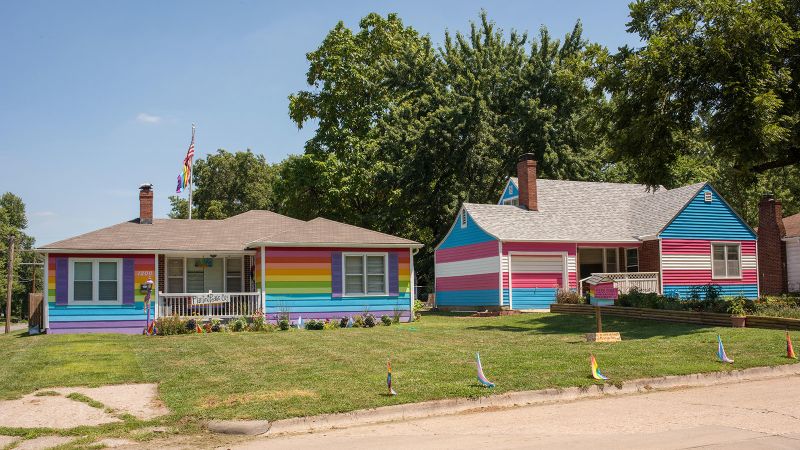
His move to Topeka marked the beginning of a bold statement. Jackson, who identifies as a “news junkie,” chose to live in a house directly opposite the Westboro Baptist Church. The location was intentional, but he had no plans to simply reside there. Instead, he painted the exterior in vibrant rainbow stripes, transforming it into a visual representation of the Pride flag. The act was not just a decoration—it was a deliberate act of defiance, a form of protest tailored for the digital age. The house, now dubbed the Equality House, became a symbol of resistance against the church’s hate-driven rhetoric, its colors glaringly visible from the windows of the neighboring congregation.
“The Equality House is a symbol of compassion, peace, and positive change,” the organization’s website says.
Despite his enthusiasm, Jackson anticipated the reaction would be fleeting. He assumed people would see the photo, chuckle, and move on. But the opposite occurred. The house quickly became a focal point of attention, drawing visitors eager to witness the confrontation. Topeka’s strategic position along I-70, a major east-west highway, meant the Equality House was not just a local curiosity but a visible landmark for travelers. Its proximity to the Westboro Baptist Church amplified its impact, turning it into a cultural touchstone.
Years later, Jackson expanded his mission by acquiring a second home on the same street. This time, he opted for pink, white, and blue stripes, echoing the trans pride flag. The decision was both symbolic and strategic, reinforcing his message of inclusivity. While he doesn’t label the Equality House as a “spite” house, many argue its presence was a calculated provocation. The term “spite architecture” itself suggests a purposeful design to annoy or challenge someone specific, a concept that has taken root in American cities.
The History of Spite Architecture
Spite architecture is a unique phenomenon, rooted in the American tradition of private property and individualism. Unlike “nail houses,” which are often associated with owners holding out for better prices or refusing to sell to developers, spite houses are built with a clear intent to irritate a particular group or individual. The most famous example is Boston’s “Skinny House,” a narrow, four-story structure that blocks sunlight and views from a grand mansion across the street. The tale dates back to the 19th century, when two brothers owned adjacent plots. One constructed a lavish home for himself, while the other, returning from the Civil War, built a slim tower to assert his claim over the smaller portion of land. The result? A structure that became both a historical curiosity and a tourist spot, now labeled as a “spite house” on Google Maps.
The Skinny House’s story illustrates how spite architecture can transform from a personal feud into a public spectacle. While its sale price in 2021 reached $1.25 million, the house’s symbolic value far outweighs its monetary worth. Visitors often pose with arms stretched between the two buildings, a gesture that underscores the tension between the mansion and the narrow tower. Yet, the act of building a spite house is not limited to historical conflicts. In modern times, it has evolved into a form of social commentary, often driven by political or ideological motives. Jackson’s project in Topeka is a contemporary example, blending activism with architectural expression.
The Debate Over Hostile Architecture
While the Equality House and the Skinny House are standout examples, the broader debate about hostile architecture continues. Critics argue that such structures are not just about provocation but about systematically excluding people or groups from public spaces. The term “hostile architecture” has gained traction in discussions about urban design, where elements like benches with curved backs or narrow pathways are used to deter certain behaviors. However, the concept of spite houses adds a personal dimension to this debate, highlighting how architecture can be wielded as a weapon of psychological warfare.
Although Jackson’s initiative was motivated by compassion, the location of his homes made their purpose undeniable. Facing the Westboro Baptist Church, the Equality House was not just a home but a front-row seat for conflict. The irony is that in a city where private property rights are fiercely protected, the act of building a spite house becomes an audacious statement. It challenges the notion of ownership as a passive right, instead framing it as a tool for activism or retaliation.
Today, the term “spite house” is used to describe a range of structures, from the eccentric to the intentionally provocative. In Topeka, Jackson’s homes have become landmarks, drawing both admiration and controversy. The question remains: does architecture designed to annoy or exclude others serve a greater purpose, or does it simply highlight the divisive nature of human interactions? As the Equality House stands defiantly in the shadow of the Westboro Baptist Church, it raises questions about how space, design, and symbolism intersect to shape societal attitudes. Whether seen as a symbol of hope or a case of architectural aggression, the story of Jackson’s spite houses is a testament to the power of design in both provoking and inspiring change.
While the United States is home to many examples of spite architecture, the concept has global roots. From narrow towers to strategically placed structures, these homes reflect the human urge to assert dominance over space. In a world where architecture often serves as a silent language, the Equality House and its counterparts remind us that buildings can be more than shelters—they can be statements, protests, and even battlegrounds. As the debate over hostile architecture continues, one thing remains certain: the way we design our spaces shapes the way we live in them, and sometimes, it’s the very act of building that speaks the loudest.
