
Beloved British artist David Hockney dies at 88
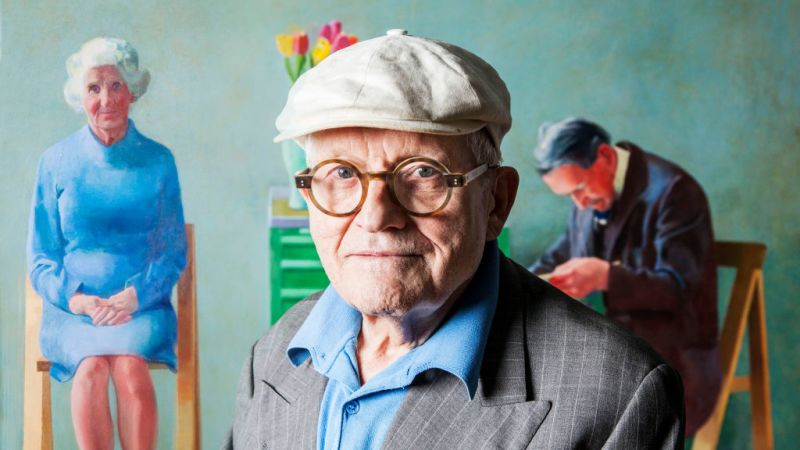
Renowned British Artist David Hockney Passes Away at 88
Beloved British artist David Hockney dies – David Hockney, the celebrated British painter whose bold, colorful portrayals of everyday life and striking portraits left an indelible mark on the art world, has passed away at the age of 88. The announcement came via a statement from his longtime publicist, Erica Bolton, who revealed that Hockney died “peacefully at home” on Thursday, just one month before his 89th birthday. His death marks the end of a remarkable career spanning decades, during which he redefined modern art with his innovative approach and unapologetic creativity.
Early Life and Artistic Beginnings
Born in Bradford, England, in 1937, Hockney’s artistic journey began in his childhood, shaped by a deep connection to the visual world. He studied at his local art school, where he first honed his skills, before moving to London to attend the Royal College of Art. This prestigious institution became the launching pad for his career, where he quickly gained recognition for his fresh perspective and technical prowess. Though he initially found success in the UK, Hockney’s ambitions led him to relocate to Los Angeles in the 1960s, a decision that would transform his creative trajectory.
Pop Art and the American Scene
Upon arriving in Los Angeles, Hockney immersed himself in the vibrant cultural landscape of the West Coast, eventually settling there permanently. His work during this period, particularly in the 1960s, positioned him as a pivotal figure in the Pop Art movement. While contemporaries like Andy Warhol focused on mass production and consumer culture, Hockney brought a personal touch to his art, often centering his creations on intimate moments and the human experience. His ability to blend bright hues with dynamic lines set him apart, offering a visual narrative that felt both lively and deeply rooted in reality.
Hockney’s early works, such as his vivid depictions of friends and lovers, showcased a fascination with human connection and the subtleties of daily life. He was unafraid to explore themes of sexuality, portraying men showering or sitting together in candid, almost mundane scenes. These images, which combined wit with explicitness, reflected his openness about his identity as a gay man—a stance he adopted in his early 20s, during a time when homosexuality was still criminalized in England. This personal truth infused his art with a unique sense of vulnerability and authenticity.
Iconic Works and Commercial Success
Among Hockney’s most iconic pieces are the series of swimming pool paintings, which captured light and space in a way that seemed to pause time. These works, first created in the 1960s and 1970s, became emblematic of his ability to transform ordinary settings into extraordinary visual experiences. A notable example, “Portrait of an Artist (Pool with Two Figures),” fetched $90.3 million at auction in 2018, briefly holding the record for the most expensive artwork by a living artist. The painting’s value soared, yet Hockney remained untroubled by its financial success, prioritizing artistic expression over monetary gain.
His oeuvre extended far beyond painting, encompassing photography, printmaking, and even stage design for opera and ballet. In the 1980s, he experimented with photocollages, which merged photographs with hand-drawn elements to create layered, surreal compositions. Later in his career, his landscape paintings took on more abstract qualities, earning acclaim for their bold use of color and spatial innovation. Despite the commercial value of his works, Hockney often joked about the price he received for some of his most celebrated pieces. For instance, his groundbreaking pool painting, “Pool,” was sold by his New York dealer for just $18,000 in 1972—a figure that seemed surprisingly modest at the time.
Artistic Innovation and Digital Expansion
Even as his work gained international acclaim, Hockney never stopped experimenting. By the 2010s, he had embraced digital tools, using an iPad to create art that blended traditional techniques with modern technology. During the Covid-19 pandemic, he spent time in Normandy, France, where he produced a series of digital renderings of the surrounding countryside. These works, later printed and displayed at venues such as London’s Royal Academy and the de Young Museum in San Francisco, demonstrated his adaptability and continued relevance in an ever-evolving art world.
Throughout his life, Hockney maintained a prolific work ethic. In 2017, during a visit to his California studio, the then-80-year-old artist spoke about his daily routine, revealing that he painted for six to seven hours each day. “I’m perfectly happy doing this,” he said, adding, “I feel 30 when I’m in the studio, so I come in every day and work, because then I feel 30.” This quote encapsulates his enduring passion for creation, which remained undiminished by age or fame.
Legacy and Recognition
Hockney’s contributions to the arts were widely acknowledged, earning him numerous honors. He was a member of the Royal Academy, a testament to his stature in the art community. In addition to the John Moores Painting Prize and the Japan Art Association’s Praemium Imperiale, he received accolades for his ability to challenge conventions and inspire new generations of artists. Despite famously declining a knighthood, he accepted Queen Elizabeth II’s invitation to the Order of Merit in 2012, a distinction reserved for no more than 24 elite figures in various fields.
His influence extended beyond galleries and museums, reaching into the broader cultural sphere. Retrospectives of his work, such as the 2017 exhibition that traveled across London, Paris, and New York, highlighted his diverse output and lasting impact. Tate Britain director Alex Farquharson praised Hockney’s “endless inventiveness,” noting how his art “taught us about the joy of looking, seeing things the rest of us failed to notice.” This sentiment reflects the depth of his creative vision, which balanced technical mastery with emotional resonance.
Timeless Influence and Enduring Inspiration
Even in his later years, Hockney’s work remained a source of inspiration. His ability to capture the essence of a moment—whether through a portrait, a landscape, or a digital piece—ensured that his legacy would endure. From his early days as a student in Bradford to his twilight years in California, he consistently pushed boundaries, challenging the notion that art must adhere to a single medium or style. His studio, filled with sketches and canvases, stood as a testament to his relentless curiosity and dedication to his craft.
Hockney’s personal life, too, became a subject of fascination. His affection for his dachshunds Stanley and Boodgie, whom he immortalized in a series of paintings and a book, revealed a softer side to his otherwise bold and experimental approach. These domestic scenes, often playful and intimate, added another layer to his artistic repertoire, showing how he wove his personal experiences into his broader creative narrative. As the world mourns his passing, the legacy of his work continues to shape the landscape of contemporary art, reminding us of the power of vision, innovation, and the human spirit.
“I feel 30 when I’m in the studio, so I come in every day and work, because then I feel 30.”
This quote from Hockney in 2017 underscores his belief in the transformative power of art. For him, the act of creation was not just a profession but a way to connect with life’s fleeting beauty. His ability to distill complex emotions and ideas into visual form, whether through brushstrokes or digital tools, ensures that his work will continue to resonate with audiences for years to come. As the art world honors his contributions, the memory of David Hockney lives on in every brushstroke, every photograph, and every story he told through his art.
