
Morocco beats World Cup co-host Canada 3-0 to make it to the quarterfinals
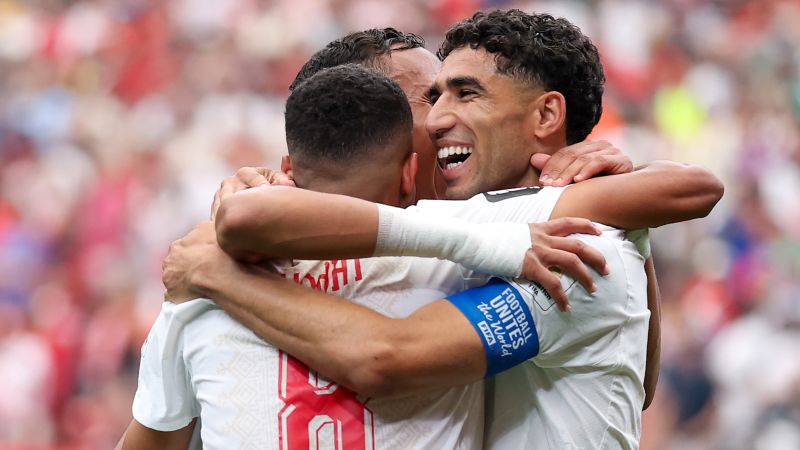
Atlas Lions Advance to Quarterfinals with Dominant 3-0 Victory Over Canada
World Cup Match in Houston Sparks Debate Over Tactical Adjustments
Morocco beats World Cup co host – At the 2026 FIFA World Cup, Morocco secured a commanding 3-0 win against Canada in Houston on Saturday, becoming the first team to reach the quarterfinals. The Atlas Lions’ decisive performance was anchored by Azzedine Ounahi, whose two goals in the 50th and 82nd minutes proved pivotal, while Soufiane Rahimi added the final tally in the closing stages. This victory sets up a high-stakes clash against the winner of France and Paraguay at Foxborough’s Gillette Stadium on Thursday.
Morocco’s triumph underscores their remarkable consistency in global competitions. The team has previously reached the semifinals in the 2022 World Cup and was controversially crowned African champions earlier this year. Their ability to maintain momentum under pressure has positioned them as a formidable force in this edition of the tournament. However, Canada’s performance raised questions about their strategy, as they dominated early play but struggled to capitalize on key opportunities.
To many, the result would seem a bit unfair to Canada as it seemed to be holding the reins for much of the contest, though as many aficionados of the Beautiful Game can attest, domination of a game – but failing to convert your chances – can sometimes result in the most painful of losses.
Despite missing star forward Alphonso Davies, who started the match on the bench, Canada began with intensity, pressing Morocco effectively and creating several threats in the first 15 minutes. A notable moment came in the 11th minute when Tani Oluwaseyi, the Villarreal attacker, broke free after a high press by Les Rouges. His shot was met by a stunning save from Morocco’s Yassine Bounou, who denied Canada an early lead. This display of composure from the goalkeeper highlighted Morocco’s defensive resilience.
The momentum shifted dramatically in the 23rd minute when Ismael Saibari, Morocco’s key midfielder who recently joined Bayern Munich, left the field injured with what appeared to be a hamstring issue. The absence of their playmaker disrupted their rhythm, forcing tactical adjustments. The hydration break provided temporary relief, allowing Morocco to regroup, but their initial attempt in the 29th minute was easily repelled by Maxime Crepeau, Canada’s goalkeeper.
The game’s tempo remained tense until the 39th minute, when Achraf Hakimi’s challenge on Richie Laryea resulted in a yellow card for both players. This incident seemed to galvanize Morocco, as they began to dominate possession and create more dangerous chances. Meanwhile, Canada’s Bilal El Khannouss received a caution in the first half, marking the fourth Moroccan player and sixth overall in the match to be booked, which added to the host nation’s frustrations.
In the second half, Canada resumed control, pressing Morocco with vigor and maintaining their attacking threat. A pivotal moment arrived when Morocco’s Luc De Fougerolles was booked for a cynical challenge on Tajon Buchanan, granting Canada a free kick near the edge of the box. Jonathan David’s effort from the set piece sailed just wide, preserving the scoreline. However, the game took a dramatic turn in the 76th minute when Stephen Eustáquio was fouled outside the box, offering Canada a chance to level the match. Buchanan’s swerving shot forced a fine save from Bounou, keeping Morocco’s lead intact.
Morocco’s breakthrough came in the 82nd minute through a clinical counterattack. Brahim Díaz, the Real Madrid star, maneuvered past two defenders on the right flank before delivering a precise cross to Ounahi, who coolly finished his brace. The goal sparked a renewed intensity in the Atlas Lions, who continued to press. In the final minutes, Rahimi’s header on the break clanged off the crossbar, narrowly missing the goal line and leaving fans on the edge of their seats.
The victory solidified Morocco’s position as a top-tier team, with their attacking flair and defensive organization proving too much for Canada. Despite the host nation’s early dominance, Morocco’s ability to adapt and exploit gaps in Canada’s defense showcased their tactical acumen. The performance also highlighted the importance of key players like Ounahi and Rahimi, whose contributions were critical in securing the win.
For Canada, the loss marked a missed opportunity to make a strong statement in the tournament. Their efforts to control the game were evident, yet they faltered in converting chances, a pattern seen in previous major competitions. The injury to Saibari and the disciplinary issues in the first half may have impacted their ability to sustain pressure, but their resilience in the second half demonstrated their potential.
The match also brought attention to the refereeing decisions, with Michael Oliver’s call on the offside incident during the penalty appeal drawing mixed reactions. While Canada’s supporters felt the decision was harsh, it ultimately allowed Morocco to maintain their lead. The Atlas Lions’ ability to remain composed under such circumstances is a testament to their maturity on the international stage.
As the World Cup progresses, Morocco’s path to the quarterfinals has set the stage for an exciting showdown. The team’s blend of technical skill and tactical discipline positions them as a strong contender for the final. Meanwhile, Canada’s campaign continues, with their performance against Morocco serving as a learning experience for future matches. The result has already sparked discussions about the tournament’s competitiveness and the evolving dynamics of group stages.
The victory in Houston is a significant milestone for Morocco, reaffirming their status as a powerhouse in world football. Their ability to overcome challenges, both on and off the field, highlights the depth of their squad and the quality of their coaching. For Canada, the defeat is a reminder that success in major tournaments requires not just talent, but the ability to translate dominance into goals. As the quarterfinals approach, the Atlas Lions will aim to build on this momentum, while the rest of the competition continues to unfold with high intensity.
