
Zohran Mamdani sharply criticizes Democratic Party as he rallies with progressive challengers
Zohran Mamdani Challenges Democratic Establishment Amid Progressive Primary Push
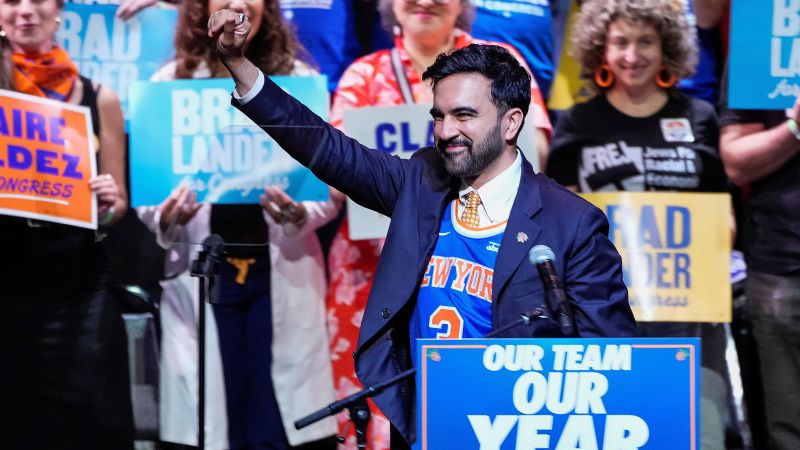
Zohran Mamdani sharply criticizes Democratic Party – On Thursday evening, New York City Mayor Zohran Mamdani delivered a pointed critique of the Democratic Party’s direction, standing alongside a group of progressive congressional candidates in Tuesday’s primaries. The event, held in the heart of Brooklyn’s Flatbush neighborhood, featured remarks from Vermont Senator Bernie Sanders, who lent his support to Mamdani’s agenda. With the upcoming 2028 presidential race already in focus, Mamdani framed the current election as a pivotal moment for the party’s future, warning of the consequences of clinging to outdated strategies.
A Bold Reckoning with Democratic Decline
Mamdani accused the party of viewing its role as steering the nation through decline rather than implementing tangible reforms for working-class communities. “For far too long, our party has seen its job as managing decline instead of delivering material change for working people,” he stated during the rally. This sentiment underscores his frustration with the Democratic establishment’s inability to unite behind progressive policies. “It has seen its job as explaining why we cannot instead of showing how we can, and that old way of thinking will lose on Tuesday. And frankly, it will lose in South Carolina and New Hampshire. It will fall short of 270 electoral votes, because the party of the past will not be what leads us into the future,” he added.
The mayor’s remarks reflect a broader theme in his political career: challenging the status quo. His anti-establishment campaign last year set a precedent for progressive movements, showcasing his willingness to confront traditional Democratic power structures. Now, six months into his mayoral tenure, Mamdani is testing his influence by endorsing three candidates in New York’s Democratic primaries. These individuals represent a shift toward left-leaning policies, targeting both incumbents and legacy figures within the party.
The Progressive Slate and Its Challenges
Mamdani’s slate includes Assemblymember Claire Valdez, who is vying for the seat currently held by retiring Rep. Nydia Velazquez. The other two candidates, Brad Lander and Darializa Avila Chevalier, face their own battles. Lander, a former city comptroller, aims to unseat Rep. Dan Goldman, while Chevalier, an educator and activist, targets Rep. Adriano Espaillat. Both Lander and Chevalier have drawn scrutiny over their social media activity. Chevalier, in particular, has faced questions regarding deleted posts that criticized Democratic leaders and her participation in a pro-Palestinian rally following Hamas’ October 7, 2023, attacks on Israel.
These challenges highlight the growing divide within the Democratic Party. Mamdani’s endorsement of Chevalier, despite her past criticisms of Democratic leaders, signals his commitment to ideological purity. “People often ask me what I think of the state of the Democratic Party. This slate here today is our answer,” he said during the rally. The mayor’s approach is not just about winning seats but redefining the party’s priorities, emphasizing grassroots mobilization over institutional compromise.
Confronting Power: Jeffries and the AIPAC Influence
In his speech, Mamdani directly addressed House Minority Leader Hakeem Jeffries, a Brooklyn-based Democrat who has endorsed both Rep. Dan Goldman and Rep. Adriano Espaillat. The mayor accused Jeffries of representing a faction within the party that prioritizes maintaining power over advancing progressive goals. “The mayor and I have agreed to strongly disagree as it relates to this particular race,” Jeffries told CNN’s Erin Burnett when asked about Mamdani’s support for Chevalier over Espaillat.
Mamdani also took aim at the American Israel Public Affairs Committee (AIPAC), a powerful lobbying group known for funding pro-Israel candidates. “They move millions in dark money to accomplish a single goal, to preserve their power, so that they can turn us against one another, instead of our leaders turning towards the moral change we all know to be necessary,” he said. The mayor criticized AIPAC’s strategy of using television ads to focus on domestic issues while downplaying foreign policy debates, arguing that this tactic distracts voters from the party’s core mission.
His remarks were especially sharp in addressing the committee’s role in recent congressional races. By allocating significant resources to pro-Israel campaigns, AIPAC has been accused of undermining progressive candidates who advocate for a more left-leaning foreign policy. Mamdani’s critique aligns with broader concerns within the progressive movement about the influence of institutional donors on electoral outcomes. “When does the race for 2028 begin?” he asked, adding, “It starts now. It starts on Tuesday.” This statement underscores his belief that the current election is a litmus test for the party’s ability to evolve.
A Test of Political Influence and Ideological Unity
As a 34-year-old democratic socialist, Mamdani has positioned himself as a leader capable of galvanizing younger voters and marginalized communities. His endorsement of Valdez, Lander, and Chevalier represents a strategic move to consolidate progressive forces in New York. The mayor’s political influence is being measured by how effectively his candidates can challenge established figures, reflecting the broader ambition of reshaping the Democratic Party’s identity.
Valdez, a Queens representative, brings a focus on economic equity and healthcare access to the race. Lander, with his experience in city governance, advocates for bold fiscal reforms and climate action. Chevalier, meanwhile, emphasizes immigrant rights and social justice, framing her campaign as a continuation of the movement’s fight for inclusivity. Together, these candidates embody Mamdani’s vision of a Democratic Party that prioritizes the needs of working people over the interests of centrist donors.
The rally in Kings Theatre was a key event for Mamdani, as he sought to rally support for his candidates while reinforcing his message of transformation. His sharp rhetoric and clear calls for action have resonated with many in the progressive base, but they also risk alienating moderate Democrats. The mayor’s ability to balance these tensions will determine the success of his broader strategy. “Our party must stop seeing itself as a vessel for decline and start delivering real change,” he asserted, a statement that encapsulates his core argument.
With the 2028 presidential race already in motion, Mamdani’s critique of the Democratic Party is part of a larger effort to build momentum for a new era of politics. His focus on unity, accountability, and bold policy shifts highlights the challenges facing the party as it navigates a rapidly changing political landscape. The upcoming primaries will serve as a critical barometer for the viability of his vision, and the results could signal a significant realignment within the Democratic fold.
As the election approaches, Mamdani’s rhetoric continues to shape the narrative around the party’s future. His call for material change, combined with his targeted endorsements, has positioned him as a formidable force in the progressive movement. While critics argue that his approach may be too radical, supporters see it as necessary for reclaiming the party’s moral compass. The mayor’s message is clear: the Democratic Party must evolve, or it will be left behind in the next chapter of American politics.
