
Trump claims vandals will force drainage of algae-plagued Reflecting Pool
Trump Accuses Vandals of Damaging Algae-Infested Reflecting Pool
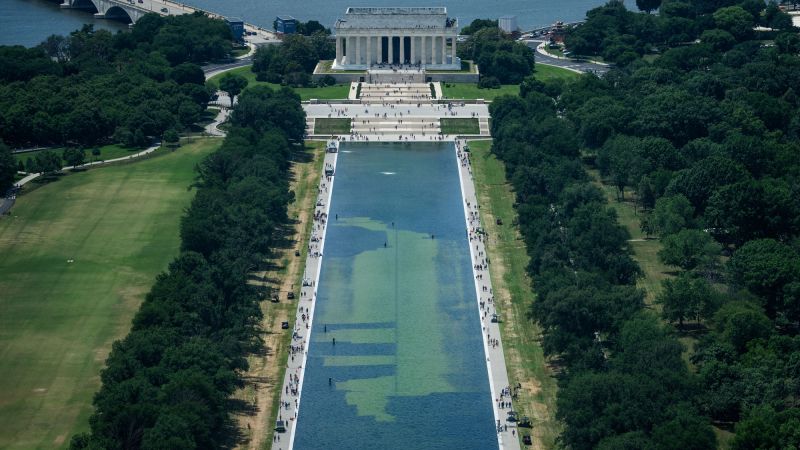
Trump claims vandals will force drainage – President Donald Trump stirred controversy on Saturday by asserting that vandals had disrupted the algae-ridden Reflecting Pool at the Lincoln Memorial, claiming the water would need to be drained to address the damage. However, Trump offered no evidence to back his allegations, leaving questions about the extent of the vandalism and its connection to the pool’s ongoing ecological issues. The pool, a historic feature on Washington, D.C.’s National Mall, has become a focal point of public debate, with its condition reflecting broader tensions over the president’s efforts to revitalize the city’s landmarks.
The Accusation
Trump’s claim emerged as part of his ongoing campaign to present the Lincoln Memorial as a pristine symbol of American heritage. He described the pool’s recent algae problem as a result of human interference, stating that “many additional people” had been arrested for damaging the structure. Yet, one individual, David Hearn, a three-time U.S. Olympian, told CNN he was merely investigating a piece of blue material that had partially detached from the pool’s bottom. Hearn’s account challenges Trump’s narrative, suggesting the alleged vandalism may have been a misunderstanding.
“After my bike ride, I saw a flap of blue material at the bottom of the pool. I reached in, felt the end, and bent it slightly,” Hearn said.
According to Hearn, the blue flap was part of the recent $14 million renovation project aimed at restoring the pool’s original beauty. He explained that he had read reports about algae in the water and peeling sealant, prompting his curiosity. His actions, he said, were driven by a desire to understand the issue rather than cause harm. However, Trump’s statement framed Hearn’s behavior as deliberate destruction, casting doubt on the Olympic canoeist’s intentions.
The Olympic Canoeist’s Defense
Hearn, who has a background in material science, described his encounter with authorities as an overreaction. He said a National Park Service employee had warned him against reaching into the water, but his actions were meant to inspect the material, not damage it. After returning to his bike, he was approached by National Guard members and later taken into custody by the U.S. Park Police. Hearn was charged with destruction and defacing government property, as well as disobeying a park worker.
“There’s nothing about the pool that was different after I left than it was before I arrived. I didn’t remove anything. I didn’t break, tear, or peel anything,” Hearn said.
Despite his arrest, Hearn insisted his actions were those of a “curious citizen.” He is scheduled to appear in court on July 9, where he will have the opportunity to elaborate on his account. CNN has contacted the U.S. Park Police and the National Park Service for further clarification and details on other arrests linked to the incident.
The Renovation and Its Legacy
The Reflecting Pool, a century-old landmark near Abraham Lincoln’s statue, was the latest project in Trump’s ambitious plan to enhance Washington, D.C. His $14 million renovation, completed earlier this year, included architectural updates such as a White House ballroom and the restoration of several deteriorating fountains. However, the pool’s condition has instead become a symbol of the challenges facing such efforts. Originally intended to mark the city’s upcoming 250th anniversary, the project now draws attention for the wrong reasons.
Trump had previously criticized the Biden administration for failing to address the pool’s algae problem, which he attributed to neglect. During a post on his social media platform, Truth Social, he vowed to “clean up the landmark and make it look gorgeous, beautiful” to reflect the surrounding monuments. Yet, as the Fourth of July and the nation’s 250th anniversary approach, the pool has taken on a new role as a stage for public dissent.
Public Reaction and the Spectacle
Visitors and locals have flooded the Reflecting Pool in recent days, documenting the murky green water on social media. Some posts feature the pool as a backdrop for criticisms of Trump’s leadership, while others celebrate the efforts to restore it. A few individuals have even peeled strips of the blue material—part of the renovation—taking them as souvenirs. Federal workers, meanwhile, have been seen pouring hydrogen peroxide into the water, a step that has sparked both admiration and skepticism.
The Interior Department, which oversees the pool, has dismissed the algae as a minor issue, stating that the water is “crystal clear” in its latest update on X. This contradicts Trump’s assertion that the algae had reached “75% gone” by the time of his claims. The department’s spokesperson, in a Wednesday post, highlighted the progress made in clearing the algae, suggesting that the problem was manageable without draining the pool.
Broader Implications
Trump’s focus on the pool’s condition has reignited discussions about the effectiveness of his beautification initiatives. While he had previously criticized the Obama administration for leaving the pool in disrepair, the current situation has exposed the complexities of maintaining such a historic site. The algae, a natural consequence of the pool’s ecosystem and warm weather, has become a metaphor for the divisions within Trump’s own administration and the public’s mixed reactions to his vision for Washington.
The controversy also extends to the etching of “8647” into the grass on the National Mall, which Trump tied to the pool’s vandalism. He argued that these incidents, along with others, were part of a larger pattern of destruction. However, critics suggest that the focus on vandals may serve as a distraction from the pool’s maintenance challenges. The algae, they argue, is a result of environmental factors and the project’s timeline, not deliberate harm.
As the debate continues, the Reflecting Pool stands as a testament to the political and cultural significance of public spaces. What was meant to be a straightforward restoration has transformed into a public spectacle, highlighting the role of media and social platforms in shaping narratives around urban renewal. Whether the pool’s condition will improve before the 250th anniversary remains uncertain, but its current state is sure to remain a talking point for years to come.
