
Trump arch moves ahead — but monument loses eight feet and four lions
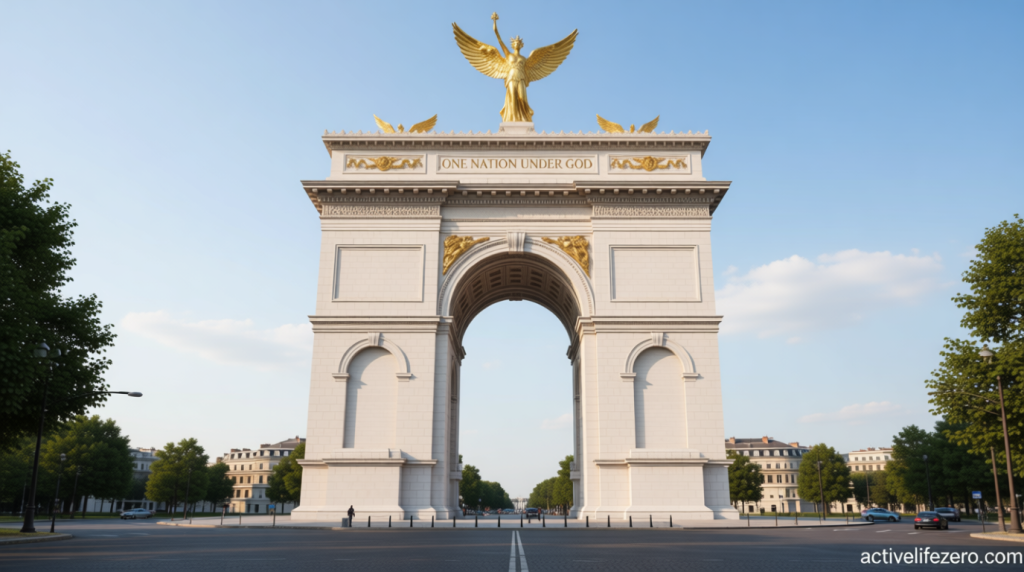
Trump Arch Moves Ahead — But Monument Loses Eight Feet and Four Lions
Trump arch moves ahead – President Donald Trump’s ambitious plan for the nation’s tallest arch gained momentum on Thursday as a key federal agency gave its nod to a revised version of the design. However, the structure, which had once promised to rise over 280 feet, now stands at more than 270 feet. The reduction in height stems from the removal of an eight-foot-tall base that was part of the initial proposal. This base, which would have added to the monument’s stature, has been eliminated, altering the visual profile of the arch.
Alongside the height adjustment, four gold lions that originally graced the base’s sides have also been axed. These lions, once a prominent feature, are being removed due to their foreign origin, as the Commission of Fine Arts (CFA) argued they are “not native to the United States.” The change, while controversial, was welcomed by some members of the CFA, who saw it as a step toward harmonizing the monument’s appearance with the solemnity of Arlington National Cemetery, which borders the proposed site.
Public Backlash and Expedited Approval
The decision to proceed with the revised design came despite a wave of public criticism. Critics, including historians and preservationists, have called the project a departure from traditional American aesthetics. The approval process, according to a source with knowledge of the internal discussions, was pushed through “at unprecedented speed, except for the White House ballroom.” This rapid movement has sparked debates about transparency and the influence of political allies within the CFA.
“The project was approved with remarkable haste, even as the public expressed widespread concerns,” said the source, highlighting the urgency with which the administration sought to finalize the design.
President Trump, however, expressed satisfaction with the outcome, calling the approved version “beautiful” during a press briefing. The CFA, which has historically been a gatekeeper for monuments and memorials, had already cleared preliminary designs. This time, the final iteration included granite as the primary material for the arch’s exterior, a choice favored for its strength and durability over marble, which had been a contender in earlier discussions.
The revised design also saw an increase in the arch’s width, though this adjustment was less prominent in public discourse. Mary Anne Carter, a member of the CFA, defended the changes, stating that the removal of the lions and the base would better align the monument with its surroundings. “Simplifying the design allows it to integrate more smoothly with the existing markers at Arlington,” she remarked, underscoring the committee’s focus on visual coherence.
Design Controversies and Architectural Tensions
James McCrery, the architect Trump had initially hired to construct a White House ballroom, raised concerns about the towering winged Lady Liberty figure that crowns the arch. McCrery, now a CFA member, had previously critiqued the figure’s proportions, deeming it out of place in the nation’s capital. Yet, these objections were dismissed by the administration, which maintained that the final decision rested with the commission.
“The president reviewed the sculptural details but chose not to challenge the design, acknowledging the differing opinions on aesthetics,” said an Interior Department official, representing the administration’s stance.
The arch, modeled after Paris’ Arc de Triomphe, is part of Trump’s broader vision to reshape the cultural landscape of Washington, D.C. This includes a sculpture garden honoring American heroes along the Potomac River, a rebranding of the Kennedy Center with his name, and even plans to dye the waters of the Lincoln Memorial Reflecting Pool. These projects, like the arch, are intended to symbolize a new era of American monumentality, though they have drawn mixed reactions from critics.
Location and Safety Concerns
The arch’s placement in the traffic circle between Arlington National Cemetery and the Lincoln Memorial has been a focal point of contention. While the CFA praised the site’s historical significance, some argue the location is symbolic but not practical. The monument’s proximity to Ronald Reagan Washington National Airport, less than two miles away, has raised safety concerns. With the arch’s height now standing at 270 feet, it could pose challenges for air traffic, particularly in an already congested airspace.
CNN previously reported that the Department of the Interior has requested a formal aeronautical study from the Federal Aviation Administration (FAA) to assess the arch’s potential impact on flights. This study, combined with public concerns about the monument’s scale, has added another layer of scrutiny to the project. The CFA acknowledged that the public has voiced over 600 comments since the last round of feedback, with 99.5% of them critical of the design.
Next Steps and Legal Challenges
With the CFA’s approval, the arch must now secure final approval from the National Capital Planning Commission (NCPC). Like the CFA, the NCPC has been influenced by Trump appointees, raising questions about the independence of the review process. The NCPC’s endorsement will be crucial for moving the project forward, as it oversees major development proposals in the capital region.
Meanwhile, the arch faces a legal challenge from a Vietnam War veterans’ group. The group argues that the monument’s scale and placement could detract from the dignity of the surrounding memorials, including the Lincoln Memorial. Their lawsuit, set to be filed on Thursday, adds a new dimension to the debate over the project’s impact on national heritage.
Despite these obstacles, the Trump administration remains committed to the arch’s realization. The structure is slated to commemorate the nation’s 250th anniversary in July, a timeline that has been used to justify its urgency. However, the controversy surrounding its design and approval process has underscored the challenges of balancing political ambition with public and artistic input.
The revised design, while a step closer to completion, still leaves room for further adjustments. As the NCPC deliberates, the arch’s fate will depend on whether its supporters can address the concerns raised by critics. For now, the project stands as a testament to Trump’s determination to leave a lasting mark on Washington’s skyline, even as its artistic and functional merits remain under scrutiny.
