Supreme Court temporarily allows construction of White House ballroom to continue

Daftar Isi
White House Ballroom Construction Gets Temporary Green Light from Supreme Court
Activelifezero.com – Construction crews hammering away at the White House grounds can keep swinging their tools. On Friday afternoon, the Supreme Court issued a brief administrative order that temporarily froze a lower-court mandate requiring the massive ballroom project to halt at midnight. The decision, handed down by Chief Justice John Roberts in his capacity as the justice who handles emergency petitions from the D.C. Circuit Court of Appeals, stops the clock on a ruling that would have shuttered the site within hours. It does not, however, declare the project lawful or unlawful. What it does is buy the nine justices time to weigh whether to pause the adverse rulings indefinitely at the president’s request.
A Stay Without a Vote, Without a Reason
Because the order was processed as a single-justice administrative stay, it carried no written reasoning, no vote tally, and no dissent. Roberts, who routinely manages urgent applications before the full bench convenes, simply paused the lower-court deadline. No new expiration date was attached. In practical terms, that means the ballroom work can proceed at the White House until the Court issues a further directive. Roberts is expected to circulate the matter to all nine justices for a full deliberation, at which point the question of whether the stay should be extended, modified, or dissolved will be put to a collective vote.
The Crew and the Clock
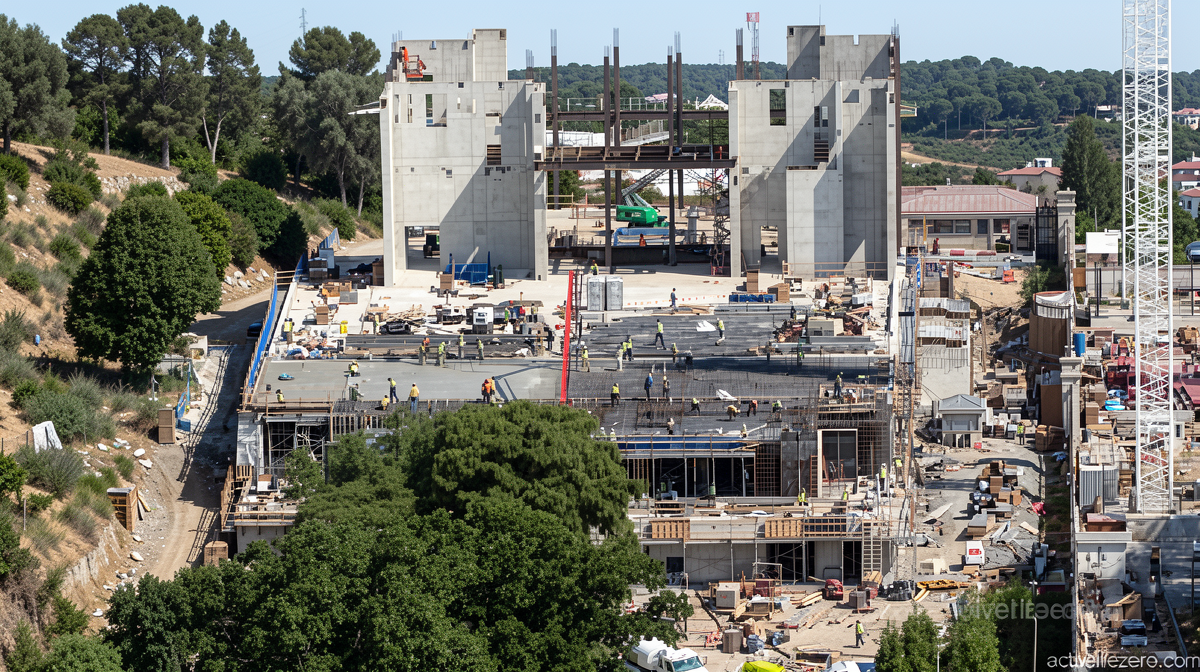
The pace of construction has been extraordinary. A filing submitted by the Trump administration to the Supreme Court described a workforce of roughly 250 laborers operating on 20-hour shifts, seven days a week. By the time the justices reviewed the petition, the government reported the ballroom complex stood at “65% complete in its entirety.” The scale of the undertaking dwarfs typical White House renovations and has drawn scrutiny from historians, architects, and members of Congress on both parties.
What the Lower Courts Said
Two federal courts have already concluded that the project, as currently pursued, lacks congressional authorization. The National Trust for Historic Preservation, the country’s leading preservation advocacy organization, filed suit in December of last year. A federal district judge in Washington, D.C., Richard Leon, sided with the Trust and ordered the president to cease ballroom work until Congress granted explicit authority to proceed. Leon did allow continued excavation of a sophisticated underground bunker beneath the planned event space, accepting the administration’s argument at that stage that the two structures were functionally separate.
As months passed, however, senior administration officials increasingly framed the entire above-ground structure as a national-security imperative, pointing to assassination attempts on the president’s life in recent years. The administration pressed its case before the D.C. Circuit Court of Appeals, seeking to overturn Leon’s injunction. In early August, a divided panel of three judges agreed with the district court and ordered that all work stop beginning August 21.
“Whether or not a massive ballroom should be constructed is for Congress to decide and is not a matter for Executive self-help,” the appeals court wrote in its 2-1 opinion. “The National Trust has shown, compellingly, that Congress has not ceded unfettered authority to the Executive Branch to dramatically redesign, reshape, and reconstruct the White House – the People’s House – to fit a particular President’s desires.”
The Administration’s Supreme Court Pitch
Days after the circuit ruling, the White House asked the Supreme Court to step in. Solicitor General D. John Sauer argued before the justices that the ballroom was justified by prior threats to the president’s life, by ongoing national-security requirements, and by what he characterized as architectural values. He framed the president’s role in unusually expansive terms:
“The President of the United States of America is not a tenant, but rather the sole, elected head of the Executive Branch, and Congress has authorized him to renovate, secure, and protect the White House and its grounds, as other Presidents have been allowed to do, without exception.”
A Project Rooted in Personal Ambition
Since returning to the White House last year, Trump — a former real-estate developer who spent decades designing and marketing large-scale commercial properties — has sought to reshape multiple elements of Washington to match his own aesthetic and functional preferences. The ballroom has been the most ambitious element of that program. Last year, the former White House East Wing was demolished to clear space for the new event complex, a move that provoked sharp criticism across the political spectrum. In August, the president described the finished project in superlative terms:
“This will be the greatest military complex slash ballroom anywhere in the world. There won’t be anything like it.”
Sources familiar with his thinking say the president regards the ballroom and associated construction as the cornerstone of his political legacy. He has recently suggested that officials and citizens who oppose the effort are “very disloyal to our country,” a remark that underscored how personally invested he is in the project’s completion.
The President’s Public Reaction
Following Friday’s order, Trump took to social media to celebrate what he called a vindication:
“We are grateful for the Decision of the United States Supreme Court. The Military/Ballroom Complex being built on the hallowed grounds of the White House, which is so vital for National Security, will be THE GREATEST OF ITS KIND! It is something that Presidents have wanted for 150 years, and that the Military has been seeking for the last 100 years. Their wish will soon be fulfilled! Construction is under budget and ahead of schedule.”
What Comes Next
The temporary stay leaves the central constitutional question unresolved: whether a president may, without specific congressional approval, undertake a project of this scale on the grounds of the executive mansion. The full Court will ultimately decide whether to extend the pause, let the lower-court injunction take effect, or craft some narrower remedy. Until then, the 250-person crew will continue its around-the-clock schedule, and the ballroom will inch closer to completion on the most watched construction site in American politics.
Related Reading
Frequently Asked Questions
What is Supreme Court temporarily allows construction of White?
Supreme Court temporarily allows construction of White is the main topic of this guide. The article explains the context, practical details, and next steps readers should understand.
Why does Supreme Court temporarily allows construction of White matter?
Supreme Court temporarily allows construction of White matters because readers are looking for a useful answer, not just a short summary. Good content should match search intent and help them decide what to do next.