
These drag queens have no time for culture wars
These Drag Queens Have No Time for Culture Wars
These drag queens have no time – In a world where cultural debates often dominate headlines, a new film titled Stop! That! Train! offers a refreshing escape. Directed by Adam Shankman, the movie centers on a group of drag queens who have no time for the noise of culture wars, instead focusing on their vibrant personalities and comedic antics. The film, which debuts this weekend with an R rating, is a whimsical mix of humor and absurdity, blending the effervescent energy of drag culture with slapstick comedy. Shankman, whose previous work includes Hairspray (2007) and A Walk to Remember (2002), admits the project initially felt like a kids’ movie—until the risqué double entendres took center stage. “I made a kids movie, sort of,” he said, “if it weren’t for the d**k jokes.” This contrast between innocence and edginess highlights the film’s unique position in the current media landscape.
“The movie is, from a humor standpoint, as politically free as you can be, and I did that intentionally,” said Shankman. “I wanted to create a comedy-forward experience. The fact that it features these drag artists is the most transgressive element, but it’s done with a lighthearted tone that makes it easy to enjoy without taking it too seriously.”
Despite its adult humor, Stop! That! Train! remains surprisingly accessible to a broad audience. This is especially notable in a climate where drag queens have frequently been portrayed as symbols of controversy, often framed as figures challenging traditional values. The film’s reliance on physical comedy, puns, and visual gags mirrors classic comedies like Airplane! (1980) and the Naked Gun series, which are known for their slapstick appeal. Unlike those earlier works, however, Stop! That! Train! avoids targeting race, religion, or even drag itself with its jokes. Instead, it celebrates the spectacle of its characters, providing a lighthearted retreat from the more heated discussions surrounding LGBTQ+ representation.
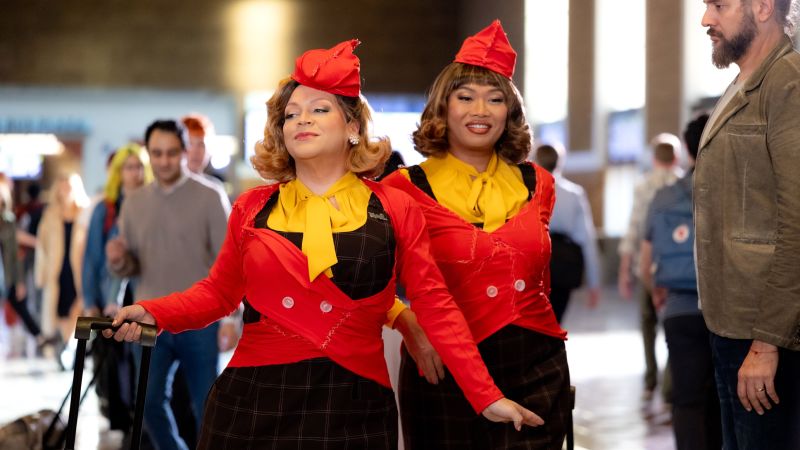
At the heart of the film’s premise are two employees of the Stank Rail commuter line, Tess and DeeDee, portrayed by drag queens Ginger Minj and Jujubee. The duo, disillusioned with their mundane jobs, dreams of a cross-country adventure to witness the Dakotas—both the geographic regions and the cultural references. After losing their positions, they orchestrate a clever plan to board the opulent Glamazonian Express, only to face chaos when the train’s brakes fail mid-storm, dubbed a “stormaganza.” The film’s title, a pun on the phrase “stop that train,” becomes a fitting metaphor for the unpredictable twists that follow. This storyline not only highlights the drag queens’ resourcefulness but also underscores their ability to turn everyday challenges into theatrical moments.
The Drag Queens’ Resilience in a Divided Culture
Drag queens have no time to dwell on cultural divides, as their art form has long thrived on defiance and creativity. In recent years, they’ve become emblematic of both pride and polarization, often caught in the crossfire of debates about gender norms and societal values. Stop! That! Train! navigates this terrain with a light touch, focusing on the joy of performance rather than the ideological battles that surround it. “We’ve all seen these movies a million times,” said Ginger Minj. “But this one has that extra spark of drag that makes it feel fresh and inclusive for anyone who’s ever wondered what it’s like to be part of that world.”
Shankman’s decision to center the narrative on drag queens is a bold choice, particularly in an era where their presence in media is often scrutinized. By casting them as protagonists, the film challenges the notion that drag is inherently provocative, instead framing it as a celebration of individuality and humor. The drag queens’ wit and charisma shine through, making the movie a joyful ode to the art form that has no time for cultural rigidity. This approach not only entertains but also invites viewers to appreciate drag for its vibrant expression rather than its political implications.
A Legacy of Drag in Hollywood
Drag has been a part of cinema since its inception, according to Joe E. Jeffreys, a drag historian at NYU’s Tisch School of the Arts. Early examples include a 1901 silent film distributed by Thomas Edison’s company, where female impersonator Gilbert Roland showcased his talents. Over the decades, drag has evolved from a niche performance to a mainstream phenomenon, with iconic moments like the 1970s drag balls and the rise of RuPaul as a global superstar. Stop! That! Train! continues this legacy, blending drag’s theatricality with cinematic storytelling to create a film that is both entertaining and socially relevant.
The movie’s ability to have no time for culture wars is a testament to the resilience of drag as an art form. While political debates often overshadow drag’s contributions to entertainment, this film highlights its power to unite through humor and shared experience. By focusing on the drag queens’ journey, Shankman ensures that the narrative remains centered on their joy and creativity, offering a rare glimpse into a world that thrives on self-expression rather than controversy.
