
A chance encounter led to one of the largest T. rexes ever found. Now, it could be ‘lost to science’
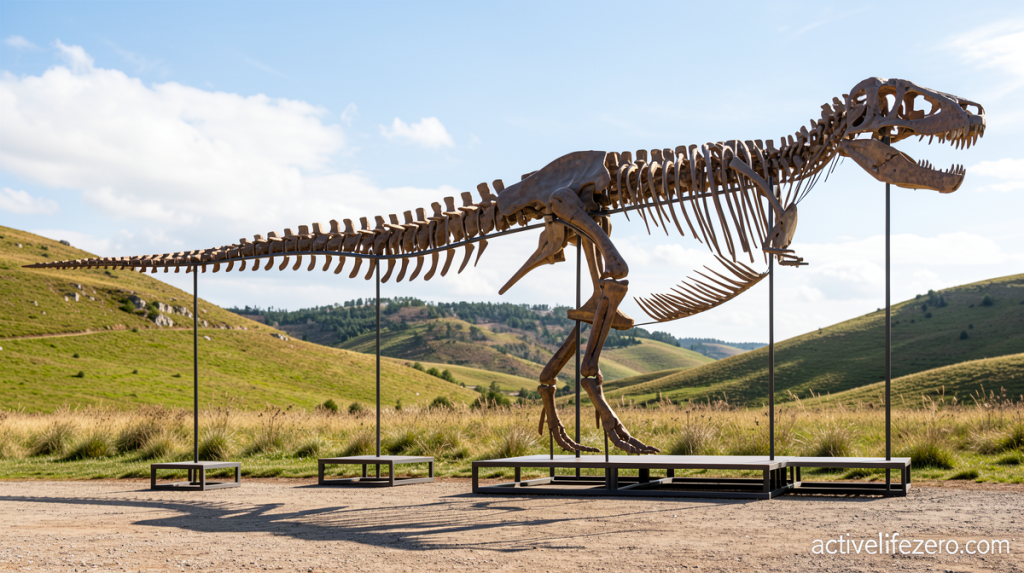
A Rare T. rex Skeleton May Vanish Into Private Hands After Historic Auction
A chance encounter led to one – One of the most significant dinosaur discoveries in recent memory faces an uncertain future. The fossil known as Gus, a massive Tyrannosaurus rex skeleton unearthed from a South Dakota ranch, is scheduled for sale at Sotheby’s auction house in New York City. If purchased by a private collector, this remarkable specimen could disappear from public view and scientific scrutiny for generations. The sale highlights an ongoing tension between fossil ownership rights and the preservation of scientific knowledge.
A Rancher’s Long-Held Dream Realized
Before his name became permanently associated with one of history’s greatest predators, Gary “Gus” Licking worked as a cattle rancher on his family’s land. For years, he harbored a quiet conviction that something extraordinary lay buried beneath his soil. His property rests within the Hell Creek Formation, a geological treasure trove spanning Montana, Wyoming, and both Dakotas. This region holds unparalleled significance for paleontology, having yielded the first T. rex skeleton in 1902 and providing the fossils that established the species’ scientific name.
The Licking ranch covers approximately 6,500 acres in Harding County. It sits near where Stan, another nearly complete T. rex, was discovered. That skeleton shattered auction records in 2020 when it sold for $31.8 million. Now, Gus is poised to potentially surpass that milestone as the world’s most valuable fossil.
The Chance Meeting That Changed Everything
The discovery of Gus began with an unexpected encounter. Thomas Heitkamp, a commercial paleontologist who founded Theropoda Expeditions, a Texas company specializing in private land excavations, happened to pass through the area. He stopped to introduce himself to Licking, who was inspecting a watering trough near the road.
I was passing by the ranch randomly one day and Gary was checking a watering trough near the road, so I stopped I and introduced myself. The Licking ranch had been on my radar because of its location within the Hell Creek formation. Gary had always been interested in fossils and artifacts, and he had quite a good collection of things he had found in his home.
Heitkamp explained that Licking understood his property’s fossil wealth through decades of residence. The rancher believed thorough exploration would eventually reveal something substantial. That belief proved correct when Heitkamp and his team uncovered Gus in 2021. Licking identified the skeleton’s general location but passed away before the excavation finished, never witnessing the complete specimen.
Measuring Up: Gus Among the Giants
According to Sotheby’s, Gus measures 38 feet in length and stands 12.5 feet tall, with a skull spanning 54 inches. The skeleton contains 183 fossil bone elements, achieving approximately 61 percent completeness by bone count and 75 to 80 percent by mass. While impressive, Gus falls slightly short of two other famous specimens. Stan reaches about 70 percent completeness by bone count, and Sue—the first dinosaur ever sold at auction in 1997—achieved an exceptional 90 percent completeness.
Gus also displays bite marks and healed fractures, evidence that the dinosaur survived injuries during its lifetime. Sotheby’s suggests these features may enhance the fossil’s scientific value.
The Stewardship Debate Intensifies
Despite its significance, no formal scientific publication exists for Gus. Many researchers decline to study privately owned specimens. Heitkamp noted that several independent scientists have examined the fossil informally. The auction, entirely legal since the fossil originates from private land, threatens to remove another T. rex from public access. Most T. rex skeletons already reside in private collections.
If this specimen goes to a private individual, it may or may not ever be seen by the public again. Not only that, it will never be subjected to actual proper scientific study — no reputable journal in the world will publish a scientific study based on something that is privately held.
Stuart Sumida, a biology professor at California State University, San Bernardino and president of the Society of Vertebrate Paleontology, emphasized this concern. The SVP strongly opposes fossil sales. When specimens enter private hands, their trajectories vary. Some receive museum loans while maintaining private ownership. Others vanish entirely into personal collections, inaccessible to researchers and the public alike.
