
These Gen Zers are into a new kind of clubbing and it’s more prayer than party
Gen Z’s Spiritual Dance: Bhajan Clubbing in India’s Urban Hubs
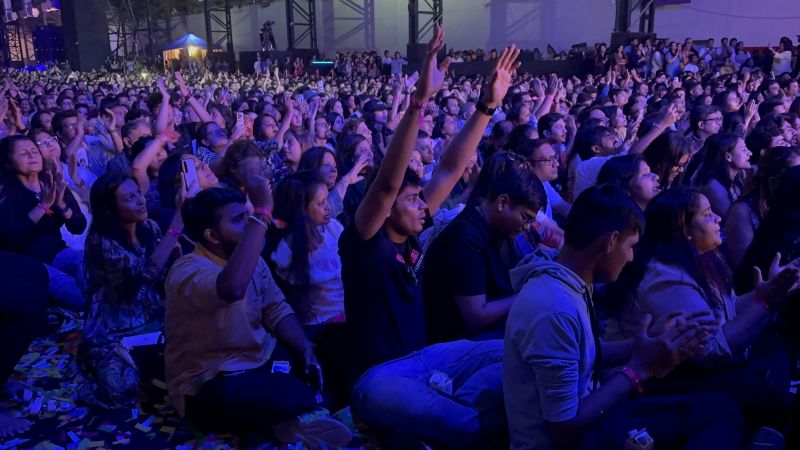
These Gen Zers are into a new – In Mumbai, a bustling commercial center, a unique event is drawing young crowds to a venue that resembles a massive aircraft hangar. As night falls, the space fills with energy, but the atmosphere is far from the typical club scene. Attendees, primarily Gen Z office workers and teenagers, arrive wearing wristbands after scanning QR codes. They remove their shoes, sit cross-legged, and await the start of what promises to be an immersive experience. Unlike conventional parties, the air is filled with the scent of buttermilk and the echoes of centuries-old Hindu devotional songs, not the usual whiff of marijuana or the clink of glasses.
The Rise of Bhajan Clubbing
Bhajan clubbing, a hybrid of spirituality and socializing, is gaining traction across India. It blends the traditional devotional singing of bhajans with modern concert aesthetics, creating a space where the sacred and the secular coexist. The trend, rooted in the global “sober curious” movement, appeals to a generation seeking fulfillment without the reliance on substances. Attendees report feeling connected to something greater, with many describing the experience as transformative.
One such attendee, Jill Veera, 25, shared her perspective with CNN. “This concert brought me closer to God,” she said, highlighting the emotional depth of the event. “In most concerts, people smoke, vape, or drink. But here, the buttermilk was my way of enjoying the moment.” Her words reflect a shift in priorities: a desire for communal joy without the intoxicating effects of alcohol or drugs.
Behind the scenes, the event’s success is driven by Backstage Siblings, a duo who have transformed ancient bhajans into a contemporary format. Raghav Agarwal, one of the performers, emphasized the contrast between traditional practices and modern interpretations. “Bhajans are about devotion, not escapism,” he told CNN. His sister, Prachi Agarwal, added that the event caters to diverse groups: “You can come here with your grandparents, your friends, or your dates—everyone finds their way to the music.”
A New Language for Old Songs
The bhajans themselves, though not new, are now reimagined for a digital age. These devotional hymns, historically sung in temples and religious processions, have been adapted into performances that mirror the grandeur of music festivals. The result is a spectacle that resonates with Gen Z’s love for visual and auditory stimulation. “The smoke machines, LED screens, and energy of the crowd feel like they belong in a techno concert,” said Dhwani Paradia, 26, who attended with her 23-year-old sister, Fiyoni Paradia.
For the Paradia sisters, the appeal lies in the balance between ritual and recreation. “The way the songs are arranged now makes them accessible to people who might not have explored spirituality before,” Dhwani noted. Fiyoni echoed this, pointing out that the event’s structure feels familiar: “The backdrops and lighting are similar to what you’d see at an electronic music festival.” This synergy between tradition and innovation has allowed the movement to flourish, attracting millions of views on social media platforms.
Online videos of these gatherings have become viral, capturing moments of collective chanting, spontaneous dancing, and emotional catharsis. Attendees often cry, hug strangers, or move barefoot, creating a sense of unity that transcends individual experiences. These clips, shared widely on platforms like Instagram and TikTok, have helped normalize the trend and draw new participants to the cause.
Political and Cultural Context
The rise of Bhajan clubbing occurs amid broader cultural and political shifts in India. Hindu symbolism and religious identity are increasingly prominent in public life, sometimes at the expense of secular ideals. This context is evident in the support the trend has received from leaders of the ruling Bharatiya Janata Party (BJP), including Prime Minister Narendra Modi. In a recent address, Modi praised the movement, calling it “heartening” that Gen Z was embracing spirituality through modern platforms.
While some view the trend as a positive evolution, others criticize it for commercializing sacred practices. Social media critics argue that the focus on spectacle risks reducing bhajans to mere entertainment. “Spirituality should be about inner peace, not a show,” one commenter wrote. Yet proponents counter that these gatherings offer a fresh, inclusive way to connect with faith. “They’re not replacing temples, they’re expanding access to spirituality,” said a supporter in an online forum.
India’s religious economy, valued at around $58 billion in 2025, is expected to grow steadily in the coming years. Bhajan clubbing is part of this expansion, tapping into a market that values both tradition and innovation. For many young Indians, the events represent a bridge between their cultural heritage and their modern lifestyle, proving that spiritual practices can evolve without losing their essence.
Tradition Meets Innovation
Despite the modern flair, the core of Bhajan clubbing remains unchanged. The songs, often led by a lead singer and accompanied by rhythmic instruments, are designed to evoke emotional and spiritual responses. Attendees describe the experience as both grounding and uplifting, a way to reconnect with their roots while embracing the energy of a contemporary setting.
Organizers have made it clear that the event is about mindfulness, not mindless revelry. Alcohol and drugs are banned, and the emphasis is on collective participation. “It’s not about getting lost in the crowd, but finding yourself through the music,” said Raghav Agarwal. The duo’s ability to blend traditional hymns with modern production has set them apart, creating a niche market that appeals to those seeking balance in their lives.
As the movement grows, it challenges perceptions of what a spiritual gathering can look like. It’s no longer confined to temples or religious festivals; instead, it thrives in large venues, offering a dynamic alternative. For Gen Z, this format is a testament to their ability to redefine traditions in ways that feel relevant and engaging. “We’re not rejecting the past—we’re reinterpreting it for our time,” Dhwani Paradia said.
With backing from Saregama, one of India’s oldest music labels, the trend is gaining institutional support. This partnership underscores the growing recognition of Bhajan clubbing as a cultural phenomenon. As the movement evolves, it may reshape how spirituality is experienced in the 21st century, proving that the sacred and the social can coexist in unexpected ways.
The success of Bhajan clubbing also highlights a generational shift. Younger Indians are prioritizing mindfulness and community over individual indulgence, a trend mirrored in Europe and America. This global movement, known as “sober curious,” is now taking root in India’s urban centers, where the fusion of old and new is creating a new kind of spiritual experience. For the participants, it’s a chance to celebrate life, one hymn at a time.
