
Venezuelans scour collapsed buildings by hand while government machinery stands unused
Venezuela’s Earthquake Crisis: Manual Search Efforts Amid Government Slowdown
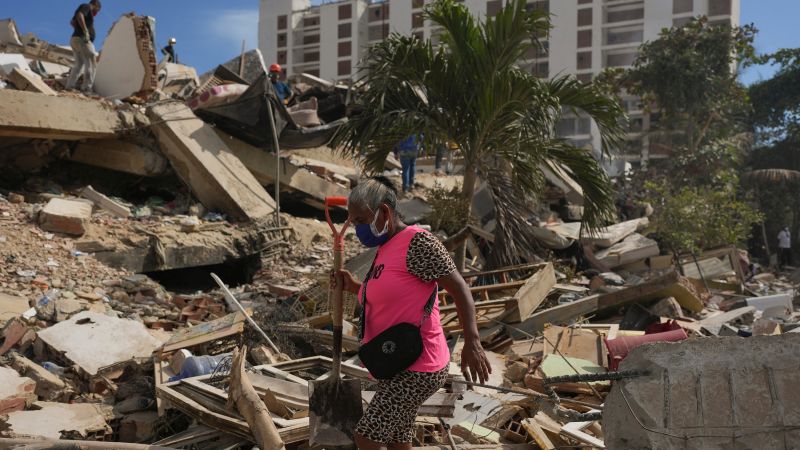
Venezuelans scour collapsed buildings by hand – More than a week after a devastating earthquake struck La Guaira, residents continue to sift through rubble-strewn streets, their hands working tirelessly to uncover survivors trapped beneath collapsed structures. Yet, the government’s response has lagged, with heavy machinery—such as excavators—sitting idle in the shadow of the devastation. As CNN observed, the absence of functional equipment has forced citizens to rely on rudimentary tools like shovels and pickaxes, highlighting a stark contrast between the scale of the disaster and the nation’s ability to respond effectively.
Equipment Shortages Expose Systemic Gaps
Despite Venezuela’s reputation as home to the world’s largest oil reserves, the crisis has revealed a troubling disconnect between resource wealth and emergency preparedness. A government excavator, stationed near a pile of shattered concrete and twisted metal, remained motionless as locals manually cleared debris. When CNN inquired about the machine’s inactivity, the operator cited a critical fuel shortage, underscoring the logistical challenges facing rescue efforts. “There’s no gasoline,” he said, revealing a deeper issue: the state’s infrastructure and emergency systems are not adequately equipped to handle such a large-scale disaster.
Political analysts have pointed to this as a symptom of broader governance failures. Carmen Beatriz Fernández, director of DataStrategia, described the situation as a “tragedy within a tragedy.” “This disaster is exposing the same inefficiencies that plagued the country’s ability to address daily needs,” she explained. “For years, the state prioritized repression and propaganda over essential services, and now the consequences are evident.” Her words reflect growing frustration among Venezuelans, who see the earthquake as a mirror of the nation’s systemic neglect.
Opposition Voices Rise Amid Desperation
The crisis has also galvanized opposition figures, with María Corina Machado returning from exile in the United States to be directly involved in the relief efforts. Speaking to Fox News, Machado emphasized the importance of unity in the face of disaster. “We need to be together,” she said, “because this moment demands collective action.” Her presence signals a renewed push for accountability, as the opposition criticizes the government’s delayed response and lack of coordination.
Meanwhile, the government has attempted to shift blame, framing its efforts as a “well-organized” initiative. Top lawmaker Jorge Rodríguez highlighted a volunteer program, claiming it aligns with “established priorities” to distribute aid. Interior Minister Diosdado Cabello, however, admitted initial confusion. “We asked our people to organize themselves in communes,” he stated last Thursday, “so we could identify missing individuals and execute rescue operations with precision.” Yet, these assurances have not quelled public anger, as the absence of immediate action remains glaring.
Human Stories Behind the Shattered Structures
Among those working in the rubble is Hassel Mendoza, an engineer who arrived in La Guaira from Tampa two nights ago. She has been sleeping on the ground while searching for her mother, sister, brother-in-law, and nephew, all of whom were buried in their nine-story apartment building. “The search has been extremely difficult without the right tools,” Mendoza shared. “We’re using whatever we can find, but it’s not enough to make a real difference.”
Her experience mirrors that of countless others, as the lack of specialized equipment has slowed progress. A civil defense team from the neighboring state of Aragua, for instance, was unable to deploy sensors or drills to quickly locate survivors. “It’s like we’re moving through a maze without a map,” Mendoza said, describing the painstaking process of digging through concrete and rebar. Even donations of water, while appreciated, have not been sufficient to meet the overwhelming demand in the city’s most affected areas.
Death Toll and the Weight of Uncertainty
As the days pass, the official death toll continues to rise, though at a measured pace. National Assembly President Jorge Ramírez, the brother of the acting president, reported at least 1,943 fatalities on Tuesday, marking an increase of approximately 200 from the previous day. However, many believe the number is much higher, with the US Geological Survey estimating that tens of thousands could be dead. The United Nations has also ramped up its efforts, procuring 10,000 body bags to prepare for further casualties.
At a makeshift morgue near the port, the air was heavy with the scent of decay. Rows of caskets lined the docks, a grim reminder of the lives lost. Mendoza, who has been waiting for news of her family, expressed a mix of hope and dread. “We have a little hope they’re still alive,” she said, her voice trembling. “You never know until you find the bodies.” This sentiment echoes across La Guaira, where families remain in limbo, clinging to the possibility that their loved ones might yet be rescued.
Deportations and the Fragility of Hope
The earthquake’s impact extends beyond physical destruction, with some of its victims also facing a political dimension. Venezuelans deported by the US hours before the disaster struck are now missing, their absence adding to the sense of urgency. The event has underscored the vulnerability of the population, particularly those displaced by prior crises. “This is not just a natural disaster,” said one local, “it’s a reminder of how the government has prioritized control over care.”
Volunteers, both local and international, have played a critical role in the search efforts, often filling the gaps left by government inaction. Jack Thorpe, an American volunteer with Resource Rescue International, noted that some trapped individuals had entered “survival mode,” enduring extreme conditions for days. “We’re looking for life, and we’re looking for deceased,” Thorpe explained, emphasizing the dual focus of rescue teams. Yet, the lack of advanced equipment has made these efforts painstaking, with every hour potentially delaying the discovery of a survivor or a victim.
As the sun sets over the ruined city, the search continues, driven by both necessity and hope. For many Venezuelans, the earthquake has become a catalyst for reevaluating their government’s role in crises. The contrast between the people’s resilience and the state’s sluggish response is stark, with citizens stepping up in the absence of adequate support. While the government claims to be organizing rescue efforts, the reality on the ground tells a different story—one of manual labor, uncertainty, and a growing sense of frustration.
The ordeal in La Guaira serves as a microcosm of Venezuela’s broader struggles. The nation’s oil wealth, which once promised stability, has not translated into effective disaster management. Instead, the earthquake has exposed a system in disarray, with citizens forced to take matters into their own hands. As the smell of decay lingers in the humid air, the question remains: how long will Venezuelans be left to navigate this crisis alone? For now, their determination persists, even as the challenges mount and the human toll deepens.
