
‘Salami slicing’: How China is trying to increase control in the Pacific
‘Salami Slicing’: How China is Expanding Influence in the Pacific
Salami slicing – Within weeks, China’s maritime operations have pushed further into contested waters than ever before, with its ships conducting “law enforcement” missions beyond their usual reach. These actions include mapping sensitive seabeds and carrying out “research” in a lagoon more than 500 miles from its shores, all under the guise of peaceful activities. Analysts suggest this incremental approach, often termed “salami-slicing,” is part of a broader strategy to solidify territorial claims in the Pacific, where China’s sovereignty assertions are frequently contested.
China’s use of this tactic has been a point of contention for years. By taking small, calculated steps just below the threshold of open conflict, Beijing aims to assert control over disputed areas without triggering a full-scale military response. The latest moves, however, are seen as a significant escalation, targeting regions considered critical by both Beijing and Washington. The western Pacific, in particular, is viewed as a strategic linchpin, with the First Island Chain—a series of islands stretching from southern Japan through the Philippines and Taiwan—playing a central role in the balance of power.
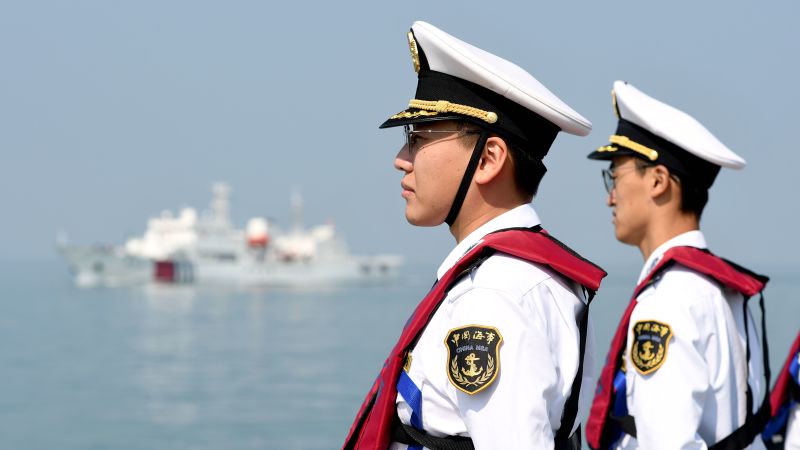
The recent maneuvers by China’s Maritime Safety Agency (MSA) have drawn particular attention. Three vessels from the agency recently sailed through the Bashi Channel, a narrow strait between the Philippines and Taiwan, to begin operations in waters east of the island. This marks a pivotal shift, as observers note it is the first time MSA ships have ventured beyond the “First Island Chain.” Such a move could signal China’s intent to claim jurisdiction over regions previously under the shadow of its 9-Dash Line, a controversial boundary in the South China Sea.
“This is the first time we’ve seen them make some kind of a sovereignty patrol outside of the 9-Dash/10-Dash Line,” said Ray Powell, director of the SeaLight project at Stanford University’s Gordian Knot Center for National Security Innovation. Powell, who specializes in China’s gray-zone tactics, described the action as the “Bashi Breakout.” He emphasized its significance, stating, “Beijing is essentially saying we have jurisdiction over this area on the other side of the First Island Chain. That’s pretty significant.”
The 9-Dash Line, which China expanded in 2023 to include a 10th dash extending east of Taiwan, has been a source of international dispute. In 2016, the Permanent Court of Arbitration in The Hague ruled that the line lacked a legal basis, prompting continued challenges from neighboring nations. Despite this, China has persisted in using maritime activities to create new facts on the water, a strategy designed to legitimize its claims over time.
China’s state-run tabloid, the Global Times, framed the MSA’s movement as a “sovereignty declaration with both legal significance and political signaling.” The outlet highlighted the semi-official social media account Yuyuan Tantian, which China often employs to gauge international reactions. Through this platform, Beijing asserted that its vessels had mapped the seabed east of Taiwan for the first time, countering foreign skepticism about its ability to enforce authority in these regions.
“The waters east of Taiwan Island will constitute our ‘nearshore waters’—the very waters where we maintain a presence and exercise jurisdiction and governance,” Yuyuan Tantian stated in a recent post. This declaration pushed back against criticisms that China lacks the capacity to project power beyond its immediate reach. The move is also seen as a calculated effort to bolster its influence over Taiwan, a self-ruled island that China has vowed to reunify with by force if necessary.
Taiwanese officials have voiced concerns over the MSA’s mission. President Lai Ching-te clarified that Beijing’s objective is to “expand” its territorial reach, stating, “China’s threats towards Taiwan know no limits.” A Taiwanese security official added that the MSA ships are part of a broader plan to create a misleading perception of de facto control over the island. “Beijing is using these vessels to project an image of authority,” the official said, “while maintaining a low-profile approach to avoid direct confrontation.”
While the People’s Liberation Army Navy has historically conducted exercises in the waters east of Taiwan, analysts argue that the MSA’s non-military presence may pose a more enduring threat. Unlike military operations, which can be easily contested, the MSA’s activities blend policing functions with strategic objectives, such as enforcing environmental regulations or maritime laws. This dual role allows China to establish a consistent presence without immediately escalating tensions.
China’s actions are also linked to its broader diplomatic agenda. The recent Bashi Channel mission followed a visit by US President Donald Trump to Beijing, during which the two leaders maintained a friendly tone. Yet, Xi Jinping used the opportunity to underscore the importance of Taiwan in US-China relations. “The biggest issue that could derail US-China relations was Taiwan,” Xi emphasized, highlighting the island’s role as a potential flashpoint.
As China continues to refine its tactics, the Pacific region remains a focal point of its ambitions. The MSA’s expansion into new waters, combined with the 10-Dash Line, suggests a long-term strategy to gradually solidify control over key maritime zones. For Taiwan, this represents a growing challenge, as its government faces pressure to defend its sovereignty amid China’s relentless efforts to assert influence.
Historically, China’s approach has relied on a mix of military and civilian operations. The MSA’s recent activities, however, reflect a shift toward more sustained, non-threatening presence. By using civilian law enforcement organizations, Beijing can maintain a veneer of peaceful intent while advancing its territorial ambitions. This strategy, analysts argue, could redefine the dynamics of power in the region, with the potential to alter the status quo over time.
