
Using the stars and paddles, indigenous Taiwanese recreate risky sea journey of Great Pacific Migration
Indigenous Taiwanese Seafarers Reenact Perilous Ocean Voyage of the Great Pacific Migration Using Stars and Paddles
A Bold Nautical Expedition
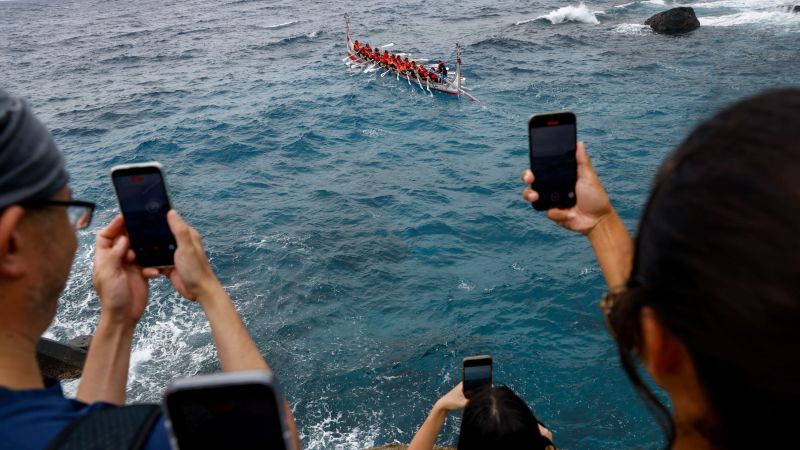
Using the stars and paddles indigenous – On Monday, a group of 60 Tao seafarers from Taiwan’s Orchid Island set sail on a 111-mile voyage across the Pacific, navigating by the stars and enduring powerful ocean currents to reach the Ivatan people on Batan Island in the Philippines. This replica of an ancient journey, believed to have taken place over 4,000 years ago, marks a significant effort to reconnect with the migratory practices of Taiwan’s indigenous ancestors. The crew took turns rowing their traditional wooden canoe, named “Ovayan,” or “Golden Friendship,” as they retraced the path once used by early Austronesian navigators. Their arrival the next day was met with a vibrant display of cultural celebration, including drum and dance performances by the Ivatan community, underscoring the enduring ties between these seafaring groups.
Genetic and Linguistic Connections Across the Pacific
Modern Taiwan’s indigenous population, now a small fraction of the island’s total inhabitants, is thought to be the progenitor of many Austronesian communities that settled across vast oceanic regions. These groups, spanning from Hawaii and Easter Island in the eastern Pacific to Madagascar off the African coast, share genetic and linguistic similarities that point to a common origin. The navigational prowess of their ancestors, who traversed immense distances in primitive vessels, has long been regarded as one of humanity’s most extraordinary feats. This ability to locate distant islands without the aid of maps or modern technology is a cornerstone of the Great Pacific Migration theory, which suggests that early seafarers spread across the globe via an intricate network of maritime routes.
Recreating a Forgotten Route
The recent expedition aims to revive a sea passage that has not been used for over three centuries. Historically, the Bashi Channel—a stretch of water between Taiwan and the Philippines—was a vital artery for Austronesian migration. Early voyagers relied on rudimentary canoes and their knowledge of the stars to navigate these waters, facing immense risks that modern technology could not fully mitigate. Hsieh Chen-Hsiung, a shipbuilder featured in a promotional video, emphasized the importance of craftsmanship: “If the surface is uneven, with slight bumps here and there, the resistance from the sea will be much greater.” The canoe, constructed by over 200 individuals from six tribal communities, was bound together using traditional methods, avoiding nails and emphasizing the cultural pride in reviving ancient techniques.
The Tao People’s Role in the Migration Story
The Tao, one of Taiwan’s smaller indigenous groups, have a population of just 5,120 according to official records. Yet, their contribution to the Great Pacific Migration is pivotal. While indigenous people now account for only 3% of Taiwan’s 23 million residents, their ancestors played a crucial role in shaping the linguistic and cultural landscape of the Pacific. Maraos, chairperson of Taiwan’s Indigenous Peoples Cultural Foundation (IPCF), highlighted the significance of the event: “This is not only a significant day for the Pacific Ocean but also a day of commemoration for the Austronesian people.” Maraos, who uses a single name, represents the Tao’s deep-rooted connection to their maritime heritage and the broader Austronesian family.
Astronomy and Survival on the Open Ocean
Professor Peter Bellwood, an emeritus archaeologist at the Australian National University, asserts that the Great Pacific Migration likely began in Taiwan around 5,000 years ago. “Then, it spread into the Philippines, and then onwards,” he explained to CNN. The migratory groups carried essential resources such as yams, taro, and livestock, which were critical for survival on isolated islands. Bellwood also noted that women often accompanied these voyages, as they possessed foundational knowledge of astronomy. “They could see where they were going and record directions to return home,” he added, underscoring the ingenuity of these early navigators.
Linguistic Evidence of a Shared Heritage
Victoria Chen, a senior lecturer at Victoria University of Wellington in New Zealand, points to the linguistic connections that reinforce Taiwan’s role as the cradle of Austronesian dispersal. Many languages in the Pacific, including Bahasa Indonesian, Māori, and Hawaiian, share similar words such as “five,” which is “lima” in Indonesian, “rima” in Māori, and “ʻelima” in Hawaiian. However, Taiwan exhibits a greater diversity of Austronesian languages, featuring more complex grammatical structures and expansive vocabularies. “The high-level diversity suggests that Taiwan was the original dispersal of the family,” Chen said. This linguistic evidence supports the “Out of Taiwan” theory, which posits that the Austronesian people originated in the island before spreading across the globe.
Challenges to the Migration Theory
Despite widespread scientific acceptance, the “Out of Taiwan” theory has faced recent challenges from mainland Chinese academics. Some scholars argue that the origins of Austronesian peoples may instead be traced to southern China, a narrative that Taipei believes is intended to bolster Beijing’s territorial claims over Taiwan. The theory remains a point of contention, with debates focusing on archaeological records and genetic data. Bellwood, however, maintains that the evidence is compelling, pointing to the presence of Austronesian artifacts and DNA traces in distant regions. The recent voyage by the Tao people not only highlights their cultural resilience but also serves as a tangible reminder of the migration’s historical significance.
Cultural Resilience and Global Recognition
The expedition, supported by the Taiwanese government, is part of a broader initiative to celebrate and preserve indigenous traditions. By using traditional methods to build the canoe, participants demonstrated a commitment to honoring their ancestors’ skills and knowledge. The journey’s success is seen as a milestone for Taiwan’s indigenous communities, who have long been marginalized in the nation’s narrative. As Bellwood noted, the migratory legacy of these seafarers is a testament to their adaptability and innovation. The event also draws attention to the linguistic and cultural richness of the Austronesian family, which stretches across thousands of islands from Southeast Asia to the Pacific.
Conclusion: A Link to the Past
The reenactment of this ancient voyage offers more than just a glimpse into the past—it reaffirms the enduring connection between Taiwan’s indigenous people and the global Austronesian network. By paddling across the Pacific, the Tao seafarers not only honored their ancestral skills but also contributed to ongoing discussions about the origins of human civilization. As the world continues to explore the vast networks of prehistoric migration, the story of the Great Pacific Migration remains a powerful reminder of humanity’s ability to conquer the seas and shape the cultural tapestry of distant lands.
