
How smartphones and the New York Knicks created Brooklyn’s biggest block party
The Digital Spectatorship Phenomenon
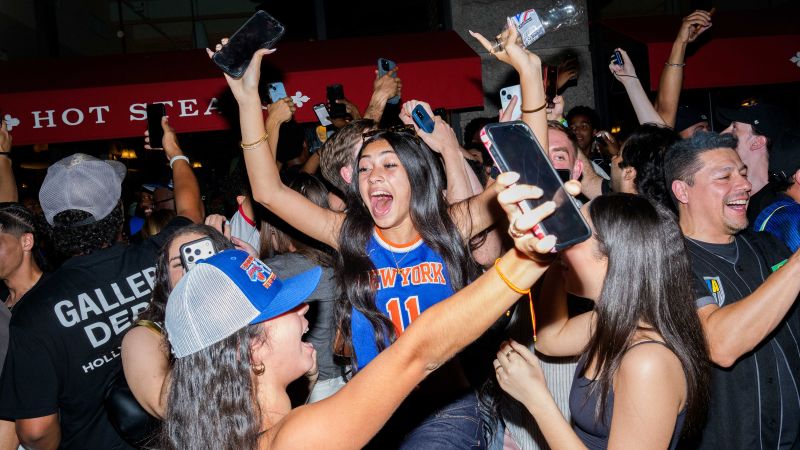
How smartphones and the New York – As the New York Knicks advanced through the Eastern Conference Finals, their improbable comebacks and dominant performances sparked a surreal spectacle across Brooklyn. The official watch parties outside Madison Square Garden transformed into digital arenas where phone screens became the primary medium for collective celebration. What began as a straightforward gathering of fans evolved into a chaotic, self-referential display of screen-centric enthusiasm, with semi-professional streamers orchestrating staged antics for live cameras. These cameras, mounted on gimbals, drew even more spectators to pull out their own devices, creating a feedback loop of attention that blurred the line between reality and performance. Legacy news crews, once the arbiters of sports narratives, now found themselves documenting the same phenomenon they had helped create—a kind of digital echo chamber where every moment was curated for virality.
Amid this frenzy, the Knicks’ fanbase emerged as the driving force behind the chaos. For decades, they had waited in patient anticipation, their loyalty tested by years of mediocrity. Yet, with each win, the narrative shifted. The team’s ascent felt less like a series of victories and more like a generational reckoning. Fans who had once gathered in sparse numbers now filled streets and public spaces, their collective energy fueled by the promise of a long-awaited triumph. The city itself became a stage, with smartphones acting as both tools and symbols of this new era of fandom. Even the act of watching a game was no longer passive; it was a performance, a digital ritual where every gesture was amplified by the glow of screens.
“Sports have always been a way to bridge time, but now they’re being lived through the lens of a phone,” remarked one observer at a watch party in Fort Greene. “You don’t just watch the game—you become part of it, even if it’s just by capturing it.”
As the playoffs progressed, the paradox of modern fandom became increasingly evident. The more fans sought to immortalize the moment on video, the more the moment itself was altered. A spontaneous cheer could be reduced to a TikTok clip, a crowd’s roar transformed into a muted backdrop for someone’s filtered selfie. This meta experience created a sense of detachment, as if the city’s excitement were being filtered through a screen rather than felt directly. Yet, there was a strange beauty to it—a collective surrender to the idea that the act of observation could shape the event itself.
A Century of Knicks Devotion
For over a hundred years, the Knicks have been a mirror of New York’s triumphs and struggles. Their 1973 championship remains a distant memory for many, a relic of a time when sports were experienced without the omnipresence of technology. Today, the team’s resurgence has reignited a passion that spans generations. Parents who once cheered for the Knicks in their youth now bring their children to watch the games, their own experiences passed down as stories of perseverance and hope. The city’s long wait for a return to glory has created a sense of shared history, with fans feeling the weight of a century of underachievement.
When the Knicks finally secured their victory in Game 5, the streets of Brooklyn erupted into a kaleidoscope of screen-lit faces. The game was not just watched—it was performed for the audience of digital viewers, with fans gathering in public spaces to project their collective joy. At a crossroads in the Fort Greene neighborhood, people arrived with picnic blankets, beach chairs, and drinks in hand, transforming the area into a makeshift stadium. A Cuban restaurant’s outdoor space became an impromptu screen, its walls bearing the weight of the city’s anticipation. The crowd, however, outgrew the space, turning the intersection into a traffic hazard as police had to intervene to manage the overflow.
Despite the disruption, the essence of the celebration remained unchanged. Fans stayed, their faces illuminated by the small screens in their hands, sharing the moment in real-time with strangers and friends alike. The act of watching on phones, while fragmented, created a sense of unity—a shared experience that transcended physical distance. It was a testament to how technology could redefine the way people connect with sports, turning the city into a living, breathing archive of basketball history.
The Architecture of Fandom
Even in spaces designed for traditional spectating, the Knicks’ presence reshaped the environment. At the Brooklyn Academy of Music, a 16-foot screen positioned near the steps offered a staggered view, allowing fans to gather in layers. Yet, the sheer volume of attendees meant that only a fraction could see the action clearly. Most were relegated to the periphery, their eyes fixed on the screen while their hands scrolled through social media, capturing every moment for later dissemination. This duality—between physical presence and digital engagement—defined the Knicks’ run, making it both a collective celebration and a personal, screen-obsessed ritual.
Their success also highlighted a generational shift. For the first time in decades, the Knicks were not just a team for die-hard fans but a cultural phenomenon that drew casual viewers into the fold. The bandwagon, once a metaphor for temporary support, became a literal one as new fans joined the parade. The city’s long-standing connection to the team was reimagined through the lens of social media, where every fan’s perspective was a post, a comment, or a reaction. The Knicks’ journey was no longer just about winning games—it was about creating a narrative that could be shared, reshared, and reinterpreted in infinite ways.
As the final moments of Game 5 unfolded, the crowd’s collective breath held. The Knicks’ victory, hard-won and hard-fought, felt like a reset button for the city. The temporal distance between past and present—between the 1973 championship and this moment—was bridged by the unifying power of the screen. In an age where time is measured in seconds and moments are preserved in pixels, the Knicks’ success became a symbol of possibility, a reminder that even the most unlikely stories can find their way into the spotlight.
Yet, the question lingered: was this celebration still authentic, or had the city’s connection to the game been reduced to a series of curated clips? The omnipresent iPhone, with its ability to document and distribute moments instantly, offered both a tool for connection and a barrier to immersion. Fans who once gathered in front of a single TV screen now scattered across the city, each holding their own device as a portal to the same event. It was a strange irony—a team that had waited a century for recognition now had its story told through the very technology that had once alienated it from the public’s attention.
Still, the energy of the night was undeniable. In Fort Greene, where the streets were packed with revelers, the Knicks’ triumph felt like a communal heartbeat. The screens, though small, carried the weight of a city’s collective hope, and the cheers that followed were no less powerful than those of an arena. For a moment, the Knicks were not just a team but a unifying force, their victories echoing through the streets as if the city itself were celebrating. The final clinch, captured on countless devices, became a symbol of a new kind of fandom—one that thrives in the digital age while still clinging to the old, unshakable joy of shared excitement.
