
Four UK pro-Palestinian activists jailed over raid at Israeli firm Elbit
Four UK pro-Palestinian activists jailed over raid at Israeli firm Elbit
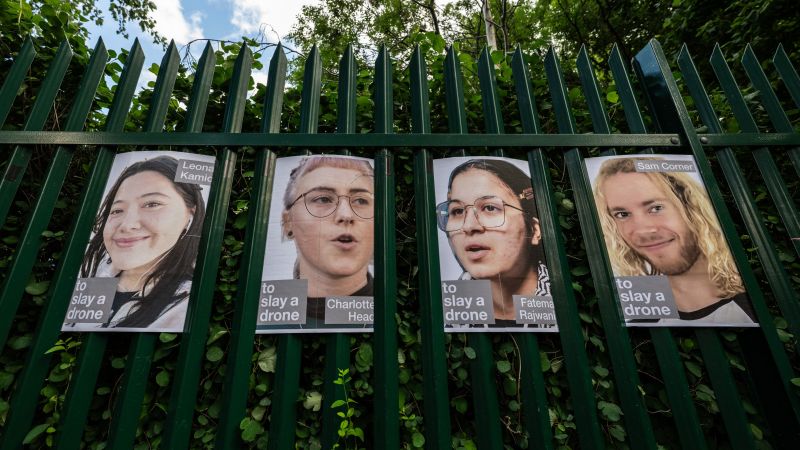
Four UK pro Palestinian activists jailed – In a landmark ruling, four British activists associated with the Palestine Action group have been handed sentences totaling over 20 years for their role in a 2024 attack on an Israeli defense company’s facility in Bristol, southwest England. The convictions, delivered at Woolwich Crown Court in May, marked a significant escalation in the legal battle surrounding the incident, which caused more than £1 million in damages. The judge, Jeremy Johnson, emphasized that the assault had a “terrorism connection,” leading to harsher penalties for the offenders, despite their previous acquittal on aggravated burglary charges.
Details of the Convictions
The activists—Charlotte Head (30), Samuel Corner (23), Leona Kamio (30), and Fatema Zainab Rajwani (21)—were found guilty of criminal damage and, in Corner’s case, grievous bodily harm. Prosecutors argued that the raid should be classified under terrorism laws due to its intent to influence British government policy toward Israel and the scale of property destruction. Corner, who was convicted of inflicting serious injury on a police officer using a sledgehammer, received a seven-year sentence, with the court noting his use of “extreme and gratuitous” force. His autism, previously cited as a defense, was deemed insufficient to justify the attack.
Kamio and Head received five-year terms, while Rajwani was sentenced to four years and eight months for the criminal damage. All four will serve an additional year on licence after release. The attack, which took place around 10 months into Israel’s bombardment of Gaza, followed a deadly Hamas-led assault in October 2023. The timing of the raid underscored the activists’ belief that the destruction of Elbit Systems UK’s facility was a necessary step to halt what they described as Israel’s “genocide” in the region.
The Group’s Legal Status
Palsetine Action, the organization behind the raid, was later proscribed under the UK’s Terrorism Act. However, the High Court recently ruled that the decision to ban the group was unlawful, though the ban remains in place pending a government appeal. The ruling, expected on Monday, has sparked debate over the classification of the group as a terrorist entity. Judge Johnson acknowledged that Palestine Action was not yet proscribed at the time of the offence but stated the damage and intent to affect British-Israeli policy created an aggravating factor.
Lawyers representing the activists have contested the terrorism framing, arguing that the charges are disproportionate. They highlighted that the group was not formally labeled a terrorist organization during the raid and that the activists had not been charged with any specific terrorist offense. “The application of terrorism laws to this case sets a dangerous precedent,” said Kerry Moscogiuri, chief executive of Amnesty International UK. “Criminal damage has never been treated as terrorism within the UK justice system, and this verdict risks criminalizing protest as extremism.”
The activists have consistently maintained that their actions were aimed at destroying weapons to end the violence in Gaza. They disavowed any intention to harm people, emphasizing that the raid was symbolic. “We targeted the machinery of war, not individuals,” one of their representatives stated in court. “Our goal was to disrupt Israel’s military operations and raise awareness about the humanitarian crisis.”
Reactions and Controversy
Following the verdict, a chorus of public figures and human rights advocates have expressed concern over the severity of the sentences. Over 100 prominent individuals, including author Sally Rooney, climate activist Greta Thunberg, and actor Steve Coogan, signed an open letter criticizing the decision. They argued that treating criminal damage as terrorism could unfairly label protesters as extremists, with the punishment potentially shadowing them for life.
“It is completely disproportionate to punish protesters for criminal damage as if they were terrorists,” said Kerry Moscogiuri. “This sentence will stay with them for the rest of their lives, even though their actions were motivated by a desire for justice.”
Elbit Systems, the Israeli defense firm at the center of the attack, described the incident as a major disruption. In impact statements, the company claimed it had received nearly £1.2 million from insurers to cover the damages, though it stressed the event had lasting effects on staff safety and morale. Specialist military drone equipment, IT systems, and computers were among the items destroyed during the raid, highlighting the strategic nature of the assault.
The legal proceedings have also drawn attention to the broader implications of the UK’s approach to prosecuting pro-Palestinian activism. Critics argue that the ruling could embolden authorities to use terrorism laws against dissenting voices, particularly during times of heightened political tension. “This case demonstrates how easily peaceful protest can be weaponized,” said a legal analyst in a statement. “The connection to terrorism is being stretched to justify lifelong consequences for activists who acted in good faith.”
Outside the court, police confirmed that over 100 people had been arrested for supporting Palestine Action. The arrests followed a surge in demonstrations and rallies in support of the group, which has become a focal point for pro-Palestinian sentiment in the UK. Despite the legal challenges, the group continues to attract widespread backing, with its members framing their actions as a necessary response to the ongoing conflict in Gaza.
As the sentences take effect, the debate over the use of terrorism laws in domestic contexts is likely to intensify. Supporters of the activists argue that the punishment overshadows the group’s non-violent intent, while the government maintains that the raid’s connection to the broader conflict justifies its classification as a terrorist act. The case will undoubtedly shape future legal strategies for activists advocating for Palestinian causes, raising questions about the balance between security and civil liberties in the UK justice system.
In the wake of the sentencing, the activists have vowed to continue their efforts, asserting that their convictions do not diminish their commitment to the cause. “We are not afraid of the consequences,” said one of their attorneys. “The destruction of Elbit’s facility was a bold statement to highlight the suffering in Gaza and hold the Israeli government accountable.” The group’s activities, which include direct actions and public campaigns, have become a symbol of resistance, even as legal battles persist over their classification.
With the High Court’s decision on the proscription still pending, the activists’ fate remains a focal point for discussions on the intersection of law, activism, and international conflict. The case has not only drawn condemnation from human rights groups but has also sparked a national conversation about the boundaries of protest and the role of terrorism in shaping legal outcomes. As the four individuals prepare to begin their sentences, their actions will continue to resonate in the UK’s political and social landscape, challenging perceptions of justice and dissent.
