
Pope blesses Barcelona’s Gaudi-designed towering architectural masterpiece
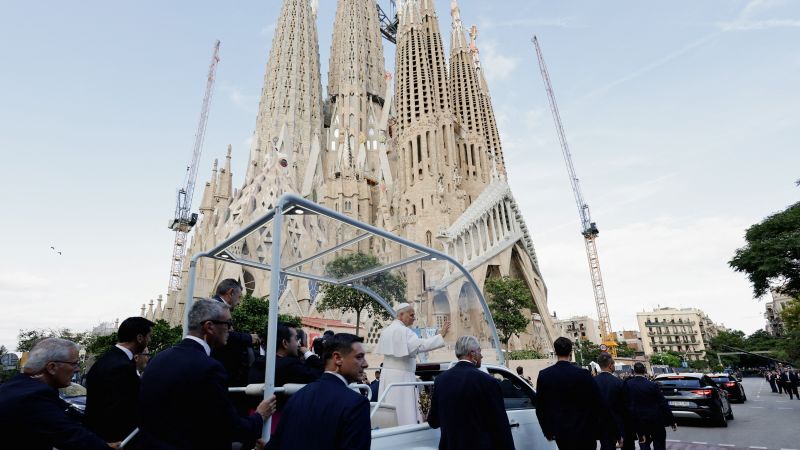
Pope Blesses Barcelona’s Gaudí-Designed Basilica in Centenary Ceremony
Pope blesses Barcelona s Gaudi designed – On June 10, 2026, Pope Leo XIV marked a historic moment at Barcelona’s Sagrada Família, a monumental basilica that has stood as a symbol of artistic ambition and spiritual devotion for over a century. The event coincided with the 100th anniversary of the death of its architect, Antoni Gaudí, who passed away in 1926 after being struck by a tram. His demise, attributed to a lack of immediate medical attention as bystanders mistook him for a beggar, left his magnum opus incomplete—a fate that has become a defining feature of the basilica itself.
A Centenary of Artistic Vision
The Pope’s visit culminated in a Mass attended by thousands, including the Spanish royal family, and the official blessing of the newly completed Tower of Jesus Christ. This structure, now the tallest in the world, represents a pivotal milestone in the basilica’s 144-year journey toward completion. Gaudí, who died knowing his work would remain unfinished, envisioned a building that transcends time, blending natural forms with sacred symbolism. His legacy, preserved through the ongoing efforts of architects, is now honored in a ceremony that underscores its enduring significance.
The Sagrada Família, a UNESCO World Heritage Site, continues to draw millions of visitors annually. According to the basilica’s records, American tourists outnumber Spaniards, a testament to its global appeal. During his homily, Pope Leo XIV described the basilica as “much more than a monument,” emphasizing its role as a living testament to faith and perseverance. “The fact that it is incomplete is not a flaw,” he said, “but a promise that we wish to honor with consistency.” His words echoed the spirit of Gaudí, whose designs were deeply rooted in religious devotion and the natural world.
Gaudí’s Architectural Language
Antoni Gaudí’s creative philosophy drew from the organic shapes of nature and the rituals of religious tradition. The 18 towering spires, for instance, are said to symbolize different biblical figures, including the apostles, evangelists, and the Virgin Mary, while the three facades narrate the life of Jesus, his crucifixion, and the final judgment. These elements reflect Gaudí’s belief that architecture should embody spiritual meaning, much like a “spiritual pilgrimage.”
One of the most striking features of the basilica is the intricate carvings that depict trees, flowers, and fruit in painstaking detail. The building’s exterior is a stunning fusion of vibrant colors, geometric precision, and the fluidity of nature. Peter Stanford, author of *Gaudí: God’s Architect*, noted that the towers are often compared to “drippy candles,” but he also highlighted a less commonly acknowledged influence: “castells,” the human tower formations unique to Catalan festivals. According to a Gaudí disciple quoted in *The Tablet*, these towering structures inspired the basilica’s vertical aspirations, symbolizing both human collaboration and divine aspiration.
The basilica’s construction faced numerous challenges, including the Spanish Civil War, which disrupted progress in 1936. At that time, anti-clericalist anarchists attacked the site, setting fire to the crypt and Gaudí’s workshop. Despite the destruction, his collaborators managed to reconstruct lost plans, preserving his original vision. Modern architects, led by Jordi Faulí, have since leveraged digital modeling, 3D printing, and industrial robotics to complete the project. Faulí stated that Gaudí’s design logic, though centuries old, remains a guiding force for today’s builders, bridging the gap between tradition and innovation.
A Statement on Faith and Conflict
Pope Leo XIV’s visit also served as a platform to address contemporary issues. In his homily, he denounced actions that contradict the teachings of Jesus, including war, the killing of innocents, and the abandonment of the suffering. “We cannot believe in Jesus and promote war,” he declared, “nor can we believe in Jesus and kill the innocent.” His remarks resonated with the basilica’s theme of unity and hope, a message that aligns with Gaudí’s own spiritual convictions.
The Pope further criticized the joint US-Israeli strikes on Iran, as well as the use of religious rhetoric to justify military conflicts. He called for a renewed commitment to compassion, stating, “We cannot believe in Jesus and abandon those who weep, those who flee from misery.” These comments reflected his broader stance against policies that prioritize aggression over empathy, mirroring the basilica’s role as a beacon of faith in a world often divided by strife.
During the ceremony, Valentina, a blind girl, shared a heartfelt explanation of the Tower of Jesus Christ using a braille-inscribed model. Her involvement highlighted the basilica’s accessibility and its role as a space for all to connect with the divine. After the blessing, the basilica was illuminated with a dazzling display of lights, accompanied by fireworks and drone projections of Gaudí’s face. The event symbolized the merging of past and present, honoring the architect’s vision while celebrating the basilica’s transformation into a completed masterpiece.
The Path to Sanctity
The Vatican has long recognized Gaudí’s spiritual contributions, with his sainthood process advancing steadily. In April of last year, the Pontifical Council for the Promotion of the New Evangelization declared him “venerable,” a crucial step toward canonization. This recognition has bolstered the basilica’s status as not only a cultural landmark but also a site of deep religious significance. The Pope’s visit, therefore, carried both historical and spiritual weight, connecting the unfinished dream of Gaudí to the present-day mission of the Church.
Gaudí’s design was never meant to be static; it was an evolving expression of faith. The basilica’s completion reflects this philosophy, as its architecture continues to inspire awe and reflection. Pope Leo XIV’s blessing of the Tower of Jesus Christ reinforced the idea that faith shapes not only stone but also the future. “Faith that shapes the stones,” he proclaimed, “is the very essence of this sacred space.” His visit also paid homage to the legacy of Pope Benedict XVI, who consecrated the basilica in 2010, further solidifying its place in Catholic history.
The Sagrada Família stands as a testament to the power of artistic and spiritual dedication. Though Gaudí could not see its full realization, his work has become a living symbol of perseverance. The Pope’s centenary ceremony not only celebrated the basilica’s completion but also reaffirmed its message of hope and unity. As the towers rise higher and the lights illuminate the night sky, the basilica continues to fulfill its role as a masterpiece that bridges the past and future, guided by the enduring vision of its creator.
In an era where faith is often questioned, the Sagrada Família remains a powerful reminder of the potential for human creativity to mirror divine inspiration. Its completion marks a significant chapter in the Church’s history, while its unfinished nature invites ongoing dialogue about the role of art in spiritual life. As the world watches the basilica’s final spires reach toward the heavens, the legacy of Antoni Gaudí and Pope Leo XIV’s endorsement serve as a unified call to continue the journey of faith, one stone at a time.
