
The largest scorpion to walk the Earth was the size of a baseball bat
The Largest Scorpion to Walk the Earth Was the Size of a Baseball Bat
The largest scorpion to walk the Earth – Over 415 million years ago, during the early Devonian era, a scorpion of colossal proportions roamed the ancient landscapes of what is now Great Britain. Scientists have now uncovered compelling evidence that this creature, Praearcturus gigas, was not just large but exceptionally robust, measuring approximately one meter in length—equivalent to a large baseball bat. This revelation challenges previous assumptions about the evolution of arthropods and their transition from aquatic to terrestrial environments.
A Breakthrough Through Fossil Reassessment
The discovery emerged from a collaborative effort involving researchers who revisited fossils housed in London’s Natural History Museum for over a century. By combining these historical specimens with newly unearthed fossils from three distinct sites, the team pieced together a more detailed picture of P. gigas. This process highlighted how revisiting old evidence can lead to groundbreaking insights, underscoring the value of persistent scientific inquiry.
Initially, P. gigas was classified as a crustacean, similar to lobsters and other shellfish. However, the study’s findings suggest it belonged to a different group of arthropods, specifically scorpions. This reclassification was prompted by a critical comparison with a 2015 discovery of a Canadian scorpion, Eramoscorpius brucensis, which shared a distinctive anatomical trait: a long, triangular sternum with a central groove. The similarity between these two species, according to lead author Richard Howard, curator of fossil arthropods at the Natural History Museum, provides strong evidence of their evolutionary connection.
Uncovering the Scorpion’s World
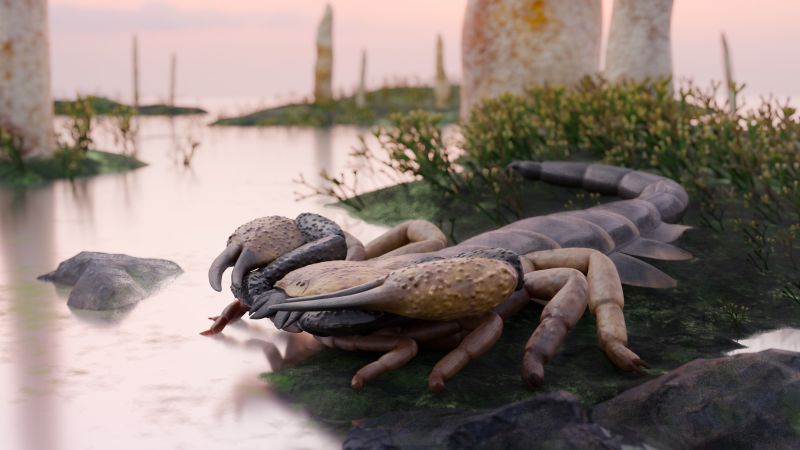
The research team utilized advanced technologies, including CT scans, to examine the fossils in greater detail. These scans revealed not only the scorpion’s size but also its unique physical features. Its legs, claws, and head were covered in coarse bumps, a hallmark of scorpion morphology. While the fossils lacked eye structures, the researchers speculate that P. gigas likely possessed eyes on the front of its head, much like modern scorpions.
One of the most striking aspects of P. gigas is its massive pincers, estimated to be around 6 inches long—roughly the length of a dollar bill. Such appendages would have enabled it to capture prey or defend itself in its environment. The scorpion’s habitat, however, remains a subject of fascination. Despite its terrestrial appearance, the creature thrived in an era when Earth’s ecosystems were still dominated by aquatic life. This raises intriguing questions about its adaptability and the conditions that allowed such giants to exist.
“That is a chonky-looking organism,” remarked Russell Bicknell, a paleobiologist at Flinders University in Adelaide, Australia. “You would not want to run into this thing in a dark alley. It would be an absolute beast.”
The early Devonian Period, spanning roughly 419 to 393 million years ago, was a time of significant ecological change. While later periods saw the rise of terrestrial giants, such as early dragonflies and millipedes, the presence of P. gigas during this earlier phase suggests a different set of environmental pressures. Elizabeth Dowding, a paleoenvironmental analyst at Friedrich-Alexander University of Erlangen-Nuremberg, emphasized the importance of this work in demonstrating how science evolves through repeated examination of the same evidence.
“How we think about extinction and evolutionary biology comes from the ability of scientists to work over the same ground, by repetition,” Dowding noted. “It’s just amazing that this story itself is one of revision and consistent curiosity over the same set of rocks. … It’s demonstrative of the way science works.”
Howard, reflecting on the scorpion’s significance, pointed out that its existence during the early Devonian challenges existing timelines. “That’s much older than we would expect to find giant arthropods,” he explained. “During this time, the boundaries between aquatic and land-based life were not as clear as they are now.” The scarcity of oxygen in the atmosphere likely contributed to this blurring, as it limited the size of organisms that could survive on land. However, the discovery of P. gigas indicates that some arthropods managed to thrive in transitional environments, bridging the gap between sea and land.
Implications for Evolutionary Biology
The study also highlights the role of P. gigas in understanding the early diversification of arthropods. Its size and features suggest it occupied a unique ecological niche, possibly as a top predator in its habitat. The researchers collaborated with an artist to visualize the scorpion in its prehistoric setting, creating detailed renderings that illustrate its dominance in an environment still dominated by water.
While the scorpion’s exact behavior remains speculative, its anatomy implies a formidable presence. The robust exoskeleton, combined with its long limbs and pincers, would have allowed it to navigate through dense vegetation or across rocky terrains. This adaptation is particularly noteworthy, as it suggests that the transition to land may have begun earlier than previously thought.
Howard further noted that the early Devonian Period was a time of experimentation for life forms. “The availability of oxygen in the atmosphere was still limited, but some species, like P. gigas, managed to push the boundaries of size and mobility.” This finding adds to the growing body of evidence that evolutionary innovations can occur in unexpected ways, especially in environments where traditional constraints are relaxed.
As the team continues their analysis, they hope to uncover more about the scorpion’s ecological role and its relationship with other arthropods of the era. Their work serves as a reminder that scientific progress often depends on revisiting old questions with new tools and perspectives. In doing so, P. gigas stands as a testament to the resilience and adaptability of ancient life forms, offering a glimpse into a world where the line between sea and land was far more fluid than it is today.
Conclusion: A Window into Prehistoric Life
The identification of P. gigas as the largest known scorpion of all time not only expands our understanding of ancient ecosystems but also underscores the importance of interdisciplinary collaboration in paleontology. By combining fossil analysis, digital imaging, and artistic interpretation, the researchers have brought a long-lost creature to life, illustrating the dynamic nature of scientific discovery. As Howard aptly put it, “This story is a perfect example of how science advances through persistence and the willingness to question established ideas.”
