
Protesters set vehicles and homes on fire as violence flares over knife attack in Northern Ireland
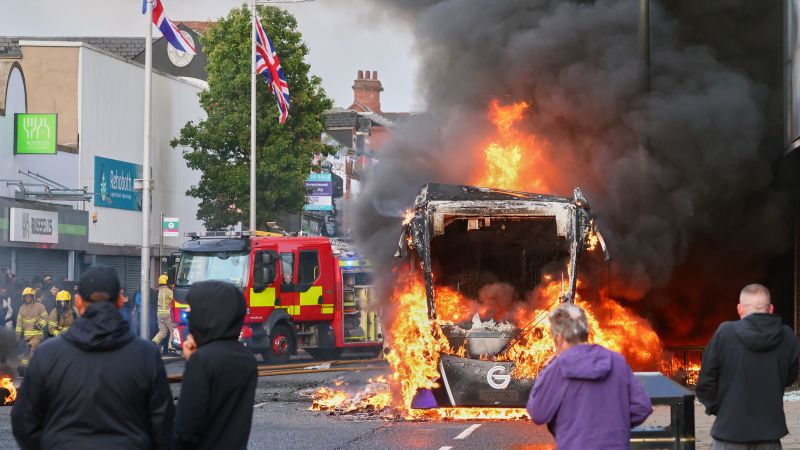
Protesters set vehicles and homes on fire as violence flares over knife attack in Northern Ireland
Protesters set vehicles and homes on fire – Following a knife attack in Northern Ireland that left a man hospitalized, protests erupted across Belfast and neighboring areas on Tuesday evening. Masked groups engaged in destructive acts, targeting vehicles, homes, and public infrastructure. The violence, described by UK Prime Minister Keir Starmer as “horrific,” has drawn widespread attention and condemnation from local leaders.
Belfast sees widespread unrest
On Tuesday night, crowds in Belfast gathered in multiple locations, igniting fires that spread rapidly. Homes were engulfed in flames, and emergency vehicles raced through the streets as firefighters worked to contain the chaos. Video footage verified by CNN shows vehicles being set ablaze and barricades destroyed, with some scenes capturing protesters hurling debris and confronting bystanders. The unrest extended beyond Belfast, with similar incidents reported in Newtown Abbey and Kilkeel, where cars were deliberately ignited, according to geolocated clips shared online.
Political tensions escalate
Claims of racial bias have intensified as the situation unfolds. Northern Ireland First Minister Michelle O’Neill labeled the actions as “outright thuggery,” emphasizing that groups of masked men were “burning families out of their homes.” She warned that the violence undermines the communities they claim to protect, calling it disingenuous to frame such behavior as a legitimate response to the knife attack. The attack itself occurred on Monday night in northern Belfast, where a 30-year-old man was charged with attempted murder after striking another individual with a knife. The victim suffered serious injuries, including wounds to his eyes, back, and face, and remains in a hospital.
“The attack in North Belfast was heinous and wrong. But there are dangerous attempts to exploit that to target and attack innocent people who are simply trying to live, work and raise their families here,” First Minister O’Neill stated on X. “Racism, intimidation and violence are wrong wherever they occur.”
Nationwide protests triggered
The unrest has sparked smaller demonstrations in other British cities, including Bangor, Glasgow, and London. In London, far-right protesters confronted law enforcement, chanting anti-immigration slogans. While the scale of these protests pales in comparison to Belfast’s chaos, they reflect growing concerns about immigration and security. Northern Ireland’s Assistant Chief Constable Ryan Henderson noted that the knife attack is not yet linked to terrorism, though investigations are ongoing. He clarified that the suspect, a Sudanese man, had the legal right to reside in the region.
Community divides deepen
Residents have expressed mixed reactions to the violence. Some support the protests as a justified response to the attack, while others criticize the destruction as excessive. Police have acknowledged “sporadic pockets of disorder” and confirmed that several vehicles were damaged. They urged calm, emphasizing the importance of peaceful protest and responsible behavior. “We must ensure that the anger over this incident does not spiral into wider conflict,” said Police Chief Constable Jon Boutcher, addressing concerns about social media inflaming tensions.
Link to past racial tensions
The current unrest echoes previous incidents of racially motivated violence. A year ago, Ballymena experienced nights of chaos after two Romanian teenagers were accused of sexually assaulting a local girl. Though the charges were later dropped, the event left a lasting impact on community relations. Justice Minister Naomi Long condemned the recent protests, stating that some demonstrators are “intent on wreaking destruction on the very communities they claim they are trying to protect.”
“There is no place for masked thugs to take to the streets and threaten, intimidate, disrupt and cause wanton damage – it is simply disingenuous to claim this is being carried out for the good of Northern Ireland,” Long added in a statement. “While I recognize and understand the concerns following on from the attack in north Belfast, hate cannot be allowed to win.”
Political climate intensifies
The knife attack has intensified debates in the UK over immigration and racial tensions. Last week, the release of bodycam footage showing the death of Henry Nowak, a white student stabbed by police in December, sparked national outrage. Critics accused authorities of using the incident to stoke racist sentiments, while far-right groups amplified the narrative to attack immigration policies. Prime Minister Starmer echoed these concerns, calling the recent violence “horrific” and “sickening,” and vowing “absolutely no tolerance for abhorrent scenes of violence like this on our streets.”
“My thoughts are first and foremost with the victim, and I thank the first responders, including members of the public who intervened,” Starmer said. “This attack has reignited discussions about the role of immigration in shaping public discourse and community safety.”
Unanswered questions remain
Despite the chaos, key questions about the knife attack remain unresolved. While the suspect is a Sudanese man, there is no evidence yet linking the incident to terrorism. Northern Ireland’s police are still in the early stages of their investigation, with no clear motive identified. The attack was captured on video by a witness, who recorded the man pinning another individual, whose head was covered in blood, before bystanders and officers intervened. The footage, which has gone viral, highlights the severity of the attack and the immediate community reaction.
Call for clarity and unity
As the situation unfolds, leaders are urging citizens to remain united and avoid knee-jerk reactions. “We must not let people who know nothing about Northern Ireland impact on the behaviors of our people from afar through social media,” Boutcher emphasized. He stressed the need for facts to guide public sentiment rather than misinformation. Meanwhile, Kemi Badenoch, head of the Conservative Party, quickly tied the attack to illegal immigration, though she provided no concrete evidence. “It is crucial that police bring out the facts as quickly as possible so the public can understand the full picture,” she asserted.
The incident underscores the fragile balance between security concerns and community tensions in Northern Ireland. With the potential for further unrest, officials are racing to address both the immediate crisis and the broader narrative surrounding the attack. As fires continue to spread and voices grow louder, the path forward will depend on how effectively these issues are managed and how the public perceives the motives behind the violence.
