
Top-ranked Aryna Sabalenka: ‘Just want to quit tennis’ after French Open quarterfinal defeat
Top-Ranked Aryna Sabalenka: ‘Just Want to Quit Tennis’ After French Open Quarterfinal Defeat
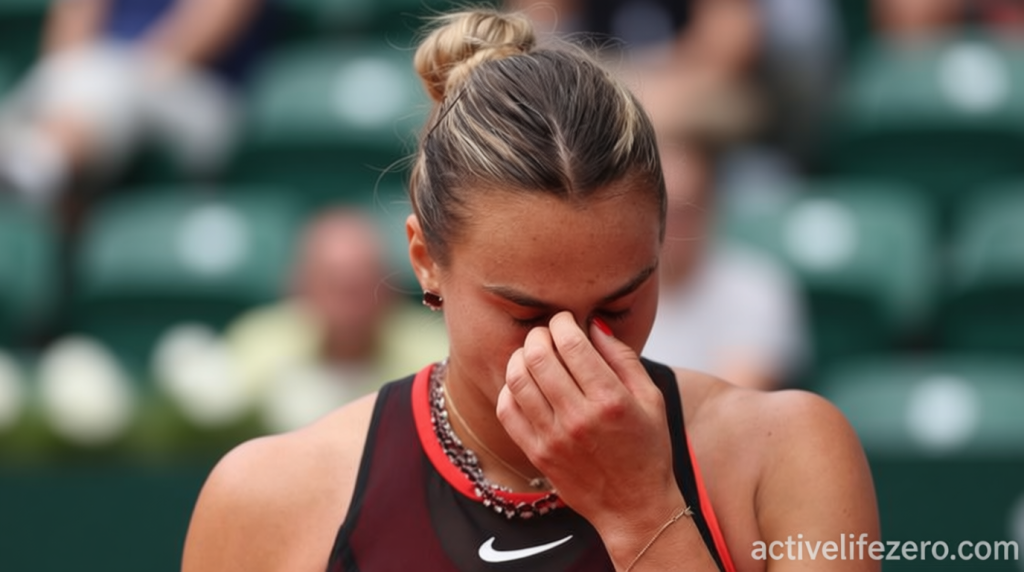
Top ranked Aryna Sabalenka – Following a second consecutive match where a significant advantage vanished, top-ranked Aryna Sabalenka expressed frustration over her recent performance at the French Open. After a third-set collapse against Diana Shnaider, the Belarusian star admitted she felt compelled to distance herself from the courts. “I just want to quit tennis right now,” Sabalenka said following a 3-6, 7-5, 6-0 loss in the quarterfinals on Wednesday. She acknowledged the need for mental recovery, stating, “We’ll see in a few days. Hopefully, I’ll get back on track mentally.”
Sabalenka’s path to a first French Open title has been a long one, but her setback on Wednesday reignited concerns about her form. Despite leading 4-1 in the second set and holding a 30-15 advantage while serving for the match at 5-4, the four-time Grand Slam champion saw her momentum vanish. Shnaider, a first-time grand slam quarterfinalist, capitalized on Sabalenka’s inconsistency, winning 12 of the final 13 games in the decisive set. The 23-year-old Russian, who had previously been a spectator in major tournaments, displayed remarkable composure under pressure, contrasting sharply with Sabalenka’s visible agitation.
“I just think it’s a combination of everything,” Sabalenka lamented. “You overthink, then you make easy mistakes, then you miss opportunities.”
The match unfolded in challenging conditions, with wind disrupting rallies and amplifying Sabalenka’s frustration. Her outbursts—shouting to herself, glaring at her team, and even screaming after a critical error—echoed her struggles in the 2023 U.S. Open final. “You know those rooms where you just go in and smash everything,” she added, reflecting on her emotional response. “Probably I will spend a whole day tomorrow over there destroying stuff. Maybe it will help, maybe not.”
Sabalenka’s defeat added to a growing list of surprises in this year’s French Open. Earlier in the tournament, defending champion Coco Gauff had been eliminated in the third round, while Iga Swiatek, the four-time title holder, fell at the fourth round. This trend of upsets continued as top-seeded Jannik Sinner also suffered a second-round exit, and 24-time Grand Slam winner Novak Djokovic was ousted in the third round. These early exits have created a more open field, with unheralded players now vying for a place in the semifinals.
The Italian contingent has been a standout in this year’s competition, with Flavio Cobolli’s victory over No. 4 seed Felix Auger-Aliassime in the men’s quarterfinals securing a finalist from the country. Cobolli, the 10th seed, defeated the Canadian in a grueling four-set battle (4-6, 6-4, 6-4, 6-4), ensuring that Italy will have a representative in the semifinals. His opponent will be either Matteo Berrettini or Matteo Arnaldi, the latter of whom was still playing in the later stages of the tournament. Berrettini, a former French Open finalist, had earlier showcased his resilience, while Arnaldi’s deep run highlights the potential of Italian tennis on clay.
In the women’s draw, Diana Shnaider’s triumph over Sabalenka marked a significant milestone. The 22-year-old Russian, making her grand slam quarterfinal debut, proved her ability to handle pressure. “Well, honestly I am speechless. Super happy,” Shnaider said after the win. “I feel like I was trying to focus point by point. Not thinking about the score. She is the world No. 1, so I just tried to do my best. I just had to fight for every point.” Her performance, characterized by disciplined play and tactical precision, signaled the arrival of a new generation of contenders.
Meanwhile, Maja Chwalinska made history by becoming only the second Polish woman to reach the Roland Garros semifinals. The unseeded 24-year-old defeated No. 22 seed Anna Kalinskaya in a tightly contested match (7-6(3), 6-3), extending her remarkable run in the tournament. Chwalinska’s achievement has been compared to the inspirational journey of Emma Raducanu, the British qualifier who captured the 2021 U.S. Open title at 18. “It was such an impressive run, you know,” Chwalinska recalled. “Also, she was so young.” Her own path to the semifinals included three grueling qualifying rounds, where she demonstrated unwavering determination.
Rolland Garros: A Visual Guide to the 125th Edition of the Iconic Clay Court Grand Slam
The 125th edition of the French Open has already set the stage for dramatic moments. From the thunderous applause of the Roland Garros crowd to the shifting dynamics of the tournament, this year’s event is shaping up as one of the most unpredictable in recent memory. The absence of former champions in the semifinals—a first since 1977—has created a sense of novelty, with fresh faces and emerging talents taking center stage.
Chwalinska’s victory over Kalinskaya underscored the unpredictability of the women’s draw. The Polish player’s big forehand from the back of the court, which went out of bounds, became a pivotal moment in the match. Her ability to capitalize on such errors and maintain composure under pressure has positioned her as a serious contender in the later stages. For Chwalinska, the triumph was not just about the win but also about proving her place in the upper echelons of women’s tennis.
Sabalenka’s defeat to Shnaider, however, raised questions about her ability to sustain momentum in high-stakes matches. Despite her status as a top seed and former Grand Slam winner, the Belarusian star struggled to find her rhythm, particularly in the final set. Her frustration was palpable, with moments like crouching and resting her head on her racket after a missed volley becoming symbolic of her emotional state. These displays contrasted with Shnaider’s calm, methodical approach, which allowed her to seize the opportunity and dismantle Sabalenka’s confidence.
Looking ahead, the semifinals promise to be a thrilling clash of styles and talents. On the men’s side, second-seeded Alexander Zverev will face No. 26 seed Jakub Mensik, while on the women’s side, Chwalinska’s opponent will be either Shnaider or another unseeded challenger. The tournament has already defied expectations, with multiple top seeds falling early and unseeded players making waves. This unpredictability has added layers of excitement, making the 2026 French Open a story of resilience, surprises, and the emergence of new stars.
For Sabalenka, the loss to Shnaider serves as a reminder of the fine line between triumph and defeat. Her journey to the quarterfinals had been one of dominance, but the final set exposed vulnerabilities that will need addressing. “I just have to sit back and openly think about what’s going on in my head in those tough moments,” she said, reflecting on the mental hurdles that have plagued her recent matches. “Because I’m quite an experienced player. I have been through so many things, and I overcome so many things.” Her words hint at a broader narrative of perseverance, as she seeks to rebound from this setback.
As the French Open progresses, the spotlight will shift to the underdogs who have defied the odds. The tournament’s rich history of upsets—dating back to the 1977 edition—suggests that the next few days could bring more unexpected results. Whether Sabalenka can reclaim her form or Shnaider will continue her ascent, the 125th French Open is already a testament to the sport’s ability to surprise even the most seasoned players. The competition remains fierce, and the narrative is far from over.
