
The Milky Way ate another galaxy. Scientists say they’ve found the scraps
The Milky Way ate another galaxy. Scientists say they’ve found the scraps
The Milky Way ate another galaxy – In a groundbreaking discovery, a peculiar grouping of stars may hold the key to understanding a dwarf galaxy that the Milky Way consumed approximately 10 billion years ago. Researchers have named this ancient galaxy Loki, drawing inspiration from the Norse deity of trickery, to emphasize its enigmatic role in the galaxy’s history. This revelation could reshape current theories about the Milky Way’s development during its formative stages, offering new insights into the processes that shaped our cosmic home.
Galactic Mergers and the Milky Way’s Growth
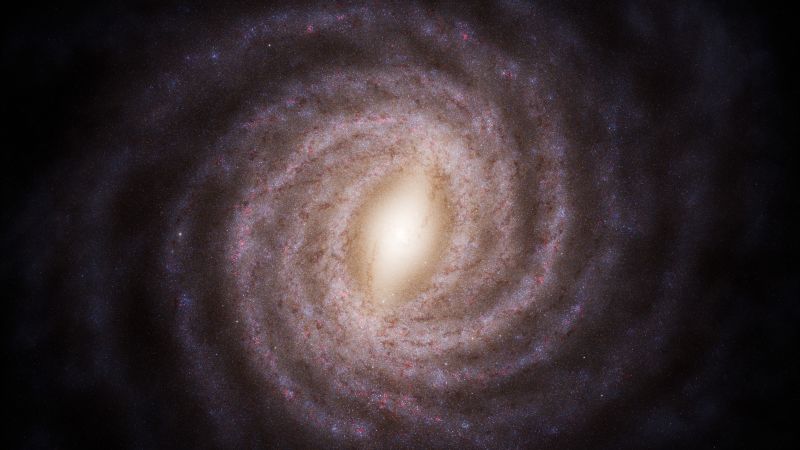
The Milky Way, a sprawling spiral galaxy spanning roughly 100,000 light-years, is home to between 100 billion and 400 billion stars, as noted by NASA. A light-year, the measure of distance light travels in a year, equals about 5.88 trillion miles or 9.46 trillion kilometers. However, the galaxy’s current size and mass are not the result of an instant event but rather a gradual accumulation over billions of years. Early in its history, the Milky Way began as a smaller system, growing by absorbing smaller galaxies, particularly dwarf galaxies, through mergers.
While the overall narrative of galactic evolution is well-established, the exact details of these mergers remain uncertain. Scientists are still piecing together the timeline of how the Milky Way expanded to its present form, and the remnants of its past meals could provide critical clues. In this context, the discovery of Loki stands out as a potential missing link, challenging assumptions about the galaxy’s early interactions with other cosmic structures.
Unusual Star Clusters and Their Significance
A recent study, published in May 2026 in the journal *Monthly Notices of the Royal Astronomical Society*, has focused on a cluster of stars with minimal metal content, located unusually close to the galactic disk. These stars, which lack heavier elements, are thought to have formed in the universe’s infancy, when only hydrogen and helium were abundant. Their presence near the disk is surprising, as such ancient stars are typically found in the galaxy’s outer regions.
Dr. Federico Sestito, a postdoctoral fellow at the University of Hertfordshire’s Centre for Astrophysics Research, and his team identified 20 of these metal-poor stars using data from the European Space Agency’s Gaia telescope. The telescope mapped the motion and chemical makeup of over 2 billion stars across the Milky Way between 2014 and 2025. To refine their analysis, the researchers employed the high-resolution spectrograph on the Canada-France-Hawaii Telescope, situated on Maunakea, Hawaii, to examine the stars’ compositions in greater detail.
Although the precise age of the stars is still under investigation, their chemical profiles indicate they are older than 10 billion years. Moreover, their proximity to the galactic disk—approximately 7,000 light-years from our solar system—suggests they may have been part of a larger system that was disrupted. The consistency in their compositions further points to a common origin, implying they all emerged from the same dwarf galaxy that was later devoured by the Milky Way.
Orbital Clues and Cosmic Origins
The study’s findings also reveal intriguing patterns in the stars’ orbital movements. Eleven of the identified stars follow prograde orbits, aligning with the Milky Way’s rotation, while nine exhibit retrograde orbits, moving in the opposite direction. This dual motion could be interpreted as evidence of the dwarf galaxy’s gravitational influence before it was absorbed. The retrograde stars, in particular, may have been torn from the original galaxy during the collision, leaving behind a trail of evidence.
“These stars act like cosmic time capsules,” said Dr. Cara Battersby, an associate professor of physics at the University of Connecticut, who was not involved in the research. “Their chemical makeup and movement patterns provide a window into the conditions that existed when the universe was young.” By analyzing the stars’ characteristics, scientists can reconstruct the environment of the early Milky Way and understand how it interacted with other galaxies during its growth phase.
“VMP stars have been around for billions of years, holding within them clues to the formation of the Universe’s earliest generations of stars,” Battersby added in an email.
The search for such stars has traditionally focused on the Milky Way’s stellar halo, a diffuse, round cloud surrounding the disk. However, this new discovery suggests that evidence of ancient mergers may also be embedded deeper within the galaxy, hidden in plain sight. The implications of this finding extend beyond just the Milky Way’s history, as it could also shed light on the broader processes of galaxy formation in the early universe.
Challenges and Future Directions
Spotting metal-poor stars near the galactic disk has been difficult due to the dense concentration of younger, metal-rich stars and interstellar dust. Sestito acknowledged this challenge, noting that the presence of these stars in such an environment is a “surprising” but significant indicator of past galactic interactions. “Their survival in the disk suggests they were part of a larger system that endured the Milky Way’s expansion,” he explained.
Further research is needed to determine whether these stars represent a single event or part of multiple mergers. The study’s authors plan to conduct additional observations to confirm the stars’ origins and assess their distribution. Such efforts could refine models of the Milky Way’s evolution, particularly in the early epochs when it was still forming. As Sestito emphasized, “Each star we analyze adds another piece to the puzzle of how galaxies like ours grow and change over time.”
The Broader Impact of the Discovery
This discovery not only deepens our understanding of the Milky Way’s past but also highlights the importance of studying metal-poor stars as tools for cosmic archaeology. These stars, with their pristine chemical compositions, serve as markers for the early universe’s conditions, offering a glimpse into the processes that led to the formation of heavier elements and the subsequent birth of new stars. By tracing their paths, scientists can reconstruct the history of the Milky Way and its interactions with other galaxies, even those that no longer exist.
Additionally, the findings may have implications for theories involving dark matter. Some researchers speculate that the mysterious glow observed in certain galactic regions could be linked to dark matter interactions, and Loki’s remnants might provide a new avenue for testing these ideas. While the connection remains speculative, the study underscores the potential for uncovering hidden truths about the Milky Way’s origins through innovative observational techniques.
As the field of galactic archaeology advances, the search for such remnants will continue to yield valuable data. The identification of Loki not only expands our knowledge of the Milky Way’s history but also reinforces the idea that the universe’s evolution is shaped by a series of dynamic events, from the formation of the first stars to the absorption of entire galaxies. These stars, though ancient and scattered, remain vital to understanding the cosmic story they help to tell.
