
Putin flexes muscle with test of powerful nuclear-capable missile
Putin Flexes Muscle with Test of Powerful Nuclear-Capable Missile
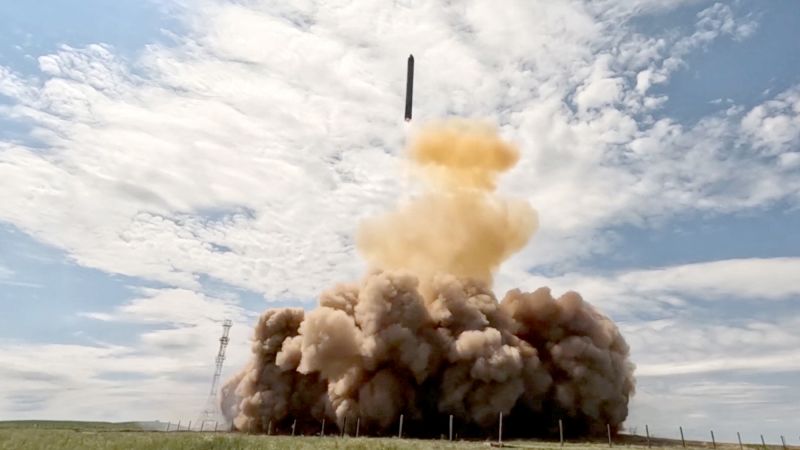
Putin flexes muscle with test of powerful – Russian President Vladimir Putin declared on Tuesday that the world’s most formidable missile system, referred to by NATO as “Satan II,” is now on track to be deployed for operational use by the close of the year. The announcement followed a successful test launch, which marked a significant milestone in the development of the RS-28 Sarmat, a silo-launched intercontinental ballistic missile (ICBM). According to the Missile Defense Advocacy Alliance, a U.S.-based nonprofit, the Sarmat is designed to travel over 10,000 kilometers (6,200 miles) and carry up to 16 independently targeted nuclear warheads. Putin, however, asserted that the missile’s range exceeds 35,000 kilometers (21,750 miles), emphasizing its strategic advantage over Western counterparts.
Technical Specifications and Strategic Implications
The Sarmat, which the Center for Strategic and International Studies (CSIS) identifies as the long-awaited replacement for Russia’s aging SS-18 ICBM, was first introduced under Soviet rule in the 1970s and later named “Satan” by NATO. Its development has been a priority for Russia, with initial plans to deploy it in 2018. Yet, the program has encountered setbacks, including a failed test in September 2024. Satellite imagery at the time revealed a crater measuring approximately 200 feet in diameter at the Plesetsk Cosmodrome, the missile’s launch site in the northwestern Arkhangelsk region.
Despite these challenges, Putin has repeatedly highlighted the missile’s capabilities, with his remarks suggesting imminent readiness. Astra, a Russian Telegram channel classified as a foreign agent by the government, expressed doubt, noting that the leader has mentioned the Sarmat’s operational status at least 10 times since 2021. The missile’s reliance on liquid fuel, as reported by various sources, adds to its complexity, requiring pre-launch preparation that contrasts with the faster deployment of solid-fueled systems. This characteristic, however, may be a strategic choice to showcase technological prowess.
Russia’s nuclear arsenal is among the largest globally, with more than 5,500 warheads in inventory, according to the International Campaign to Abolish Nuclear Weapons. The United States, meanwhile, maintains just over 5,000 warheads. The Sarmat’s introduction is seen as a critical enhancement to this stockpile, with its payload capacity significantly surpassing that of existing systems. Putin described the missile’s combined yield as more than four times greater than any Western counterpart, underscoring its potential to alter the balance of power in global nuclear strategy.
Victory Day Parade and Security Context
The timing of the Sarmat test coincides with a subdued Victory Day Parade held on May 9, marking the 78th anniversary of the Soviet Union’s victory over Nazi Germany in World War II. The event, which was the most scaled-down since 2008, featured no military hardware displays for the first time in nearly two decades. Russian authorities attributed the reduced scale to security concerns, citing recent Ukrainian strikes targeting oil refineries and other infrastructure within Russian territory.
Putin, addressing journalists after the parade, explained that the armed forces should prioritize the “decisive defeat of the enemy” in what the Kremlin calls its “special military operation” in Ukraine. This rationale reflects a broader shift in Russia’s approach to public demonstrations of military strength, emphasizing operational focus over ceremonial displays. The parade in Moscow’s Red Square, however, included giant screens that aired pre-produced videos purportedly showcasing frontline activities, offering a narrative of ongoing combat efforts.
Amid the parade’s subdued tone, the Kremlin highlighted a personal moment involving Putin. On Monday, the leader was seen personally picking up his former schoolteacher, Vera Gurevich, from a hotel in Moscow. The event, which included a bouquet of flowers and a warm embrace, was followed by a dinner at the Kremlin. The Kremlin later confirmed that Putin had invited Gurevich to attend the Victory Day festivities and spend several days in the capital, a gesture intended to project a softer image of leadership.
Security Measures and International Perceptions
Russia’s increased emphasis on personal security for Putin has drawn attention from European intelligence agencies. A report obtained by CNN and other media outlets noted that the Kremlin has expanded protective measures around the leader and limited his public appearances to fewer locations. This shift, which the Kremlin has dismissed as overblown, aligns with the broader context of the Sarmat test and the parade, both of which underscore the nation’s readiness to demonstrate military capability.
The test of the Sarmat missile, alongside the pared-down parade, has sparked debate about Russia’s strategic priorities. While the parade lacked traditional displays of military hardware, the Sarmat’s successful launch signals a renewed commitment to nuclear deterrence. Analysts suggest that the test’s timing was deliberate, serving as a reminder of Russia’s technological and strategic advancements in the face of ongoing conflicts and international scrutiny.
Putin’s comments during the parade further reinforce this narrative. By framing the military’s focus as essential to achieving victory in Ukraine, he positions the Sarmat as a key asset in the war effort. This rhetoric may aim to bolster domestic morale while projecting strength to global adversaries. The missile’s potential to deliver a massive strike range and multiple warheads could be a deterrent against NATO intervention, particularly as tensions in Eastern Europe continue to rise.
The Sarmat’s development has been a long-term project, with the alliance noting that it has faced numerous challenges since its inception in 2011. The recent test, however, appears to have resolved key uncertainties, paving the way for its deployment. While the missile’s technical specifications are impressive, its real-world effectiveness remains a subject of discussion. The CSIS report highlights that the Sarmat’s success could mark a turning point in Russia’s nuclear capabilities, offering a modern alternative to the SS-18, which has been a cornerstone of the nation’s arsenal for decades.
As the Sarmat nears operational status, its implications for global security are significant. The missile’s ability to carry multiple warheads and its extended range could enhance Russia’s strategic flexibility. Analysts point out that such advancements might be used to target both conventional and nuclear threats, reinforcing the idea of a diversified and robust nuclear force. The test serves as a clear signal to the world that Russia is not only maintaining its nuclear edge but also advancing it in response to evolving geopolitical dynamics.
Brad Lendon reported from Seoul, providing updates on the latest developments in Russian military capabilities. The successful test of the Sarmat missile, combined with the strategic decisions surrounding the Victory Day Parade, illustrates a calculated approach to projecting power. Whether this marks a permanent shift in Russia’s military posture or a temporary measure remains to be seen, but the message is unequivocally one of strength and preparedness.
