
The middle is a ‘unique place to be’ — what it’s like in the dead-center of America
The middle is a ‘unique place to be’ — what it’s like in the dead-center of America
The middle is a unique place – Reaching the precise center of the United States requires more than just a compass; it demands a commitment to an old-fashioned adventure. The road to this geographical landmark is a winding route through open plains and quiet landscapes, where the world feels less crowded and the air carries the scent of untamed nature. For many, this journey symbolizes the spirit of the American road trip—a chance to escape the hustle of modern life and immerse oneself in the heart of the country’s vast expanse.
A question of coordinates
The concept of “Middle America” is as fluid as the weather patterns that shift unpredictably over the plains. It can mean different things to different people: to some, it’s the cultural core of the nation, a place where the rhythm of life is shaped by small towns, family values, and a shared sense of familiarity. To others, it’s a physical location, a spot determined by calculations that have evolved since the nation’s borders expanded in 1959. Despite these varying interpretations, one fact remains clear—there is no universally agreed-upon point that defines the center.
“There is no generally accepted definition of geographic center, and no completely satisfactory method for determining it.”
This ambiguity has led to endless debate. Some argue that the center lies in the Dakotas, while others point to Kansas as the ultimate midpoint. The US Department of the Interior’s 1964 report captured the frustration of this uncertainty, noting that even the most precise measurements fall short of a definitive answer. Yet, for a time, there was clarity. Before Alaska and Hawaii were added to the map, a practical approach was taken: experts at the US Coast and Geodetic Survey crafted a cardboard cutout of the contiguous United States and balanced it on a pin to find its center of gravity. The result? A spot in northern Kansas, just beyond the outskirts of Lebanon, where the journey’s end feels both ordinary and extraordinary.
A road that time forgot
The 260-mile drive west from Kansas City is more than a mere distance—it’s a temporal shift. As the asphalt roads stretch toward the horizon, the landscape transforms from the familiar to the almost forgotten. Along the way, historic markers and roadside attractions offer glimpses into a bygone era. For instance, near Topeka, I-70 passes a sign that reads: “The next eight miles were the first section of interstate in the United States.” This stretch, opened in 1956, was the catalyst for President Dwight D. Eisenhower’s vision of a highway network designed to unite the nation. Yet, even as it marks the dawn of modern infrastructure, the road itself feels like a relic of simpler times.
Kansas, often described as a sea of flatness, reveals its charm in unexpected ways. The terrain undulates gently under the vast sky, with the horizon shimmering like a mirage. The air is thick with the hum of distant radio signals, and the quiet stretches between towns are punctuated by the occasional rustle of wind through the grass. As the route veers into rural roads, the pace slows, and the traveler is invited to savor the serenity of this unassuming land.
The ball of twine and the towns that guard it
Before the final stretch, the road leads to Cawker, a small community about 25 minutes from the center. Here, a whimsical spectacle awaits: the world’s largest ball of twine. This bizarre creation, housed in a weathered gazebo by the side of Route 24, has become a symbol of quirky Americana. Crafted from over 8,500,000 feet of sisal string, the ball weighs more than 27,000 pounds and was first spun by Frank Stuber, a local farmer, in 1953. It has been a fixture in Cawker since 1961 and even outgrew a rival in Minnesota in 1982 to claim its title.
Visitors are drawn not only by its size but by its character. The ball of twine is more than a tourist trap—it’s a testament to the ingenuity of rural life. Its presence has inspired a cultural phenomenon, with locals proudly displaying it as a centerpiece of their town. Even the water tower in Cawker mirrors the ball’s bulbous shape, a subtle nod to its iconic status. The visitor book is filled with names from across the globe, each adding a thread to the tapestry of this peculiar attraction.
The heart of the lower 48
When the journey reaches its climax, the dead-center of the “lower 48” emerges unexpectedly. Located off Highway 281, just north of Lebanon, this patch of Kansas holds a quiet dignity. While its selection was somewhat arbitrary—based on the old cardboard map and a pin’s balance—it has become a place of quiet significance. The community around it, though modest, carries a deep connection to the land and its history.
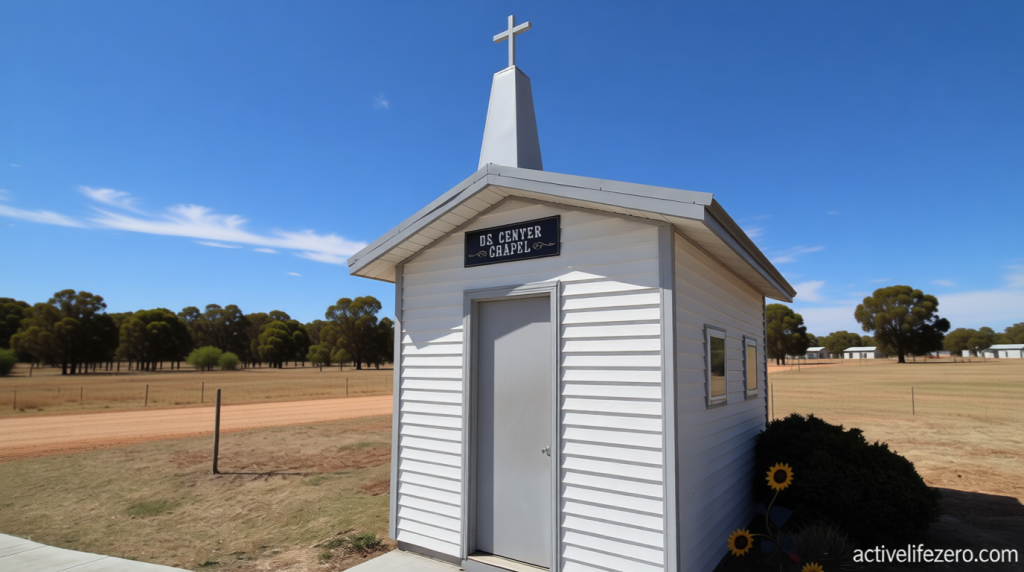
A small, white one-room chapel sits nearby, its roof gently sloping like the hills that surround it. Pine trees, planted with purpose, line the paths, offering shade and a sense of rootedness. The absence of noise and the presence of open skies create an atmosphere that feels both timeless and intimate. For those who have romanticized the heartland, this location is a tangible reminder of what lies beyond the edges of urban life. It’s a place where the rhythm of the day is dictated by the sun and the seasons, and where the past lingers in every corner.
As the traveler arrives, the road trip reaches its climax. The journey has been a blend of challenge and wonder, where each mile unveiled a new layer of the American landscape. The drive through Kansas, with its patchwork of fields and tiny towns, has been a journey through the soul of the nation. And though the exact center may never be universally agreed upon, the experience of reaching it is unforgettable. It’s a place that defies the noise of the world, where the simplicity of life feels profound and the essence of Middle America is captured in a single, unassuming location.
In the end, the middle of America is not just a destination—it’s a feeling. It’s the sense of arriving somewhere meaningful after a long, winding journey. It’s the quiet pride of a community that has embraced its place in the national narrative. And it’s the reminder that even in a world of constant change, there are spots that remain etched in memory, waiting for those who seek them with open roads and open hearts.
