
Why the search for Lynette Hooker just resumed 2 months after her disappearance in the Bahamas
Why the search for Lynette Hooker just resumed 2 months after her disappearance in the Bahamas
Why the search for Lynette Hooker – Two months have passed since the mysterious vanishing of Lynette Hooker in the Bahamas reignited a renewed search effort. The Coast Guard has returned to the island nation to investigate anew, this time focusing on a different stretch of the Sea of Abaco. The 55-year-old woman disappeared on the night of April 4, 2026, when her husband claimed the couple was en route to their yacht after a dinner in the Abaco Islands. Her husband, Brian Hooker, described the incident to police, stating that Lynette had fallen from an 8-foot dinghy during turbulent waters. However, discrepancies between the location data and his statements to investigators have cast doubt on the accuracy of his account, according to a US official involved in the criminal inquiry.
The Disappearance and Initial Search
On the night of April 4, Lynette Hooker, an avid sailor, and her husband were traveling by dinghy toward their yacht after a meal in the Abaco Islands. Brian Hooker told authorities that the couple encountered rough seas, causing Lynette to fall into the water. “She was swimming toward the sailboat, and we lost sight of each other pretty quickly as it was just about sundown,” he recounted to his friend Daniel Danforth over Facebook Messenger. This account has since been scrutinized alongside satellite data and other evidence. The inconsistencies have led to questions about whether her disappearance was an accident or something more deliberate.
“She was swimming toward the sailboat, and we lost sight of each other pretty quickly as it was just about sundown,” Brian Hooker told his friend Daniel Danforth over Facebook Messenger.
In the immediate aftermath, local police in Abaco, along with the Royal Bahamas Defence Force and fire and rescue teams, launched a search of the surrounding waters. Within hours, the Coast Guard joined the operation by air, deploying drones and professional divers to cover the area. The search initially aimed to locate Lynette alive, but it quickly transitioned to a recovery mission on April 7. By the following day, the Coast Guard had initiated a criminal investigation, examining whether her death might have been intentional.
Challenges in the Investigation
The investigation has been complicated by conflicting details in Brian Hooker’s statements. He initially reported that the dinghy lost power when Lynette fell, because she had the engine safety key. This explanation, however, does not align with the location data from electronic devices, which suggest a different route or speed than what he described. The US official noted that these inconsistencies have prompted investigators to revisit the timeline of events and the circumstances of the incident.
As part of the criminal inquiry, the Coast Guard has taken custody of the 8-foot dinghy Hooker claimed his wife fell from. The boat is now being analyzed for any clues that might explain what happened. Additionally, search teams have been combing the shoreline for physical evidence, including traces that could indicate Lynette’s presence or movement. Cadaver dogs have been deployed to sniff out any signs of her remains, adding another layer of forensic detail to the investigation.
The New Search and Its Significance
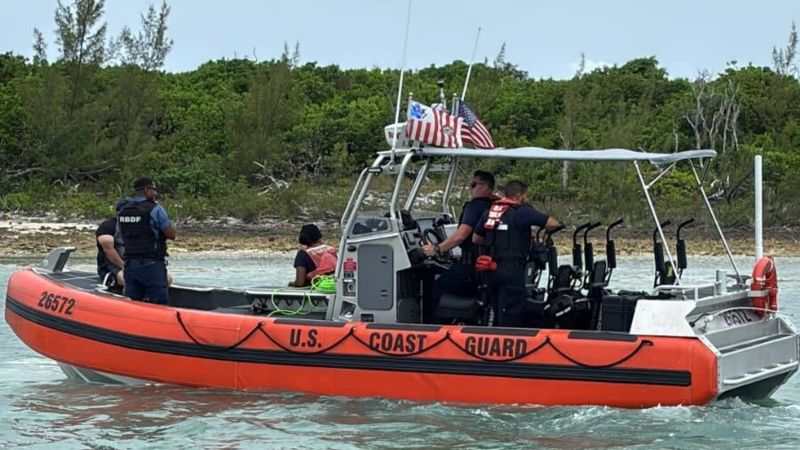
Now, two months after Lynette’s disappearance, the Royal Bahamas Police Force has granted the Coast Guard permission to conduct another search in a different area of the Sea of Abaco. The new location is near Elbow Cay, a small island off the coast of Great Abaco, which Brian Hooker said they were heading to. On Wednesday afternoon, a bright orange Coast Guard dinghy was seen navigating waters near Hope Town, accompanied by a Royal Bahamas Defence Force vessel. Searchers disembarked the boat and waded into the shallow waters, carefully scanning the area for any signs of the missing woman.
As of Thursday morning, divers had entered the water in the Sea of Abaco, intensifying efforts to uncover what happened. This renewed search follows the discovery of contradictions in Hooker’s timeline, which led to the decision to expand the investigation. The official emphasized that the new search is focused on areas not previously covered, increasing the chances of finding new evidence that could shed light on Lynette’s fate.
Hooker’s Account Under Scrutiny
Brian Hooker, who has consistently denied any wrongdoing, initially told police that after Lynette fell into the water, he paddled toward shore for hours before reaching a boatyard in Hope Town. There, he contacted authorities for assistance, according to Richard Cook, the fire team lead with Hope Town Volunteer Fire and Rescue. “He paddled for hours before reaching the shore and seeking help,” Cook said in an update. However, investigators have since questioned the accuracy of this timeline, particularly regarding the dinghy’s movement and the conditions of the water during the incident.
The Coast Guard’s criminal investigation has been further complicated by Hooker’s actions. After being questioned as a suspect, he was released and promptly returned to the United States. His absence from the Bahamas has raised additional questions about his role in the disappearance. While no suspect has been publicly identified in the federal probe, the search teams are working tirelessly to piece together the events of that night. The new search in the Sea of Abaco aims to address gaps in the previous investigation and uncover any overlooked details.
The challenges facing the Coast Guard investigators are both technical and logistical. The Sea of Abaco, known for its unpredictable currents and deep waters, presents a difficult environment for search operations. The use of advanced technology, including drones and sonar equipment, has been critical in covering vast areas efficiently. However, the search team must also contend with the passage of time, as evidence may degrade or be harder to locate in two months.
Despite these challenges, the renewed search offers a fresh opportunity to uncover the truth. The location data from Hooker’s electronic devices, combined with the testimonies of witnesses and the physical evidence gathered so far, forms the foundation of the investigation. If Lynette’s remains are found, they could provide crucial insights into whether her death was accidental or intentional. The Coast Guard remains committed to uncovering the full story, even as the case continues to evolve with each new development.
