
US Marine Corps retires the first fighter jet that didn’t need a runway
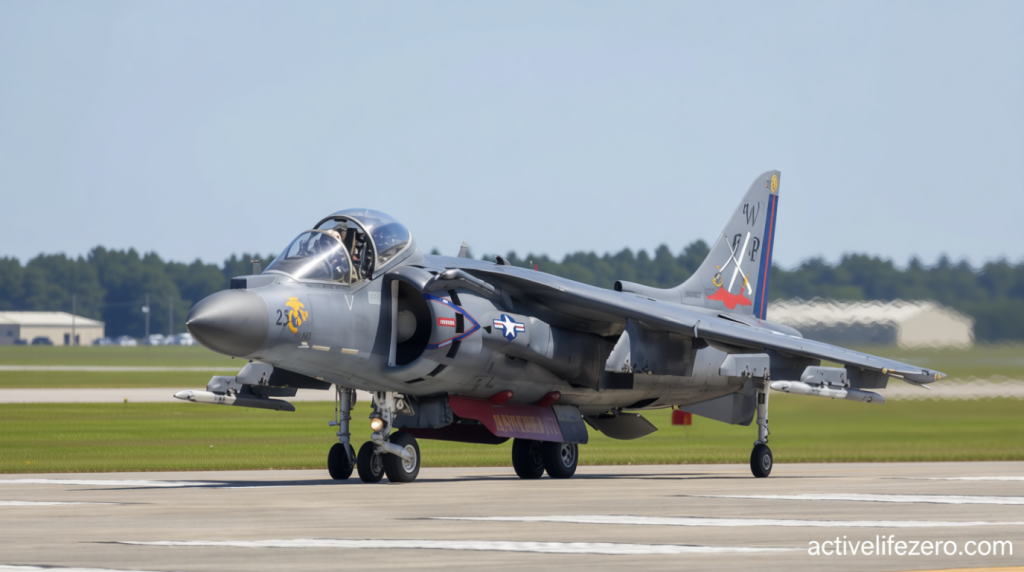
US Marine Corps Bids Farewell to the Iconic ‘Jump Jet’
US Marine Corps retires the first – The United States Marine Corps marked a significant milestone on Wednesday with the retirement of the AV-8B Harrier II, a groundbreaking vertical takeoff and landing jet that has served the military for five decades. This aircraft, known as the “jump jet,” has long been a symbol of Marine aviation’s ingenuity, drawing admiration from air show enthusiasts and leaving an indelible mark on military history. The event, held at Marine Corps Air Station Cherry Point in North Carolina, celebrated the end of an era for the last active unit to operate the Harrier, with around 5,000 attendees witnessing its final displays of capability.
A Legacy of Versatility and Innovation
At the heart of the Harrier’s appeal was its revolutionary design, allowing it to take off and land vertically without the need for a traditional runway. This feature made it uniquely suited for operations in rugged terrain or from the decks of amphibious assault ships, enabling Marines to project power rapidly across contested areas. According to Lt. Col. John B. Cumbie, commanding officer of Marine Attack Squadron 223, the Harrier’s ability to “forward deploy globally” and its “legendary V/STOL” system have cemented its reputation as a combat force multiplier. The ceremony honored not just the aircraft itself, but the personnel who operated it, highlighting its role in shaping modern warfare.
Engineered with a single turbofan engine, the Harrier’s thrust vectoring system—four nozzles that could pivot between horizontal and vertical positions—was a technological marvel. This innovation allowed the jets to function in environments where conventional planes would be grounded, such as during the 1991 Operation Desert Storm. Gen. Norman Schwarzkopf, the US commander at the time, praised the Harrier as one of the seven most critical weapons of the campaign, a testament to its battlefield utility. The aircraft’s adaptability extended beyond war zones, as it played a role in peacekeeping missions and humanitarian efforts, proving its value in diverse scenarios.
From Pop Culture to the Frontlines
While the Harrier’s military achievements are well-documented, its cultural impact is equally noteworthy. The jet became an unexpected symbol of consumerism in the 1990s when Pepsi launched a promotional campaign featuring it as a reward for loyal customers. The Super Bowl ad encouraged people to accumulate 7 million points by drinking Pepsi products, with the promise of winning a Harrier. For those who couldn’t meet the quota through consumption, the company offered a more accessible option: purchasing Pepsi Points for 10 cents each. This loophole led to a frenzy, with a young business student named John Leonard calculating that he could secure the jet for just $700,000—far less than the $23.6 million it cost in the 1990s. Although his bid was ultimately rejected, the story underscores the Harrier’s lasting presence in public imagination.
“
The Harrier didn’t need an airfield. All it needed was a Marine flying it and a few support crew to fill it with gas and load weapons at primitive landing sites.
” — Retired Marine Lt. Col. Mike Rountree, former Harrier pilot
The aircraft’s durability and reliability were further demonstrated by its long service life. The AV-8B, an upgraded version of the earlier AV-8A model, was introduced in 1985 after being developed by McDonnell Douglas. The original Harrier, created by Britain’s Hawker Siddeley in the 1960s, paved the way for the US Marines to adopt the technology in 1971. Over the years, the Harrier participated in numerous conflicts, including the 1999 NATO campaign in Yugoslavia, the Afghanistan war, and the 2011 Libya intervention. Its versatility even extended to the Caribbean Sea, where it supported US operations off the coast of Venezuela before the January capture of Nicolás Maduro.
Transition to the Future of Aviation
As the Harrier retires, the Marine Corps is preparing to replace it with the F-35B, a stealthier vertical takeoff and landing fighter jet. The F-35B, which costs approximately $110 million per unit, has already begun operations aboard amphibious assault ships like the USS Tripoli, where it is deployed in the current conflict with Iran. While the Harrier’s retirement signals the end of its service in the US military, it remains in use by the Italian and Spanish armed forces, which continue to operate the aircraft on smaller ships. For aviation enthusiasts, the remaining Harriers will soon be on display at museums, preserving their legacy for future generations.
The Harrier’s unique capabilities, including its six underwing mounts for bombs or rockets and a 25-millimeter cannon capable of firing 300 rounds, made it a formidable asset. The Wings Over the Rockies aviation museum notes that a fully loaded Harrier carries more firepower than a World War II B-17 Flying Fortress bomber, a comparison that highlights its role in modern aerial combat. Despite its retirement, the aircraft’s influence on military aviation endures, inspiring advancements in aircraft design and operational flexibility.
Retired Lt. Col. Mike Rountree, who flew the Harrier during its peak years, reflected on its significance during the ceremony. “The Harrier’s ability to operate in unconventional environments was unmatched,” he said. “It was more than a machine—it was a symbol of the Marines’ adaptability and courage.” His words resonate with those who remember the jet’s iconic status, both as a military asset and a cultural phenomenon. From its combat record to its role in a viral Pepsi promotion, the Harrier’s story is one of innovation, resilience, and enduring legacy.
As the last US Harrier unit prepares to hang up its wings, the aircraft’s retirement marks a shift in the Marine Corps’ aviation strategy. The transition to the F-35B represents a move toward more advanced technology, yet the Harrier’s contributions remain invaluable. Its ability to redefine the concept of mobility in aerial warfare, combined with its place in pop culture, ensures that it will be remembered as a milestone in military aviation. For the thousands who attended the ceremony, the event was not just a farewell to an aircraft, but a tribute to a generation of pilots and support crews who relied on its unique capabilities to carry out missions in some of the world’s most challenging environments.
The Harrier’s 55-year service has left a lasting imprint on military history. With its distinctive ability to hover and operate from anywhere, it became a staple of rapid response operations. The aircraft’s adaptability allowed it to thrive in a variety of missions, from high-intensity combat to peacekeeping efforts. Even as newer models take its place, the Harrier’s impact on the Marine Corps and global defense strategies will not be forgotten. Its retirement is a bittersweet moment for aviation historians and military personnel alike, as they reflect on the aircraft’s role in shaping modern warfare.
