
UK cyberspying chief says the West is between peace and war as Russia ramps up hybrid attacks
UK Cyberspying Chief Says the West is Between Peace and War as Russia Ramps Up Hybrid Attacks
UK cyberspying chief says the West – At a recent gathering held at Bletchley Park, a historic site in the heart of England, Anne Keast-Butler, the head of Britain’s GCHQ, delivered a stark warning about the evolving landscape of global conflict. The speech, delivered in the shadow of the World War II code-breaking center, underscored the growing urgency of cybersecurity in the face of relentless Russian aggression. Keast-Butler emphasized that artificial intelligence has become a pivotal tool in modern warfare, with its potential to tip the balance between peace and war.
The Role of AI in Cyber Warfare
In her remarks, Keast-Butler highlighted the rapid integration of AI into cyber operations, describing it as an “unstoppable force” that is reshaping the nature of threats. She noted that algorithms are now being weaponized in ways that blur the lines between traditional warfare and digital confrontation. “Tech companies are releasing AI-driven innovations at an astonishing rate, with consequences that could reshape our security frameworks,” she stated. The director stressed that while AI presents unprecedented opportunities, it also introduces significant risks, particularly if not managed with the utmost vigilance.
“I’ve spent three decades working in national security, and the risk of miscalculation is as high as I’ve ever seen it,” Keast-Butler said. “The ground beneath our feet is shifting, and the window for the UK and its allies to stay ahead is narrowing.”
Keast-Butler’s concerns are not unfounded. Russian hybrid attacks have intensified in recent months, with the focus shifting from conventional military strategies to a more insidious blend of cyber, economic, and psychological operations. This approach allows Moscow to exert pressure on the West without triggering a full-scale war, effectively operating in a “gray zone” where the boundaries of conflict are often unclear. The director warned that without a coordinated response, the West risks being outmaneuvered in this new domain of warfare.
Targeting Critical Infrastructure
Russia’s tactics have targeted essential systems across Europe, from power grids to communication networks. Keast-Butler specifically named the nation as a major threat, accusing it of “relentlessly targeting critical infrastructure, democratic processes, supply chains, and public trust” in the UK and its allies. She cited examples of cyber intrusions into energy systems and infrastructure hubs, emphasizing the need to uncover Moscow’s intent and capabilities. “One area in sharp focus for us is protecting the data and energy flowing through the critical cables and pipelines in and around British waters,” she added.
The speech coincided with new intelligence revealing that Russian forces have suffered “almost half a million combat deaths” since the invasion of Ukraine in February 2022. Despite these losses, the Kremlin continues to escalate its hybrid operations, leveraging technology and sabotage to weaken Western nations. Keast-Butler argued that such activities are not just a passing trend but a sustained effort to erode trust and destabilize institutions. “Russia is scaling up its daily hybrid activity against the UK and Europe, stretching from the seabed to cyberspace,” she said.
Global Cyber Threats and the Need for Vigilance
Keast-Butler’s remarks echoed similar warnings from intelligence agencies across the globe. In recent months, Sweden, Poland, Denmark, and Norway have all reported cyberattacks attributed to Russian hackers, targeting key infrastructure such as power plants and dams. These incidents have raised alarms about the vulnerability of democratic systems and the potential for cyber operations to disrupt essential services. The head of the UK’s National Cyber Security Centre, Richard Horne, joined the chorus of warnings, stating that hostile states like Russia, China, and Iran are responsible for the most severe cyber threats the country faces.
“Such attacks could increase dramatically if Britain becomes involved in an international conflict,” Horne said, reinforcing the need for immediate action. “The window for the UK and its allies to stay ahead is narrowing, and we must treat cybersecurity with a level of urgency that matches the gravity of the situation.”
Keast-Butler emphasized that the UK’s strategic position in global cybersecurity is under threat, particularly as China emerges as a dominant science and technology superpower. “Rapid advances in artificial intelligence mean that the ground beneath our feet is shifting, and we must ensure that our defenses evolve at the same pace,” she explained. To counter this, GCHQ is developing a plan to embed cutting-edge AI into cyber defense systems, aiming to enhance response times and predictive capabilities.
Historical Context and Strategic Partnerships
The GCHQ director’s speech took place at Bletchley Park, a manor house 45 miles northwest of London, where during World War II, a team of mathematicians, cryptographers, and experts successfully cracked Nazi Germany’s Enigma code. This historical backdrop served as a reminder of the importance of collaboration and innovation in intelligence. Keast-Butler, the first woman to lead the agency, drew parallels between past successes and current challenges, stressing that the modern era demands a similar level of strategic coordination.
She also highlighted the importance of international partnerships, particularly the UK-US intelligence alliance. “The UK-US intelligence partnership is fundamental for the security of both our nations,” Keast-Butler said. However, she noted that recent shifts in US foreign policy, including President Donald Trump’s “America First” approach, have strained these relationships. “If we are to face a new age of cyber threats, we need to reinforce our alliances and ensure mutual trust,” she argued.
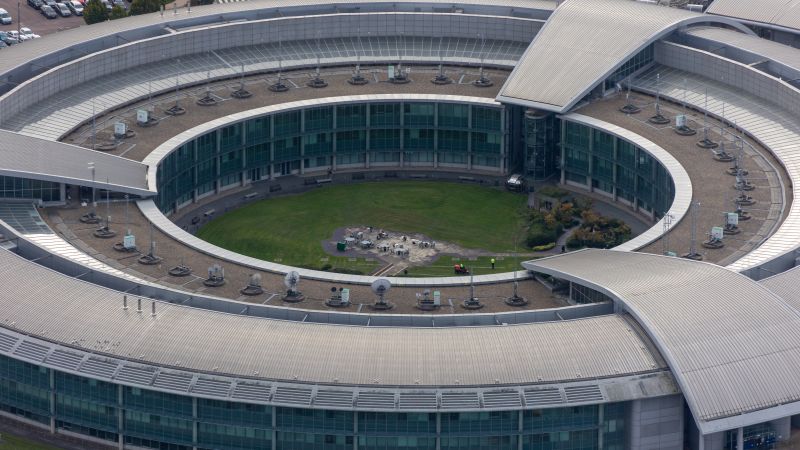
GCHQ, the Government Communications Headquarters, works in tandem with MI5, the domestic security agency, and MI6, the foreign intelligence service. Together, these organizations form a network of expertise and resources essential to countering global threats. The director’s vision for the future includes leveraging AI to not only defend against attacks but also to anticipate and neutralize them before they escalate.
Conclusion: A New Frontier in Security
As the world watches Russia’s hybrid warfare strategy unfold, Keast-Butler’s speech serves as a clarion call for unity and action. She urged citizens, businesses, and governments to recognize cybersecurity as a priority that transcends borders. “We must make cybersecurity 10 times more urgent, from boardrooms to living rooms,” she declared. The stakes, she said, are high: the West must stay one step ahead of adversaries who are constantly adapting their methods in the digital age.
