
‘The best outcome’: Laos cave survivors surprise rescuers by freeing themselves
‘The best outcome’: Laos cave survivors surprise rescuers by freeing themselves
The best outcome – After weeks of anticipation, five men emerged from a flooded cave in central Laos, defying expectations by escaping on their own. The international rescue operation had prepared for a high-stakes extraction, but the survivors’ spontaneous decision to navigate the labyrinthine tunnels without assistance marked a pivotal shift in the mission. When the first of the group broke through the waterlogged passageways on Friday, the team paused their efforts, anticipating a lengthy process. Instead, the remaining four followed suit, creating a moment of disbelief among the rescuers who had braced for a protracted battle against nature.
A Rescue Paused by Unexpected Courage
The operation had been underway for days, with divers working tirelessly to lower water levels inside the cave. Just hours before the survivors’ emergence, the team had finalized plans for a risky maneuver to guide the villagers out through the flooded tunnels. Yet, as Australian diver Josh Richards prepared to descend into the depths, the survivors unexpectedly appeared at the entrance, their ordeal seemingly over before it had fully begun. “I was literally putting my wetsuit on to head in when they emerged on their own,” Richards recalled, his voice tinged with both relief and astonishment. This self-reliance not only saved time but also minimized exposure to the hazardous conditions that had threatened the team’s progress.
“It was the best outcome, because the pumping was always the plan, and is the safest way, where nobody’s gonna get into a risk, so we’re happy that we didn’t have to go anymore,” said Richards, reflecting on the unexpected turn of events.
The five had entered the cave system more than a week prior in search of gold, their adventure taking a tragic turn when rising rainwater submerged the tunnels. For their families, the weekend brought a mix of joy and exhaustion, as the villagers who had spent days in suspense finally reunited with their loved ones. One local, Thao Oun, had been on the brink of despair, searching for his father in the darkness. When his father emerged, he collapsed to his knees, embracing him tightly before being wrapped in a silver and gold emergency thermal blanket. “The relief was overwhelming,” Oun said, his voice breaking as he wiped away tears that had accumulated from days of anxiety.
The Perils of a Subterranean Labyrinth
The cave’s treacherous environment had tested the limits of human endurance. Narrow rock passages dropped at steep angles into murky, opaque water that Richards described as resembling coffee. In some sections, the route narrowed to just 60 centimeters wide—a space barely enough to maneuver, let alone navigate without assistance. The survivors, untrained in diving, had faced the daunting challenge of traversing this unstable maze without food or water for nearly a week. “They were in a state of survival mode,” said Finnish diver Mikko Paasi, a veteran of the 2018 Thai cave rescue. “Every step required focus, and the darkness added to the psychological strain.”
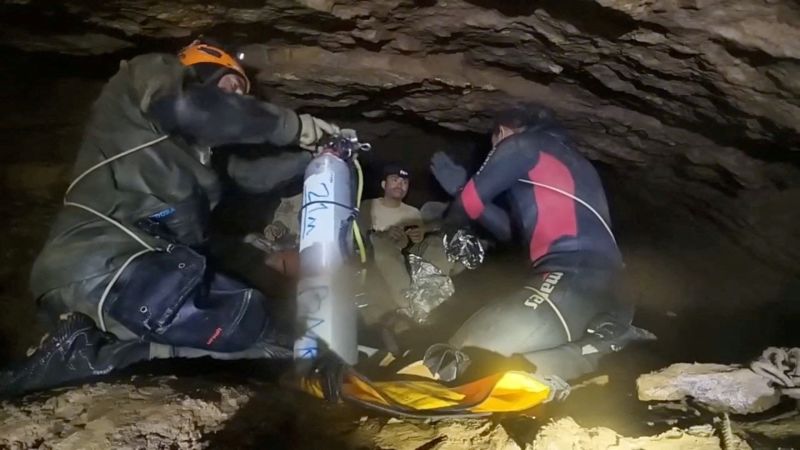
Despite the difficulties, the survivors had maintained their composure, relying on the guidance of the rescue team to prepare for their exit. Before their planned ascent, divers Norrased Palasing and Mikko Paasi had demonstrated how to operate oxygen tanks and breathing apparatus, ensuring the men could navigate the final stretch. The tutorial, conducted in dimly lit chambers illuminated only by head torches, had been a critical lifeline, equipping the villagers with the skills needed to survive the perilous journey.
Two Missing, One More Mission Ahead
Even as the rescued men celebrated their survival, the community remained gripped by uncertainty. Two other villagers, believed to have entered the cave earlier, were still unaccounted for, their fate hanging in the balance. The survivors’ emergence had provided a crucial clue: they had mapped the cave’s layout, revealing a potential air pocket 100 meters deeper within the system. “That’s the only place they could still be,” Richards explained, though the path ahead was fraught with danger. The passage, described as “even tighter and more unpleasant” than the one they had already traversed, was lined with jagged rocks and submerged in water that had risen overnight due to the relentless rain.
Rescue teams had already returned to the site on Sunday morning to scout the deeper sections, armed with new information but facing the same challenges that had plagued the operation. The water level, though reduced, had fluctuated due to the recent storm, complicating efforts to reach the missing individuals. “We’re not out of the woods yet,” said Paasi, emphasizing the fragility of the situation. “Every drop of rain could turn this into another crisis.” The team’s experience from the 2018 Thai cave rescue had proven invaluable, but the Laos situation presented its own unique set of obstacles.
The psychological and physical toll of the ordeal was evident. The survivors had been coated in mud, their bodies weakened by the lack of nourishment and the constant dampness of the cave. Some had developed skin and intestinal issues, a testament to the harsh conditions they endured. Yet, their determination to escape had been unshakable, driven by a combination of instinct, hope, and the support of the divers who had guided them through the darkness. “They showed incredible resilience,” Richards noted. “Even when the situation looked bleak, they kept moving forward.”
As the sun rose over the remote central Laos region, the focus shifted to the next phase of the mission. The rescue team, now bolstered by the survivors’ insights, prepared to dive deeper into the cave system, where the missing villagers might still be. The operation remained a race against time, with the threat of rising water levels looming large. “This isn’t over until we find everyone,” said Paasi, his voice steady but his eyes reflecting the weight of the task ahead. For the families of the missing, the wait continued, their hearts still tethered to the underground world where their loved ones had vanished weeks earlier.
The successful escape of the five men had not only alleviated immediate concerns but also inspired renewed hope for the remaining search. Their ability to navigate the cave without external help underscored the power of human perseverance, even in the most unforgiving circumstances. As the international team regrouped to plan the next steps, the shared experience of survival became a unifying force, bridging the gap between rescuers and those they had saved. The caves, once a symbol of despair, now held the promise of new discoveries—a testament to the resilience of both the trapped and the rescuers who had fought to bring them home.
