
Netanyahu says he directed Israeli military to take over 70% of Gaza
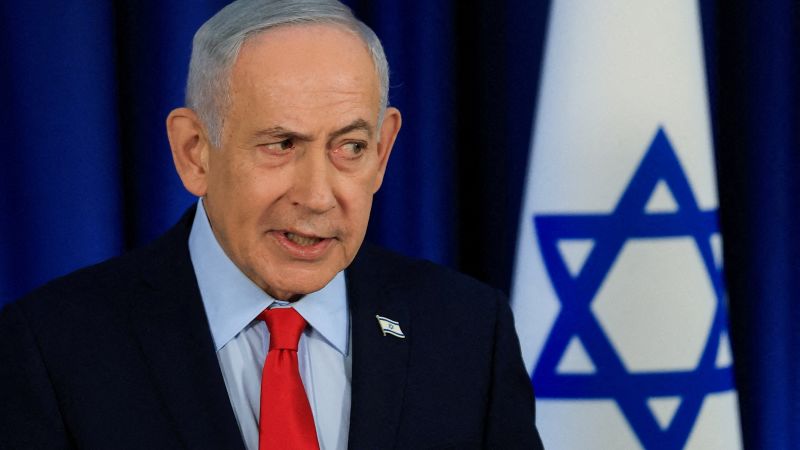
Netanyahu says he directed Israeli military to take over 70% of Gaza
Netanyahu says he directed Israeli military – Israeli Prime Minister Benjamin Netanyahu revealed Thursday that he has instructed the military to secure control over 70% of Gaza’s territory. Speaking at a conference in the occupied West Bank, he emphasized Israel’s strategy to consolidate its influence in the region, stating that the country is now occupying 60% of the Gaza Strip compared to 50% previously. “My directive is to move to — take it step by step — first of all 70. Let’s start with that,” he explained, highlighting a phased approach to the territorial expansion.
During the address, the audience pressed Netanyahu for a more aggressive stance, urging him to claim full dominion over the enclave. This demand comes as the Israel Defense Forces (IDF) recently distributed maps to international aid organizations, showcasing that the military already holds approximately 64% of Gaza’s land. The continued Israeli presence is expected to displace around 2 million Palestinians into a diminishing portion of the area, leaving them in a fragmented and increasingly vulnerable environment.
Netanyahu’s plan builds on the October 2025 ceasefire agreement between Israel and Hamas, which initially saw Israeli forces retreat to a demarcation line called the “yellow line.” This boundary left Israel in possession of roughly 53% of Gaza, a figure that has since been surpassed by the current military incursion. The gradual increase in territorial control has sparked concerns among international observers, who fear the agreement may be undermined by Israel’s persistent advances.
“We are now in 60% of the territory of the Gaza Strip. We were at 50%. We moved to 60%,” Netanyahu said, underscoring the shift in control.
Despite the ceasefire’s intention to stabilize the region, progress has stalled, with both sides failing to meet key obligations. Hamas has accused Israel of altering the yellow line, calling it a direct violation of the agreement’s terms. “This constitutes an explicit and ongoing undermining of the ceasefire agreement, a serious violation of its provisions, and an exposed attempt to impose new facts on the ground by force,” the group claimed, aiming to entrench military dominance and weaken prospects for de-escalation.
Nickolay Mladenov, the Bulgarian diplomat overseeing the implementation of the ceasefire, warned earlier this month that without tangible progress, the yellow line could evolve into a permanent barrier. “The line is not just a boundary; it is a dividing force,” he stated, noting the harsh realities faced by civilians in Gaza. “Families live in fear of Israeli airstrikes, and civilians are still being killed,” he added, emphasizing the human cost of the conflict.
Since the ceasefire took effect, Israel has conducted repeated airstrikes, citing Hamas’s violations of the agreement. These attacks have led to the deaths of over 850 Palestinians, according to the Palestinian Ministry of Public Health. The strikes have also targeted key figures within Hamas, including Izz al-Din al-Haddad, the leader of the group’s military wing. Eleven days later, his successor was eliminated in a subsequent operation, signaling Israel’s determination to eliminate leadership tied to the October 7 attacks.
“We vowed to eliminate everyone who led the October 7 massacre, and that is what will be done: They are all condemned to death everywhere,” Israeli Defense Minister Israel Katz asserted on social media, linking the current actions to the initial conflict.
Hamas has resisted disarming its weapons, a crucial component of the ceasefire plan. Mladenov pointed out that this refusal could derail efforts to stabilize Gaza, leaving it permanently divided. The agreement originally called for a gradual Israeli withdrawal from occupied areas, contingent on Hamas decommissioning its arsenal and the deployment of an international security force to monitor the region.
However, the security force’s formation remains uncertain, with only vague commitments from some countries. “Without a clear timeline for deployment, the plan risks collapsing,” Mladenov said, warning that the current situation might lead to a lasting separation of Gaza. The stalled progress has raised questions about the viability of the ceasefire and the potential for renewed hostilities.
The territorial shifts have also heightened tensions between Israel and its neighbors. As the military advances, the possibility of a permanent division of Gaza grows, with the coastal enclave’s resources and population concentrated in a shrinking area. Analysts suggest this could lead to a new phase of the conflict, where control over land becomes a central issue, and the humanitarian crisis deepens.
Netanyahu’s strategy has been met with mixed reactions from the international community. While some allies support Israel’s actions as necessary for security, others criticize the gradual annexation of territory. The prime minister’s directive to expand control to 70% has been framed as a step toward long-term dominance, with implications for Gaza’s political and economic future.
As the situation evolves, the balance between military control and civilian life in Gaza remains precarious. The continued Israeli presence, combined with Hamas’s resistance, threatens to turn the ceasefire agreement into a mere symbolic gesture rather than a lasting solution. With the yellow line increasingly becoming a physical reality, the fate of Gaza’s territory—and the people who inhabit it—hangs in the delicate negotiations between the two sides.
