
Iran strikes vessel, pausing UN efforts to evacuate ships from Hormuz
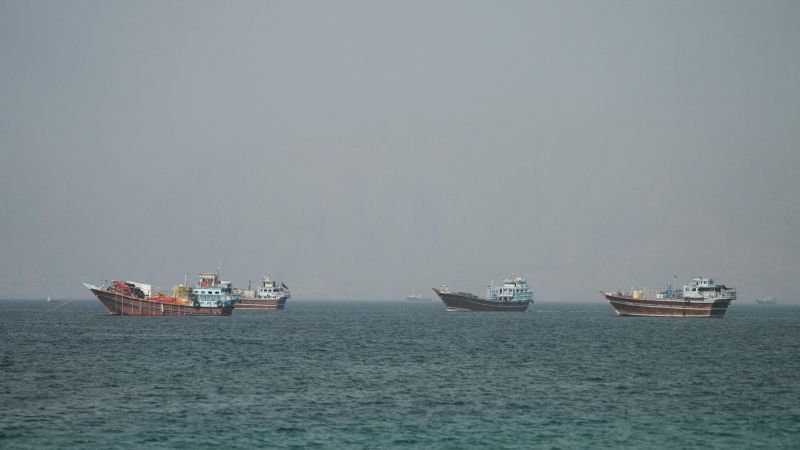
Iran Strikes Vessel in Hormuz, Halting UN Evacuation Mission
Iran strikes vessel pausing UN efforts – On Thursday, an Iranian attack on a cargo ship in the Strait of Hormuz disrupted a UN-led effort to rescue stranded seafarers and underscored the nation’s ongoing influence over the vital waterway. The incident, which occurred just days after a historic agreement between the United States and Iran, has raised concerns about the stability of the peace deal and the future of maritime traffic in the region.
Attack Details and Immediate Impact
According to the United Kingdom Maritime Trade Operations, a vessel was struck on its starboard side by an unknown projectile, damaging the ship’s bridge. The attack, which Iran has not yet officially claimed responsibility for, was attributed by a U.S. official to an Iranian drone. The strike came hours after the Islamic Revolutionary Guards Corps issued a warning that ships would only be allowed safe passage through the strait if they followed routes approved by Iranian authorities.
“The consequences of traveling on unauthorized routes will be the responsibility of the owner, operator, and commander of the vessel,” said the Persian Gulf Seaways Management Organization, a newly established agency under Tehran, in a statement posted on X.
The incident forced the United Nations’ International Maritime Organization (IMO) to temporarily halt its mission to evacuate hundreds of ships and over 11,000 seafarers stranded in the Persian Gulf since the conflict began in late February. IMO Secretary-General Arsenio Dominguez emphasized that the safety of maritime workers remains a top priority, stating, “I have always reiterated that the safety of the seafarers remains paramount. Therefore, to ensure a coordinated approach and navigational safety, the evacuation plan will be paused until further clarity is obtained.”
Evacuation Efforts and Strategic Challenges
The evacuation initiative, launched recently following the signing of a memorandum of understanding between Washington and Tehran, had seen a surge in ship movements through the strait. MarineTraffic data recorded 70 crossings on Wednesday, the highest since the war escalated in late February. Most vessels navigated along the coast of Oman, according to the maritime monitoring group. However, Thursday’s attack has cast doubt on the feasibility of such operations.
Dominguez noted that the attacked ship was not part of the IMO’s evacuation framework, highlighting the need for additional safeguards to protect seafarers from potential threats. Despite the setback, the agreement between the U.S. and Iran includes a commitment to reopen the strait without tolls for 60 days, a key provision aimed at easing tensions. The deal also grants Iran a formal role in managing commercial traffic alongside Oman, a development that has sparked debate among Gulf nations.
Global Oil Market Reactions
The attack coincided with a pivotal moment in negotiations, as Secretary of State Marco Rubio sought to reassure skeptical Gulf countries about the agreement’s benefits. The deal had initially driven global oil prices to their lowest level since the war began, but the incident prompted a slight increase, with Brent crude rising by 2% to $74 per barrel. This fluctuation reflects the delicate balance between diplomatic progress and the threat of renewed hostilities in the region.
Rubio, during a meeting with the Gulf Cooperation Council in Bahrain, defended the agreement, insisting that no international waterway should be subject to tolls. “The reality of it is that no country on Earth has a right to charge for the use of international waterways, and that will never be an acceptable condition of any deal,” he stated. However, the U.S. administration’s stance has been challenged by Iran’s assertion that the strait’s control is essential for its leverage in negotiations.
Historical Context and Future Uncertainty
This week’s attack marks the first disruption to the evacuation mission since the U.S. and Iran agreed to de-escalate tensions. The agreement, which includes a 60-day toll-free period for the strait, also saw the U.S. lift its blockade of Iranian ports—a move that has been welcomed by some Gulf states but remains under scrutiny. Meanwhile, Iran has introduced a new agency to oversee the strait’s operations, signaling its intent to maintain control over the passage.
Despite the U.S. commitment to a toll-free strait, Tehran has previously suggested it could impose a service fee as an alternative to tolls. Rubio acknowledged this possibility, calling it a “game of semantics.” “You can call it a toll, you can call it a fee, whatever you want to call it. It’s a game of semantics,” he said, underscoring the strategic importance of the waterway for both nations.
The incident has reignited concerns about the effectiveness of the agreement. While the U.S. aims to secure safe passage for ships, Iran’s actions demonstrate its ability to assert dominance over the strait. The evacuation mission, which had gained momentum, now faces uncertainty as the IMO reassesses its approach. Analysts suggest the attack may serve as a test of Iran’s willingness to uphold the peace deal, or a warning of its intent to reclaim control.
As the situation evolves, the U.S. continues to seek clarity on Iran’s intentions. CNN has contacted the White House for further comments, and the IMO is expected to release more details about its revised strategy. The attack not only pauses immediate rescue efforts but also underscores the complex interplay of diplomacy and military power in the region.
Broader Implications for Maritime Security
The strike highlights the risks of relying on a single waterway for global oil supply, with the strait serving as a critical chokepoint. The U.S. and Iran’s agreement, though a step toward peace, has not fully resolved disputes over sovereignty and control. For now, ships are advised to proceed with caution and report any suspicious activity, a precaution that reflects the heightened vigilance required in the region.
As the IMO and other agencies work to stabilize the situation, the incident serves as a reminder of the fragile nature of diplomatic progress. The success of the evacuation mission—and the broader agreement—will depend on Iran’s ability to balance its strategic interests with the need to ensure safe passage for international trade. With global oil prices fluctuating and tensions lingering, the future of the strait remains a focal point of international attention.
