
Hamas says it will dissolve Gaza government as US-brokered ceasefire plan stalls
Hamas Says It Will Dissolve Gaza Government as US-Brokered Ceasefire Plan Stalls
Hamas says it will dissolve Gaza – On Monday, Hamas declared its intent to dissolve the administrative structure of the Gaza government, a decision analysts believe shifts the dynamics of the ongoing conflict by increasing pressure on Israel. The move, announced by the group’s Government Media Office (GMO) head, Ismail al-Thwabta, aims to transition power to the Palestinian technocratic committee outlined in the US-brokered ceasefire agreement. This transition, however, does not yet translate to immediate changes on the ground, where Hamas and its affiliated security forces continue to hold strong control over the territory not directly occupied by Israeli military forces.
The Shift Toward Technocratic Governance
Hamas’ statement highlights its willingness to cede governance to the National Committee for the Administration of Gaza (NCAG), a body designed to manage the enclave under the terms of the agreement. Al-Thwabta emphasized that the group has already completed all necessary administrative and legal preparations to facilitate this handover. Despite this, the announcement leaves out a key requirement of the second phase of the ceasefire deal: disarmament. This omission underscores Hamas’ focus on political restructuring rather than immediate military concessions, a stance that has persisted throughout the negotiation process.
While the symbolic nature of the dissolution may not alter the practical control Hamas exercises, it marks a strategic pivot. The decision places the responsibility of implementing the ceasefire agreement back on Israel, as US President Donald Trump has been urging Prime Minister Benjamin Netanyahu to accelerate progress. This includes establishing “pilot areas” in Gaza where the technocratic committee would govern, a step Hamas claims is crucial to ensuring Palestinian authority over the territory.
“We call on all concerned and relevant parties to immediately accelerate the steps for the National Committee for the Administration of Gaza (NCAG) to enter quickly and assume its national and administrative duties and responsibilities, in order to strengthen the steadfastness of our noble Palestinian people and heal their wounds,” al-Thwabta said in a statement at Al-Aqsa Martyr’s Hospital in Gaza City.
International Mediation and the Stalled Agreement
The Board of Peace, established to oversee the ceasefire plan, acknowledged Hamas’ announcement but stressed that it would prioritize tangible actions over promises. In a statement shared on X, the board reiterated its demand for a unified authority, stating, “The core principle remains one authority, one law and one weapon.” This sentiment reflects the broader challenge of reconciling Hamas’ political aspirations with Israel’s security concerns.
Experts suggest that Hamas’ move is an attempt to outmaneuver Israeli resistance. Muhammad Shehada, a Gaza specialist at the European Council on Foreign Relations, described the statement as a calculated effort to bypass Netanyahu and appeal to Trump’s influence. “Hamas has clearly said that the move was intended to pave the way for a breakthrough,” Shehada explained to CNN. He noted that the group is emphasizing its readiness to relinquish all governance responsibilities, from A to Z, in hopes of securing international recognition for the technocratic committee.
Broader Implications of the Ceasefire Stalemate
Although the NCAG represents a potential path to a recognized Palestinian government, its effectiveness remains uncertain. The committee has been based in Cairo since October, when it was first envisioned as part of the ceasefire plan, but has yet to enter Gaza or exercise authority. Shehada argued that Hamas’ strategy, while shrewd, may come too late to sway Israeli leadership. “Even if that bet pays off—whether Trump is convinced or the plan unfolds as intended—Israel retains ultimate control over Gaza,” he said. “The NCAG is likely to face obstacles from the outset.”
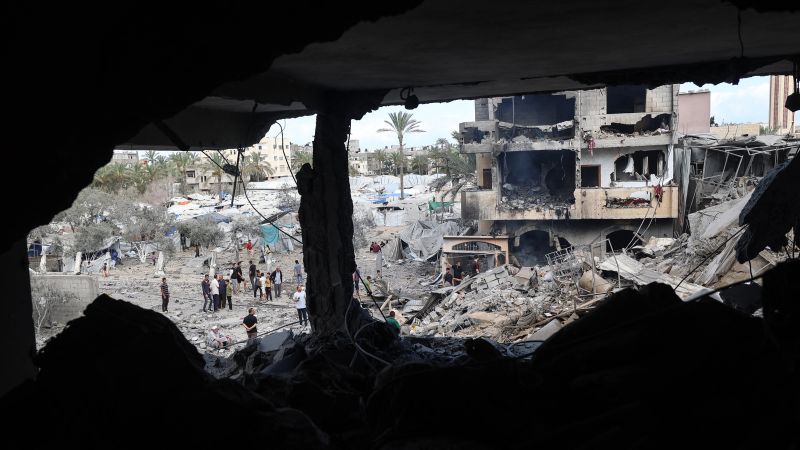
The stalled ceasefire plan has left Gaza in a state of prolonged tension. Recent reports describe scenes of chaos, with bodies unclaimed and rats scurrying through abandoned homes as months of ceasefire efforts yield little progress. The 20-point agreement, which began in October, has faltered amid disputes over key terms, including Hamas’ commitment to disarm and the establishment of the NCAG. While mediators like Qatar, Turkey, and Egypt have sought to present a united front to Trump, the lack of clear conditions for the committee’s entry has fueled skepticism.
Michael Milshtein, head of the Palestinian Studies Forum at Tel Aviv University, viewed Hamas’ announcement as part of a broader strategy to reframe the ceasefire negotiations. “This wasn’t a surprise,” he told CNN. “Hamas and its mediators are trying to reshape the deal’s formula to make it more palatable to international stakeholders.” He highlighted the role of the key mediators in attempting to demonstrate that the agreement is on track, even as Israeli resistance continues to stall progress. “The goal is to intensify US pressure on Israel to implement the next phases of the plan,” Milshtein said.
The dissolution of the Gaza government, while symbolic, underscores the deepening impasse in the ceasefire talks. Despite Hamas’ willingness to hand over administrative functions, the group has yet to agree on disarmament, a critical component that Israel insists on for its security. This reluctance has been a consistent point of contention, with Hamas arguing that governance and security must be separated to ensure long-term stability.
As the situation in Gaza remains fluid, the success of the NCAG hinges on Israel’s cooperation. The committee’s ability to enter the territory and assume control will determine whether the ceasefire plan can achieve its intended goals. For now, the dissolution of the existing government serves as a reminder of the precarious balance between political maneuvering and the practical realities of conflict resolution.
Challenges and Uncertain Timelines
Amid the stalled negotiations, the Board of Peace held highly productive meetings in Cyprus last week. However, the lack of clarity on the committee’s entry conditions has left the future of the ceasefire agreement in doubt. “The NCAG is prepared to take over Gaza once the right conditions are met,” the board stated, but it failed to specify what those conditions might be. This ambiguity has allowed the conflict to persist, with daily life in Gaza continuing under the shadow of uncertainty.
With approximately 60,000 government employees in Gaza, the transition to technocratic leadership will require careful coordination. Hamas has pledged to treat these workers as state employees, ensuring continuity in governance. Yet, without a clear timeline or Israeli agreement, the process remains stalled. The group’s announcement, while bold, may not be enough to force a resolution if the core issues—particularly disarmament—remain unresolved.
As the international community watches closely, the question remains whether Hamas’ symbolic gesture can bridge the gap between political aspirations and practical implementation. The collapse of the ceasefire plan, despite efforts to revitalize it, highlights the complex interplay of interests and the persistent challenges of achieving lasting peace in the region.
