
Egypt uncovers lost Byzantine-era city in the western desert
Egypt uncovers lost Byzantine-era city in the western desert
Egypt uncovers lost Byzantine era city – Recent excavations in Egypt have led to the revelation of a remarkably well-preserved residential city from the Byzantine era, one of two significant archaeological discoveries announced on Saturday. These findings, located in the Dakhla Oasis and the Marina el-Alamein site near Alexandria, are poised to enhance the nation’s struggling tourism industry. The Ministry of Tourism and Antiquities emphasized that such discoveries could reignite interest in Egypt’s rich historical heritage, which has long been a cornerstone of the country’s economy.
Ancient urban layout in Dakhla Oasis
The Dakhla Oasis, situated in Egypt’s western province of New Valley, has yielded evidence of a sophisticated urban settlement dating back to the fourth century. The city, which existed during the height of the Byzantine empire, showcases architectural and social structures that offer insight into daily life and governance. According to Hisham el-Leithy, secretary general of the Supreme Council of Antiquities, the city’s layout includes a network of north-south roads intersecting with east-west streets, creating open squares and communal areas.
“The quarters reflect a well-organized urban plan, with public spaces that suggest a thriving community,” el-Leithy stated. “This discovery is a major step in understanding how ancient civilizations adapted to the desert environment.”
At the heart of the settlement, a basilica church from the mid-fourth century has been uncovered, standing prominently over the main thoroughfares. Alongside it, remains of two defensive watchtowers were identified, indicating efforts to protect the city’s periphery. Mahmoud Massoud, head of the archaeological mission, noted that these structures highlight the strategic importance of the area during the Byzantine period.
“The basilica and watchtowers provide tangible proof of the city’s role as a religious and administrative hub,” Massoud explained. “These finds could reshape our understanding of Byzantine influence in this region.”
Tombs and artifacts at Marina el-Alamein
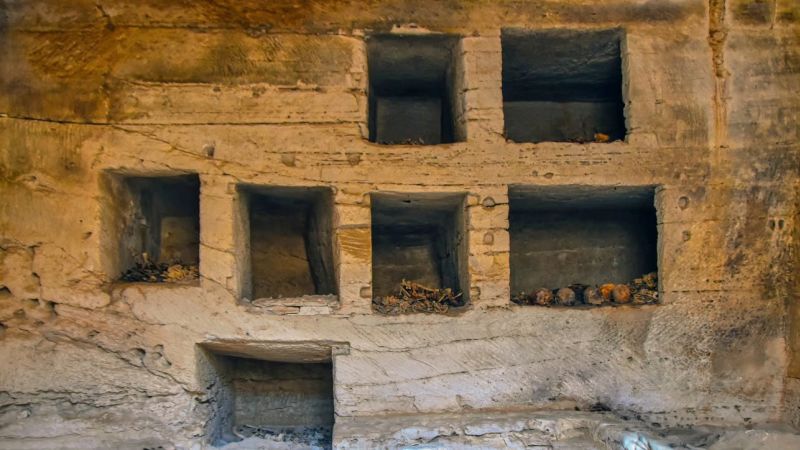
Meanwhile, the Marina el-Alamein site, approximately 100 kilometers west of Alexandria, has revealed 18 new ancient tombs, bringing the total to 48. The tombs include 11 rock-cut structures, averaging 8 meters in depth, and seven surface-built limestone monuments. These excavations have uncovered a range of items, from pottery vessels and amphorae to lamps, plates, and altars, shedding light on the daily lives and rituals of the people who once inhabited the area.
“The tombs are a treasure trove of artifacts that tell stories of both domestic and spiritual practices,” said Eman Abdel-Khaliq, leader of the mission. “Among them, a 2.5-meter-long granite sarcophagus was discovered, with skeleton remains still under analysis.”
Further exploration at the site uncovered a striking feature: a plaster sphinx statue placed near the sarcophagus. Additionally, archaeologists found 4 gold pieces positioned inside the mouths of several deceased individuals, a practice known as “the golden tongue,” believed to symbolize a connection to the afterlife. These findings underscore the site’s significance as a cultural and religious center during the Greco-Roman era.
Historical context of the sites
The Marina el-Alamein site, first unearthed in 1986, is thought to be the ancient port city of Leukaspis, which thrived on the Mediterranean coast during the second century BCE. The city’s decline is believed to have coincided with the rise of the Byzantine empire, and its recent excavations have connected it to the broader historical narrative of Egypt’s transition from Greco-Roman to Byzantine rule. The Dakhla Oasis, meanwhile, has long been a focal point for archaeologists due to its designation on UNESCO’s Tentative List, which highlights its potential for inclusion in the World Heritage List.
“The Dakhla Oasis has a unique place in Egypt’s archaeological landscape,” said Diaa Zahran, director of the Islamic, Coptic, and Jewish Antiquities department. “The pottery fragments we found, known as octraca, provide rare evidence of written records from this period.”
These fragments, dating to the late fourth century, contain inscriptions that detail commercial transactions, correspondence, and other aspects of life. They are believed to have been used as writing material, offering a glimpse into the social and economic dynamics of the time. The discovery also includes a heavily fortified structure with thick walls, suggesting a period of conflict or heightened security.
Revival of Egypt’s tourism sector
Egypt’s tourism industry has seen a remarkable resurgence in recent years, recovering from years of political instability following the 2011 uprising and the disruptions caused by the coronavirus pandemic. The country welcomed a record 19 million visitors last year, marking a 21% increase compared to the previous year. This growth continued into 2026, with 6.1 million tourists arriving in the first four months of the year—up from 5.7 million during the same period in 2025.
“Tourism is not just an industry for Egypt; it is a lifeline,” said the ministry statement. “These discoveries align with our efforts to position Egypt as a premier destination for historical and cultural exploration.”
The Ministry of Tourism and Antiquities has stressed that the newly unearthed sites will play a crucial role in attracting international visitors. The combination of ancient cities, tombs, and artifacts provides a compelling narrative that could draw scholars and tourists alike. The strategic location of the Suez Canal, which is a major economic artery, further supports the country’s bid to recover and expand its tourism-driven economy.
Broader implications for historical research
These discoveries are more than just tourist attractions—they are critical for academic and historical study. The basilica church in Dakhla, for instance, may offer new insights into the spread of Christianity in the region. Its design and construction suggest a blend of Roman and Byzantine architectural styles, reflecting the cultural exchange of the era. The presence of Latin inscriptions and Christian symbols at the site reinforces its religious and economic significance.
“The bronze coins we found bear the portraits of Byzantine emperors and are a testament to the city’s integration into the empire’s trade networks,” Massoud remarked. “They also reveal the material culture of the time, including tools and household items.”
At the Marina el-Alamein site, the variety of tombs and artifacts provides a snapshot of life in the Greco-Roman period. The limestone basins and amphorae suggest a thriving market economy, while the altars and lamps point to religious practices. The golden tongue tradition, where gold was placed in the mouths of the dead, aligns with beliefs about the afterlife and the importance of sustenance in the spiritual realm.
Together, these findings represent a major milestone for Egypt’s archaeological community. By uncovering layers of history spanning centuries, they not only enrich the nation’s cultural identity but also provide tangible evidence of its role as a crossroads of civilizations. As experts continue to analyze the artifacts, the potential for new insights into Byzantine and Greco-Roman Egypt grows. The government’s commitment to promoting these sites underscores the importance of preserving and showcasing the country’s heritage for both academic and economic purposes.
