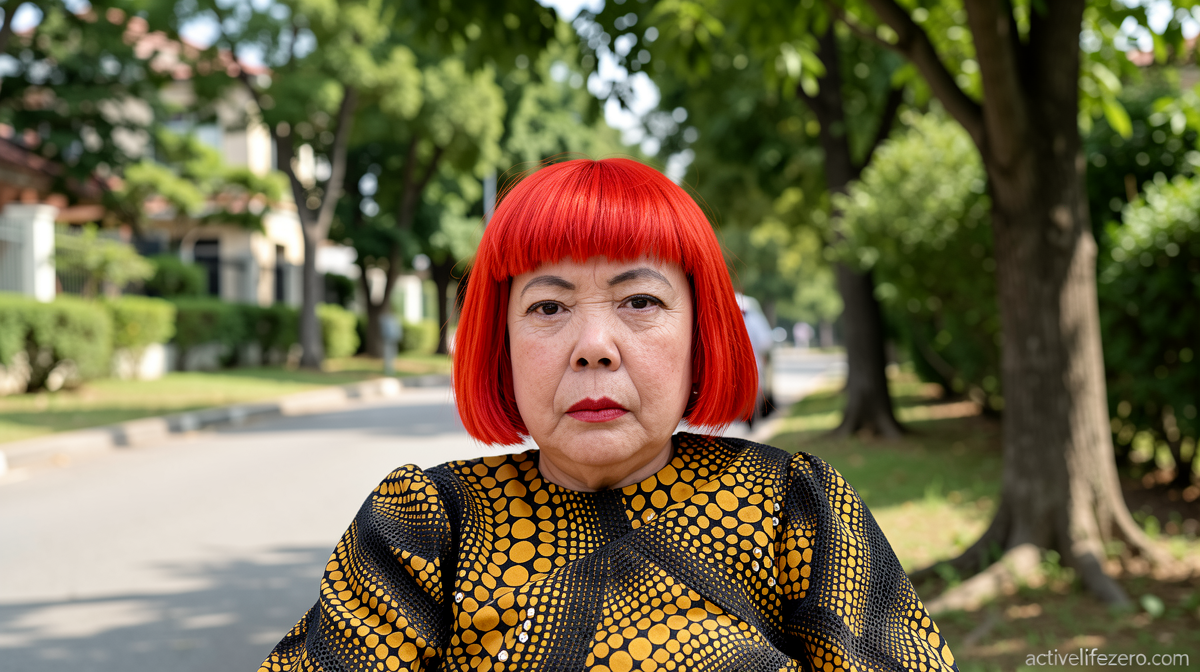
Japanese artist Yayoi Kusama, who filled the world with polka dots, dead at 97

Daftar Isi
Yayoi Kusama, polka-dot pioneer, dies at 97
Activelifezero.com – Japanese artist Yayoi Kusama who filled the world with repeating dots, mirrored corridors, and towering pumpkins has died at age 97. A statement posted Thursday on her official website confirmed she passed away at a Tokyo hospital on August 14. By the time of her death, she stood among the most commercially successful figures in all of contemporary art.
Her immersive “Infinity Mirror Rooms” drew millions of visitors into corridors of endless, kaleidoscopic reflection. Pumpkin sculptures and dot-saturated canvases generated tens of millions in auction revenue each year. Yet the global fame she achieved in later decades made all the more striking the obstacles she overcame to reach it: childhood trauma, chronic mental illness, and years of near-total obscurity.
From wartime Japan to New York’s avant-garde
Born in 1929 into an abusive household, the young Kusama spent much of her childhood sewing parachutes at a military factory during World War II. Vivid hallucinations flooded her vision with the dot patterns that would define her career. Though she briefly studied the modernist nihonga tradition at an art school in Kyoto, she showed little interest in Japanese art conventions.
Instead, she dove into abstraction and the obsessive repetition of her celebrated “Infinity Nets” series. Encouraged by correspondence with Georgia O’Keeffe and disillusioned with postwar Japan, she left for America in the late 1950s — first Seattle, then New York, arriving just as pop art was taking shape. There she upended the city’s abstract-impressionist establishment with storms of dots, flowers, and phallic forms across paintings, sculptures, films, literature, and performance.
“Let’s forget ourselves, dearest Richard, and become one with the Absolute, all together in the alltogether (sic).” — Kusama’s 1968 open letter to President Nixon, offering sex in exchange for peace in Vietnam.
In keeping with 1960s counterculture, she staged “happenings” that turned naked bodies into dotted canvases. She addressed gender equality, gay rights, and anti-war sentiment head-on. The art establishment borrowed from her work freely but never fully embraced her. Despite friendships with Andy Warhol and Donald Judd, she remained an outsider. Alexandra Munroe, senior curator of Asian art at the Guggenheim, captured that isolation in a 2018 CNN profile: “Besides being a foreign woman of color from a chastened Asian power, the psychological content of (Kusama’s) work set her identity apart from the Western mainstream that wrote the first histories of the 1960s avant-garde.”
After returning to Japan in the early 1970s, Kusama checked into a psychiatric hospital where she lived voluntarily and continued
Related Reading
Frequently Asked Questions
What is Japanese artist Yayoi Kusama who filled?
Japanese artist Yayoi Kusama who filled is the main topic of this guide. The article explains the context, practical details, and next steps readers should understand.
Why does Japanese artist Yayoi Kusama who filled matter?
Japanese artist Yayoi Kusama who filled matters because readers are looking for a useful answer, not just a short summary. Good content should match search intent and help them decide what to do next.