
A first look inside the $850 million Obama Presidential Center
A first look inside the $850 million Obama Presidential Center
A first look inside the 850 million – The Obama Presidential Center, now nearing completion, is set to open its doors on June 19, coinciding with Juneteenth, a day marking the end of slavery in the United States. This landmark project, which has taken over a decade to materialize, represents a significant shift in the traditional model of presidential memorials. Located in Chicago’s Hyde Park neighborhood, the center spans 19.3 acres and includes a museum, public library, community space, and an open-air courtyard. Its unveiling has sparked both excitement and debate, as it reimagines how history, culture, and civic engagement intersect in a modern presidential institution.
The Sky Room: A Symbol of Reflection and Vision
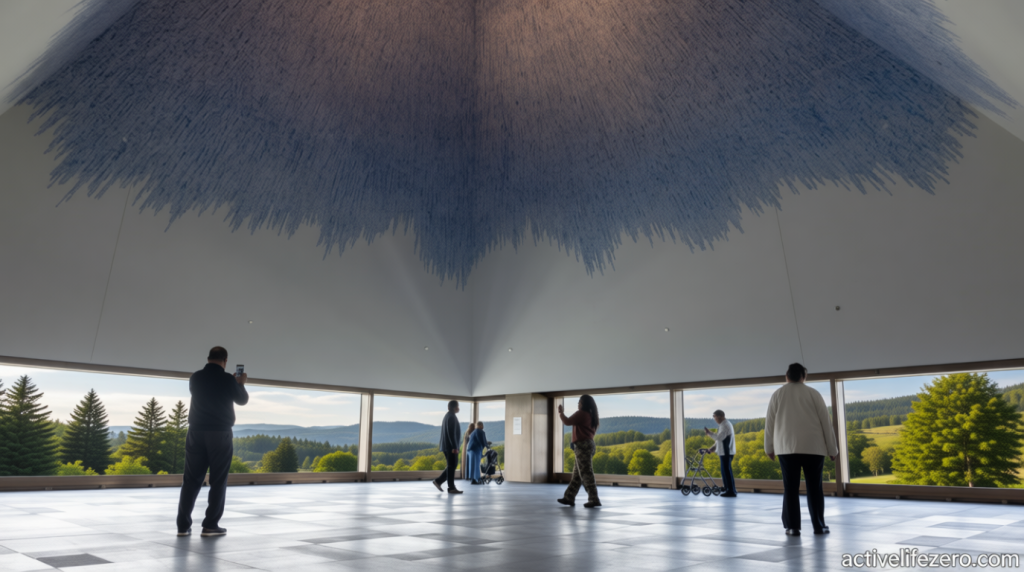
At the summit of the center’s main structure, the Sky Room provides a panoramic view that encapsulates the city’s historic South and West Sides, along with the shimmering waters of Lake Michigan. Designed to be a contemplative space, it invites visitors to pause and absorb the surroundings—a fitting metaphor for the center’s broader mission. The room’s ceiling is adorned with a striking artwork by Idris Khan, whose overlapping text panels evoke the idea of ongoing progress. The words, drawn from Obama’s speeches, slope upward like a waterfall of meaning, culminating in a rim of light that mirrors the horizon.
“You have a sense when people walk in, they look up and they feel like it belongs to them, like it’s theirs,” said Billie Tsien, one of the lead architects, during an interview at the center’s Forum building. This sentiment underscores the design philosophy of the campus, which aims to foster a sense of ownership and connection among the public.
A Campus of Purpose and Innovation
Unlike conventional presidential libraries, the Obama Center is not confined to a single building. Instead, it functions as a multifaceted campus, blending archival preservation with community-oriented programming. The design, led by architects Tod Williams and Billie Tsien, emphasizes openness and accessibility, integrating spaces for education, recreation, and cultural expression. A key feature is the fruit and vegetable garden, which reflects Obama’s commitment to sustainability and local food systems. The campus also includes an NBA regulation-sized basketball court, a nod to the former president’s advocacy for youth development and physical activity.
Central to the project is the partnership with the Obama Foundation, which will operate the center privately. This approach differs from the National Archives and Records Administration’s (NARA) traditional oversight, allowing for a more dynamic and inclusive approach to history. The museum, a cornerstone of the campus, showcases artifacts and documents that highlight Obama’s political journey and legacy, while also featuring immersive exhibits and installations by contemporary artists.
Promotional Moments and Cultural Resonance
As the center’s opening approaches, former President Barack Obama has engaged in a series of high-profile promotional activities. From playing Wordle with comedian Stephen Colbert to reconciling with NBA star Anthony Edwards, these gestures have helped generate public interest. A particularly memorable event was Obama’s appearance alongside Mark Hamill, the actor who portrayed Luke Skywalker in the original Star Wars trilogy, to celebrate Star Wars Day. This move has been interpreted as a subtle nod to the center’s nickname, the “Death Star,” which has been both affectionate and satirical in its use.
Other playful comparisons have emerged, such as the “Obamalisk,” a term referencing the museum’s imposing granite facade. While the name has been used with some irony, it highlights the center’s bold architectural presence. The building’s design, which drew inspiration from the idea of four hands coming together, symbolizes the collaborative nature of shaping history and society. “We think of it as a 500-year building,” Tsien explained, “so every decision was made with the goal of creating something enduring and timeless.”
The Archive: A Digital Revolution
One of the most transformative aspects of the center is its digitized presidential archive, a first for the National Archives. The Obama Foundation has worked to convert nearly 30 million pages of documents into a digital format, ensuring greater accessibility for researchers and the public. While some of these materials are displayed within the museum, others are available online, expanding the center’s reach beyond its physical boundaries.
The archive’s integration into the campus reflects a modern approach to preserving history. Rather than being a static collection, it is designed to evolve with new technologies and interpretations. This shift aligns with the center’s mission to inspire future generations through collective storytelling and imagination. “I hope that when people come to the center, they come with an open heart about the future of democracy,” Tsien added, emphasizing the institution’s role in fostering hope and civic dialogue.
Controversies and Community Impact
Despite its visionary design, the Obama Center has not been without controversy. The location within Jackson Park—a historic site in Chicago—was the subject of legal disputes, as an environmental group challenged the city’s decision to allow a private project on public land. The lawsuit was eventually dismissed, but concerns about gentrification on the South Side remain. Critics argue that the center’s high-profile status may accelerate displacement in the surrounding community, while supporters highlight its potential to revitalize the area through cultural investment and public engagement.
Even as construction and landscaping near completion, the campus has already become a hub of activity. During its soft opening, local school groups and community members filled the space, creating a sense of anticipation for its full launch. Julie Mehretu’s 83-foot-tall vertical window, installed as part of the 28 site-specific art pieces, greeted visitors as they ascended through the building. These installations, crafted by renowned artists, add layers of meaning to the center’s physical environment, reinforcing its role as a living archive of ideas and creativity.
A Legacy in the Making
As the center prepares to welcome the public, it stands as a testament to the evolving role of presidential institutions. By combining archival functions with public spaces, it challenges the notion of history as a distant, elite pursuit. Instead, the Obama Center positions itself as a place where the past, present, and future converge. “I don’t care about the names,” said Tod Williams, one of the architects, “what matters is what it does and what it will be in the years to come.”
With its blend of art, history, and community, the Obama Presidential Center promises to be more than a monument to the former president. It aims to be a catalyst for dialogue, a space for innovation, and a symbol of the collective effort to shape a more inclusive society. As the first guests explore its halls and gardens, the question remains: Will this ambitious project fulfill its vision of becoming a lasting cultural institution, or will it be remembered as a landmark of both achievement and contention?
