
Tehran lambasts US ‘obstruction’ of Iran’s soccer team as players land in Mexico ahead of World Cup
Tehran Condemns US ‘Obstruction’ of Iran’s Soccer Team Ahead of World Cup
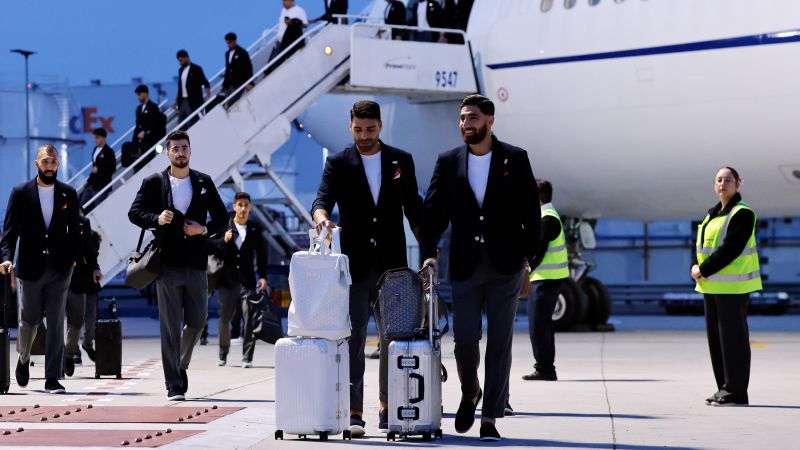
Tehran lambasts US obstruction of Iran – In a move that has sparked diplomatic tension, Iran’s national soccer team landed in Tijuana, Mexico, on Sunday, just across the border from San Diego, California. The arrival comes as the Islamic Republic’s leadership criticizes the United States over visa restrictions that have delayed the team’s participation in the upcoming World Cup. The situation has drawn sharp remarks from Iranian officials, who view the American actions as an extension of broader geopolitical hostilities.
Visa Dispute and Accusations of Favoritism
Mehdi Taj, the president of Iran’s Football Federation, expressed frustration over the visa process, stating that the team had been allowed to enter the US for the tournament but only “one day before the match,” according to semi-official Iranian media. This timing, he argued, was deliberate and reflected a lack of fairness in how the US handles international sporting events. “We do not know how far the Americans’ obstructionism will continue,” Taj said, as cited by the Iranian Students’ News Agency (ISNA). “What the United States is doing reflects malice and a lack of equality among teams.”
The US administration, meanwhile, defended its position, asserting that all necessary visas for the Iranian squad—along with their support staff—had been issued. A senior official told CNN that the measures were taken to ensure security, emphasizing concerns about potential terrorists using the World Cup as a cover to enter the country. “We will not allow the Iranian team to abuse this system to sneak terrorists into the United States under false pretenses,” the official added, highlighting the dual purpose of the visa restrictions.
Soft Power and National Pride
Soccer has long been more than a game in Iran; it is a symbol of unity and pride for a nation grappling with internal challenges. Despite social, regional, and political divisions, the national team enjoys widespread public support, making its World Cup qualification a moment of collective joy. However, the ongoing conflict between the US and Iran has transformed the sport into a battleground for soft power. The tournament now serves as a platform for political messaging, with every match drawing attention to the broader geopolitical struggle.
This year’s World Cup marks a historic first: it is the first time a host nation will welcome a team from a country with which it is currently at war. According to Reuters, the decision has intensified scrutiny of the US’s handling of the event. The Iranian team’s matches in the US, scheduled for June 15, 21, and 26, have become a focal point of this tension. While the team is set to compete in Los Angeles and Seattle, the US’s visa restrictions have raised questions about its commitment to neutrality in international sports.
Logistical Challenges and Protests
Despite the visa controversy, the Iranian squad is proceeding with its schedule, utilizing a multiple-entry visa to navigate the logistical hurdles. The federation’s spokesperson noted that the team would enter the US one day before the first match and two days prior to each subsequent game. This arrangement, they claimed, was a concession from the US, though Taj called it “truly strange” that Washington was interfering in the administration of the sporting event.
Taj also suggested that the US might be using the World Cup as a means to vent frustrations over the war. “They were defeated in some areas by the resistance of the people, and they are now trying to make up for those defeats and vent their frustrations on the football field,” he said, as reported by ISNA. The Iranian Football Federation has already filed a formal protest with FIFA, the global governing body of soccer, over the perceived unfair treatment. CNN has sought comment from FIFA on the matter, but no official response has been released yet.
The situation has also affected Iran’s support staff and media personnel, with some still awaiting approval to join the team in the US. Amir Ghalenoei, the head coach, voiced concerns over the delays, stating, “I ask you, what kind of treatment is this? I hope this situation is corrected and that such behavior is not repeated in the future,” according to Tasnim news agency. The coach’s remarks align with those of the Iranian Embassy in Ankara, which accused the US of “depriving Iran’s national team of its right to participate in the World Cup under normal conditions and without unnecessary pressure and stress.”
Soft Power on the Soccer Pitch
The political undercurrents of the World Cup have become evident in the way it is being covered in Iran. Iranian state media, including IRIB, announced that matches featuring the team will be shown in cinemas nationwide, subject to “necessary approvals.” This decision underscores the importance of the event for domestic morale, as millions of Iranians look to the team for a sense of pride and solidarity. Yet, the US’s visa policies have cast a shadow over this celebration, turning the pitch into a stage for international diplomacy.
The visa dispute has added a layer of complexity to the team’s journey. While the players have secured entry into the US, their staff and media have faced additional scrutiny. This has raised concerns about the US’s ability to provide equal access to all participating nations, with Iran’s critics arguing that the restrictions are a deliberate act of political bias. The ongoing conflict between the US and Iran, which has seen no recent signs of easing, has made every aspect of the team’s participation a potential flashpoint.
As the World Cup approaches, the focus remains on whether the US can maintain its stance without undermining the spirit of international sports. The Iranian team’s presence in Mexico, just across the border from the US, has been strategically chosen to highlight the proximity of the two nations. Mexican President Claudia Sheinbaum has assured that the squad will remain in the country between matches, further complicating the US’s efforts to exert influence. The situation continues to evolve, with both sides asserting their positions and the world watching closely.
In the end, the World Cup is a global event, yet its stage is being used to amplify the tensions between nations. For Iran, the tournament represents a chance to showcase its athletic prowess and national spirit. For the US, it is an opportunity to assert control over the flow of people and influence. Whether these goals can coexist on the soccer field remains to be seen, as the next chapter of this political drama unfolds in the stadiums and media outlets of Mexico and beyond.
