
Trump’s red card call stirs political storm around World Cup
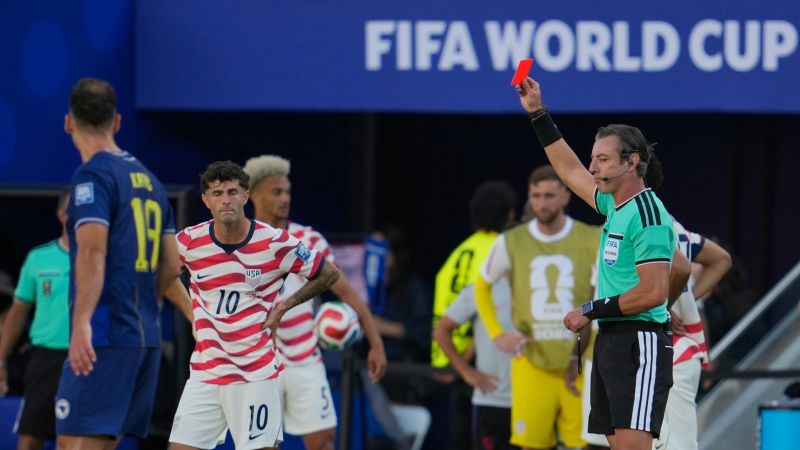
Trump’s Red Card Call Sparks Political Firestorm at World Cup
Trump s red card call stirs – For over a week, the World Cup in the United States in 2026 appeared to remain largely unaffected by Donald Trump’s influence. The tournament, held in Seattle and other host cities, had drawn widespread acclaim for its seamless execution and the excitement it generated among global fans. Yet this sense of neutrality was shattered on Sunday when President Trump intervened in a pivotal moment, prompting FIFA to reverse a controversial one-game suspension of US star Folarin Balogun. The decision sent ripples through the sports world, transforming a localized refereeing dispute into a high-stakes political drama with implications for the integrity of the international event.
A Last-Minute Reprieve
Balogun, a key player for the US national team, had been shown a red card during the group stage match against Bosnia and Herzegovina. This resulted in a one-game ban, which would have excluded him from the critical knockout clash against Belgium on Monday. However, after Trump’s appeal to FIFA President Gianni Infantino, the suspension was lifted. The president’s public reaction was immediate and emphatic. “Thank you to FIFA for doing what was right, and reversing a great injustice!” he declared on Truth Social, celebrating the outcome as a vindication of his intervention. His remarks amplified the controversy, casting doubt on the fairness of the original decision and highlighting the growing influence of political figures in soccer governance.
“Thank you to FIFA for doing what was right, and reversing a great injustice! President DONALD J. TRUMP,”
Trump’s involvement didn’t stop there. On Monday, he confirmed his direct call to Infantino, seeking a review of the suspension. “I didn’t say, ‘You have to do this,’” he explained in the Oval Office, emphasizing that he believed Balogun’s offense was not severe enough to warrant a red card. His argument hinges on the idea that the challenge against Bosnian defender Tarik Muharemović was more of a clash than a foul, though the referee’s video review ultimately deemed it serious enough. This exchange has raised eyebrows, with critics questioning whether Trump’s influence over FIFA could reshape the outcome of games in ways that serve political or national interests.
The Fallout for Global Soccer
The Belgian Football Federation, which had previously supported the suspension, now finds itself at odds with FIFA. In a statement on Monday, they accused the organization of lacking transparency in its decision-making process, suggesting the reversal of Balogun’s ban was politically motivated. The federation’s stance reflects a broader concern: that the World Cup’s neutrality could be compromised by external pressures. “We are acting to defend football in general,” said the federation’s coach, adding that the decision was aimed at preserving the sport’s integrity and ethics. This clash between national pride and institutional fairness has become a focal point of the tournament’s narrative.
Meanwhile, UEFA, the governing body of European soccer, weighed in on the controversy, criticizing FIFA’s handling of the case. “When the certainty of rules is no longer guaranteed by its guardians, the integrity of the game is at stake,” the organization stated in a formal release. The comment underscores the potential for political interference to undermine the credibility of the World Cup, an event that had previously thrived on its reputation as a symbol of unity and sporting excellence. The reversal of Balogun’s suspension has forced fans and analysts to reconsider the balance between fairness and influence in high-level competitions.
A Historical Precedent?
While controversies are inevitable in the World Cup, the level of political involvement in this case is unprecedented. Historically, events like Diego Maradona’s “hand of God” goal in 1986 or Zinedine Zidane’s infamous headbutt in 2006 were celebrated as part of the game’s spontaneity and drama. However, Balogun’s situation introduces a new dimension: the role of a political leader in deciding who plays in a match that could determine a host nation’s path to victory. This has sparked debates about whether the referee’s call was a fair judgment or a decision swayed by the president’s intervention.
The incident also highlights the challenges of modern refereeing technology. Balogun’s initial red card was based on a video assistant referee’s review, which slowed down the play and revealed the exact nature of the tackle. While some fans argue that the slow-motion footage exaggerated the severity of the challenge, others believe it was a necessary step to ensure accuracy. “Clashes between players often look worse in slow motion,” noted one analyst, “but the system’s goal is to catch fouls that might otherwise go unnoticed.” This tension between human judgment and technological precision has become a point of contention in the ongoing narrative.
Impact on the Tournament’s Legacy
As the USA faces Belgium in the knockout stage, the political subplot adds an extra layer of complexity to the match. For many American fans, the focus will likely remain on the game itself, especially if the national team advances. However, the controversy could cast a shadow over the tournament’s success, particularly among international supporters who may question the fairness of decisions influenced by political pressure. “The World Cup is supposed to be a celebration of sport,” said a European commentator, “but when leaders start calling the shots, it risks becoming a political spectacle.”
Balogun’s reprieve has also reignited discussions about the role of FIFA in maintaining consistency. While the decision to reverse the suspension might seem reasonable under scrutiny, it raises concerns about how such rulings are applied across the globe. “FIFA’s rules are meant to be objective,” argued a sports law expert, “but when a political figure like Trump gets involved, the perception of impartiality shifts.” This has led to calls for greater transparency in FIFA’s decision-making processes, particularly in cases where a player’s participation could impact the tournament’s outcome.
The incident serves as a reminder of the interconnectedness of politics and sports. In an era where global events often intersect with political narratives, the World Cup’s ability to remain apolitical is increasingly under pressure. Trump’s involvement, while perhaps not decisive in the final ruling, has created a precedent that could influence future decisions. Whether this is seen as a necessary intervention or an overreach depends on the lens through which fans view the episode. For now, the stakes are clear: the outcome of the USA vs. Belgium match will be watched not only for its on-field drama but also for the off-field politics that shaped it.
As the tournament progresses, the question remains: Will this controversy define the World Cup’s legacy, or will it fade into the background? The answer may depend on how FIFA navigates the delicate balance between political influence and the principles of fair play. For Balogun, the reprieve offers a chance to redeem his performance, but for the sport itself, it presents a challenge to uphold its integrity in the face of mounting scrutiny.
